

Most buyers walk into a Melbourne auction with nothing but hope and a pre-approval letter. That is a recipe for disaster. In a market where underquoting is rampant and structural defects hide behind fresh paint, your only real protection is a rigorous property due diligence checklist melbourne experts use to strip away the marketing fluff. You either control the deal or the deal controls you. One missed easement or a messy Section 32 can turn your investment into a $1,000,000 liability before the auctioneer even calls "sold."
We see this all the time; smart people making emotional decisions on bad assets because they lack a proven system. It is exhausting to spend months searching only to realise you have been looking at the wrong properties. This guide replaces that anxiety with the tactical framework used by the city’s top 1% to secure high-performing assets. We are giving you the exact roadmap to identify red flags early and bid with total confidence. You will learn to decode zoning changes, audit Owners Corporation records, and spot the structural issues others miss. This is how you secure your future with total certainty in the 2026 market.
Key Takeaways
- Shift your mindset from basic legal compliance to strategic asset selection to secure the top 1% of Melbourne properties.
- Stop relying on vendor building reports and learn to treat the Section 32 as your primary line of defence.
- Use our property due diligence checklist melbourne to audit future infrastructure impacts like the Suburban Rail Loop before you bid.
- Identify unfixable property flaws during physical inspections that marketing brochures and fresh paint are designed to hide.
- Gain the upper hand by using a 30-year proprietary framework that ensures you control the deal instead of the selling agent.
Table of Contents
Beyond the Basics: Why the Standard Due Diligence Checklist Fails Melbourne Buyers
The Technical Pillar: Structural Integrity and the Section 32
Beyond the Basics: Why the Standard Due Diligence Checklist Fails Melbourne Buyers
Due diligence is the high-stakes period where you either win the deal or save yourself from a financial disaster. It is not just a box-ticking exercise. It is an investigative process. Broadly speaking, due diligence is the investigation or exercise of care that a reasonable business or person is expected to take before entering into an agreement. In Melbourne’s aggressive 2026 market, it is your only shield against overpaying for a lemon. We see this all the time; buyers treat this process as a formality rather than a tactical advantage. That is where the trouble starts.
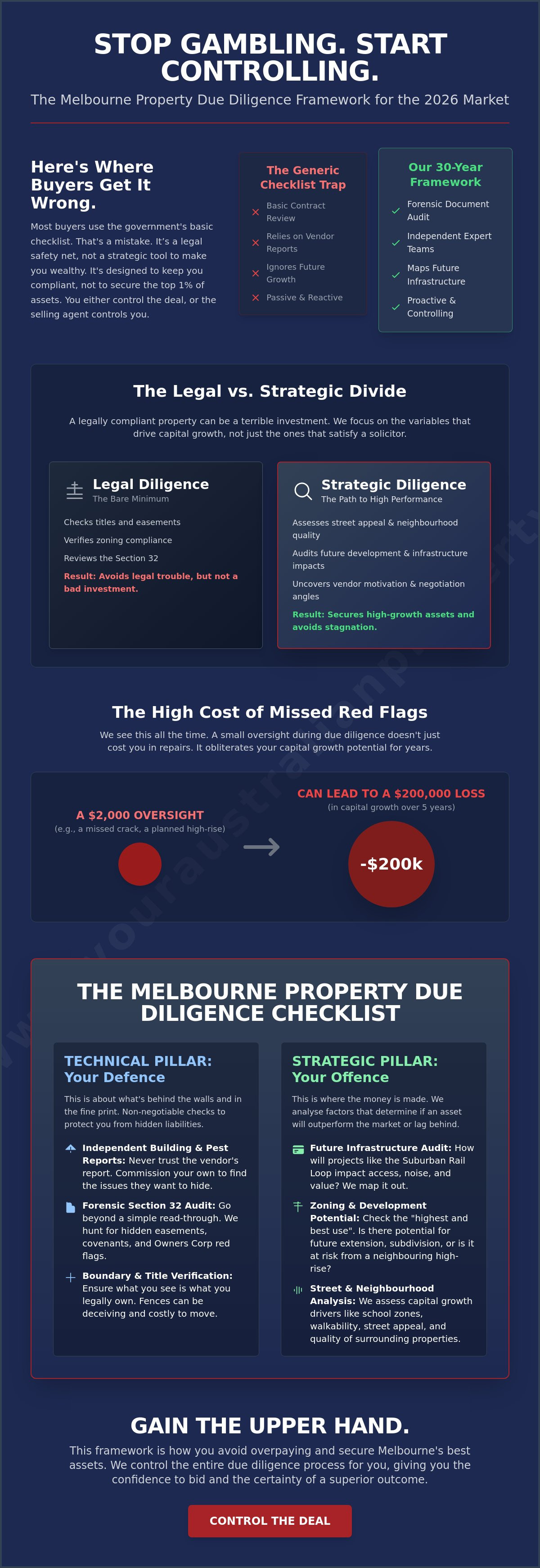
Most buyers rely on the generic Consumer Affairs Victoria checklist. That is a major mistake. That document is a legal safety net designed to keep the government happy; it is not a strategic tool to make you wealthy. It covers the bare minimum. If you wait until the contract is signed to start your checks, you have already lost. In a city where properties move in days, you need to be faster and sharper than the competition. You either control the deal or get controlled by the selling agent’s timeline. Your Australian Property pioneered a 30-year investigative approach because we know that the real red flags are never listed in a standard brochure.
The Legal vs. Strategic Divide
Legal due diligence is about checking titles, easements, and zoning compliance. It ensures the property is "compliant." But a compliant property can still be a terrible investment. Strategic due diligence goes much deeper. It assesses street appeal, future development potential, and vendor motivation. You need both to succeed. Buying a property that is legally sound but geographically stagnant is a common trap that stalls your portfolio for a decade. We focus on the variables that actually drive capital growth, not just the ones that satisfy a solicitor.
The High Cost of Missed Red Flags
Quantifying the risk is simple. A $2,000 oversight in your initial assessment, like missing a subtle crack or a planned high-rise next door, can lead to a $200,000 loss in capital growth over the next five years. We see this all the time; buyers trusting a generic checklist and ignoring the "vibe" of the street or the quality of neighbouring developments. This is why a comprehensive property due diligence checklist melbourne specialists use is mandatory. You can see how we manage this risk for our clients on the Your Australian Property homepage. We look for what is hidden to ensure your peace of mind is backed by hard evidence.
The Technical Pillar: Structural Integrity and the Section 32
The Section 32 is your first line of defence, but most buyers treat it like light reading. That is a mistake that costs hundreds of thousands. This document contains the legal bones of the property, from title details to council rates. However, it only tells you what the vendor is legally required to disclose. It won’t tell you if the foundations are failing or if the roof is one storm away from collapsing. This is why a rigorous property due diligence checklist melbourne experts rely on must always include an independent audit of these documents alongside physical inspections.
Never rely on a building report supplied by the vendor or their agent. These reports are often commissioned to facilitate a quick sale, not to protect your interests. They frequently gloss over "minor" issues that are actually structural nightmares. You either control the deal with your own experts or you get controlled by the agent’s hand-picked contractors. For any Melbourne home, especially older stock in the inner suburbs, independent structural, pest, and electrical inspections are non-negotiable. You need to know exactly what is happening behind the plaster before you raise a hand at auction.
Here’s how this plays out in the real world:
Buyer: Professional couple looking for a long-term family home.
Problem: Found a "perfect" terrace in Fitzroy North. The vendor’s building report was spotless.
Strategy: We ignored the provided report and sent in our own specialist team for an independent inspection.
Outcome: Our inspector discovered rising damp and active termites in the subfloor that the vendor report missed. We used the $45,000 repair estimate as leverage to hammer the price down. The client secured the property for $60,000 below market value.
Lesson: Independent reports are your strongest negotiation leverage. They turn "potential issues" into hard cash discounts.
Decoding the Section 32 Like an Expert
Look for undisclosed easements. These can prevent you from building an extension or installing a pool in the future. Check the land tax certificates carefully. In 2026, with the tax-free threshold at $50,000 and the COVID-19 debt surcharge still active, these liabilities can be significant. Finally, verify building permits for any renovations done in the last seven years. If the work was done without council approval, you are the one who will face the rectification orders. Understanding how these factors align with Victoria’s 30-year infrastructure strategy will help you determine if the property’s location justifies these technical risks.
Structural Red Flags You Can Spot Yourself
You don’t need to be a builder to spot the obvious. Horizontal cracks in brickwork are often more serious than vertical settlement cracks, as they indicate shifting foundations. Pay attention to your nose; musty smells are a dead giveaway for poor ventilation or drainage issues. Look up at the roofline from across the street. A sagging roof suggests timber fatigue that could require a total replacement. If you spot these issues, it’s time to get professional advice before proceeding with an offer.
Strategic Due Diligence: Mapping Melbourne’s Future Growth
Legal checks are just the beginning. Real wealth in Melbourne is built through strategic foresight. While the official Victorian Government due diligence checklist provides a baseline for safety, it won’t tell you if a four-storey apartment block is about to block your northern sun. You need to use the Victorian Planning Portal to see exactly what your neighbours are planning before you sign. This is how you avoid overpaying for a property that loses its privacy and value overnight. We see this all the time; buyers fall in love with a view that is destined to disappear behind a concrete wall.
In 2026, the Suburban Rail Loop and major transport upgrades are the primary drivers of capital growth in the middle-ring suburbs. If you aren’t mapping these projects against your target streets, you are guessing. We also see buyers ignore heritage overlays because they love the "character," only to find out they cannot even change a window frame, let alone extend. This is where a tactical property due diligence checklist melbourne experts use becomes your most valuable asset. It moves you beyond the "what is" and into the "what will be."
Zoning and Development Risks
Zoning is the difference between a quiet street and a permanent construction zone. A Neighbourhood Residential Zone (NRZ) offers protection, while a General Residential Zone (GRZ) is an invitation for developers. Here is where buyers get it wrong: they see a vacant lot next door and think "extra space." In reality, that lot is a major red flag for land banking. Developers often sit on these sites for years waiting for the right market conditions. You either control the deal by knowing the zoning or get controlled by the sound of jackhammers for the next 24 months.
Infrastructure and Gentrification Markers
Smart money follows the "coffee shop index." When high-end retail and boutique cafes start replacing old storefronts, capital growth is usually 12 to 18 months away. We also monitor school zone boundaries with surgical precision. A single street shift in a popular zone can instantly add or remove $100,000 in value. To get ahead of these shifts before they hit the mainstream market, you should explore off market properties. This gives you strategic access to assets that have not been inflated by public competition yet.
The 2026 Melbourne Property Due Diligence Checklist
Efficiency in this market is not optional. You need a property due diligence checklist melbourne that works as hard as you do. While others are distracted by staging furniture and fresh scent candles, you must look for the structural and financial landmines that destroy wealth. We have refined this five-step process over 30 years to ensure our clients never walk into a trap. Here is how you execute a professional-grade review in the current 2026 climate.
Step 1: Desktop Review. Start with the Section 32. In 2026, you must verify the COVID-19 debt surcharge status. Remember, for contracts under $10.7 million, sellers are now prohibited from passing land tax costs onto you. If you see a land tax adjustment clause in a contract below that price, it is a massive red flag. Step 2: Physical Inspection. Focus on the unfixables. You can renovate a kitchen, but you cannot change the property’s orientation or the roar of a nearby main road. If the backyard is south-facing and overshadowed, walk away. Step 3: Independent Consultants. Spend the $450 to $850 on a professional building and pest report. This is the cheapest insurance you will ever buy. Step 4: Comparable Sales Analysis. Ignore the "quoted price." Agents underquote to build auction momentum. Look at actual settled sales from the last 90 days within a 500-metre radius. Step 5: Final Risk Assessment. Set a non-negotiable Walk Away price based on the 4.35% RBA cash rate and current inflation. If the bidding passes your number, stop. You either control your budget or it controls your lifestyle for the next decade.
The Physical Inspection Checklist
Check the water pressure in the shower and the age of the hot water system. Assess noise levels during peak hour traffic; a Saturday morning open house is a curated lie. Finally, verify the boundaries against the title plan. Fences are often misplaced, and a 30cm discrepancy can lead to a bitter legal battle with neighbours. We see this all the time; buyers assume the fence line is the legal line. It rarely is.
The Negotiation Prep Checklist
Identify why the vendor is selling. Are they upgrading, divorcing, or facing financial pressure? This is your leverage. Confirm the deposit requirements and settlement terms before the auction starts. If the thought of the auction floor makes you sweat, use our auction bidding service to take the emotion out of the room. You either control the room or get controlled by it. To ensure you don’t miss a single detail during your next inspection, contact our expert team for a professional second opinion.
How We Control the Due Diligence Process for You
Most buyers are controlled by the selling agent. They wait for phone calls. They rely on vendor reports. They follow a timeline designed to benefit the seller. We flip that power dynamic. We control the deal because we control the information flow. Our 30-year proprietary due diligence framework is designed to find the "no" before you ever get to "yes." We don’t just tick boxes; we interrogate every data point to ensure you are buying an asset, not a liability.
We move faster than the market because we have spent three decades building a network of independent specialists. These are the best structural engineers, pest inspectors, and planning consultants in Melbourne. They prioritise our clients because they know we demand precision. When a property hits the market, our team is on the ground immediately. This speed allows us to execute a property due diligence checklist melbourne experts trust while other buyers are still trying to book an inspection. We provide the certainty you need to strike while the competition is still hesitating.
Our percentage-based success fee model is the ultimate alignment of interests. It is fair, transparent, and flexible. It ensures we are 100% focused on your specific outcome, regardless of how your budget or strategy evolves during the search. We aren’t here to just "close a deal." We are here to win the right deal. Our loyalty is exclusive. We never represent sellers, which means our advice is always fiercely independent and unbiased.
Why 30 Years of Experience Matters
We know the history of Melbourne’s suburbs from the ground up. We understand which pockets of the inner north have reactive soil types that threaten foundations. We know which developers have reputations for cutting corners on waterproofing and cladding in the CBD. Here’s where buyers get it wrong: they think a generic checklist is a substitute for local intuition. It isn’t. A document can tell you the zoning, but only experience tells you if that zoning is likely to be exploited by a known "land banker" on your street. Our independence is your shield.
Secure Your Melbourne Future
Don’t risk your life savings on a "hope and pray" strategy. The Melbourne market in 2026 is too complex and too fast for amateur tactics. You either control the deal or get controlled by a process designed to extract the highest possible price from your pocket. We provide the discipline, the data, and the protective guidance you need to secure a high-performing asset with total peace of mind. Stop guessing and start winning. Book your strategic consultation with Melbourne’s leading buyer advocates today.
Take Control of Your Melbourne Acquisition
The difference between a high-performing asset and a financial disaster is the quality of your investigation. You now have the tactical framework to move beyond the surface-level checks that fail most buyers. By prioritising structural integrity and mapping future infrastructure projects, you eliminate the guesswork that leads to overpaying. Using a professional property due diligence checklist melbourne specialists trust ensures you are never the one left holding a lemon when the auction hammer falls.
We bring over 30 years of Melbourne market experience to every deal. Our representation is 100% independent, ensuring our loyalty is always with you, never the seller. We also provide exclusive access to off-market opportunities that the general public never sees. You either control the deal or get controlled by the market. It is time to stop hoping for the best and start bidding with total certainty.
Secure your Melbourne property with total confidence—contact us today.
Your future in the Melbourne market is too valuable to leave to chance. Let’s secure it together.
Frequently Asked Questions
What is the most important part of a Melbourne due diligence checklist?
The most critical part is the strategic investigation of the Section 32 and planning overlays. A standard property due diligence checklist melbourne buyers use often misses the "why" behind a sale. We look for undisclosed easements or upcoming development permits that could destroy your capital growth. You either find the deal-breaker early or you pay for it later.
Do I really need a building inspection for a new apartment in Melbourne?
You absolutely need an independent inspection for new apartments. High-rise developments in Melbourne are frequently plagued by waterproofing failures and combustible cladding issues. A new build is no guarantee of quality. We see this all the time; buyers assume "new" means "perfect" and end up with massive special levies within the first three years.
How long does property due diligence take in Victoria?
Effective due diligence usually takes between three to seven days if you have the right team. In the aggressive Melbourne market, we often condense this into 24 hours to secure a deal before the auction. Speed is a weapon. If you are too slow, another buyer will step in and control the outcome while you are still waiting for a callback.
Can I pull out of a contract if I find a problem during due diligence?
You can only pull out if your contract includes a specific "subject to building and pest" clause. If you buy at auction, there is no cooling-off period and the sale is final. This is why we insist on completing your property due diligence checklist melbourne before you even think about bidding. Never sign a contract without knowing exactly what you are buying.
What should I look for in a Section 32 Vendor Statement?
Look for the "unseen" liabilities like deferred Land Tax surcharges or restrictive covenants. Verify that all renovations have valid building permits from the last seven years. We also check for any Owners Corporation debt or planned major works. If the Section 32 is messy, the property is usually a liability dressed up as an opportunity.
How does a buyer’s agent help with the due diligence process?
We take total control of the investigation so you don’t have to. Our team uses a 30-year proprietary framework to audit every technical and strategic detail. We engage our private network of specialists to find red flags that agents try to hide. We don’t just find you a house; we secure a high-performing asset while managing every risk.
Is the Consumer Affairs Victoria due diligence checklist mandatory?
Sellers and agents are legally required to make the Consumer Affairs Victoria checklist available to you. However, it is a passive document designed for legal compliance, not for making money. It is a safety net, not a strategy. You need a more aggressive, tactical approach to win in the competitive 2026 Melbourne market.
What are the red flags in a Melbourne property inspection?
Major red flags include horizontal cracks in brickwork, musty odors indicating rising damp, and sagging rooflines. We also look for "unfixable" flaws like poor natural light or high-density zoning next door. If you spot these issues during an inspection, it is a sign to either negotiate hard or walk away from the deal entirely.
Article by
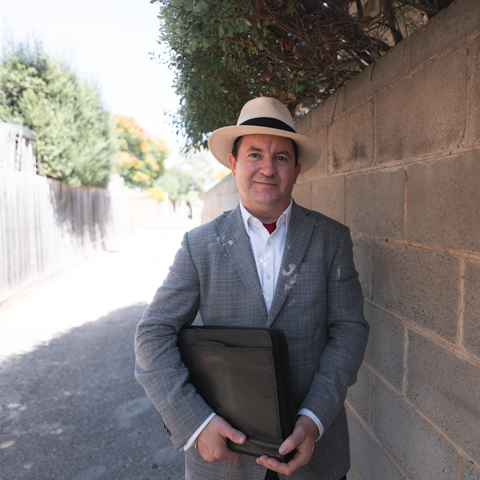
Zac Newbold – Founder & Managing Director – 30+ Years. Real Authority. Proven Results.
Zac Newbold is one of Melbourne’s most experienced Buyer’s Agents and a Fully Licensed Estate Agent since 2001.
With over 30 years inside the property market, Zac has seen exactly how buyers win – and exactly how they get overexposed, overbid, and overpay.
He’s worked across every layer of the industry – residential sales, boutique agencies, large franchise networks, property and asset management, corporate advisory, commercial real estate, and project management. That experience gives him a simple advantage: he knows how every player in the market thinks, moves, and negotiates.
At a certain point, he made a clear decision – stop working the system from all sides, and start working for one side only.
The buyer.
Because that’s where clarity matters. And that’s where deals are actually won.
Today, Zac represents buyers across Melbourne in residential and investment property, using a disciplined, strategy-led approach built on market intelligence, timing, and hard negotiation.
Through Your Australian Property Buyers Agents, Zac and his team give clients a real edge in the market – independent advice, structured strategy, and negotiation that’s designed to protect capital and win the deal.
His philosophy is simple: Treat every purchase like it’s your own money on the line – and never pay more than you have to.
Outside of property, Zac spends time with his wife and family and travels whenever the schedule allows.
If you’re serious about making your next property move, contact Zac Newbold and his team today to organise your confidential and complimentary Property Strategy Session.
Disclaimer
The information provided in this article is general in nature and is intended for educational and informational purposes only. It does not constitute financial, legal, or investment advice and should not be relied upon as such.
All property markets involve risk, and outcomes will vary based on individual circumstances. Readers should conduct their own due diligence and seek independent advice from qualified professionals before making any property or investment decisions.
While every effort has been made to ensure the accuracy of the information at the time of publication, Your Australian Property Buyers Agents makes no guarantees as to its completeness, reliability, or current relevance and accepts no responsibility for any loss or damage arising from reliance on this content.