
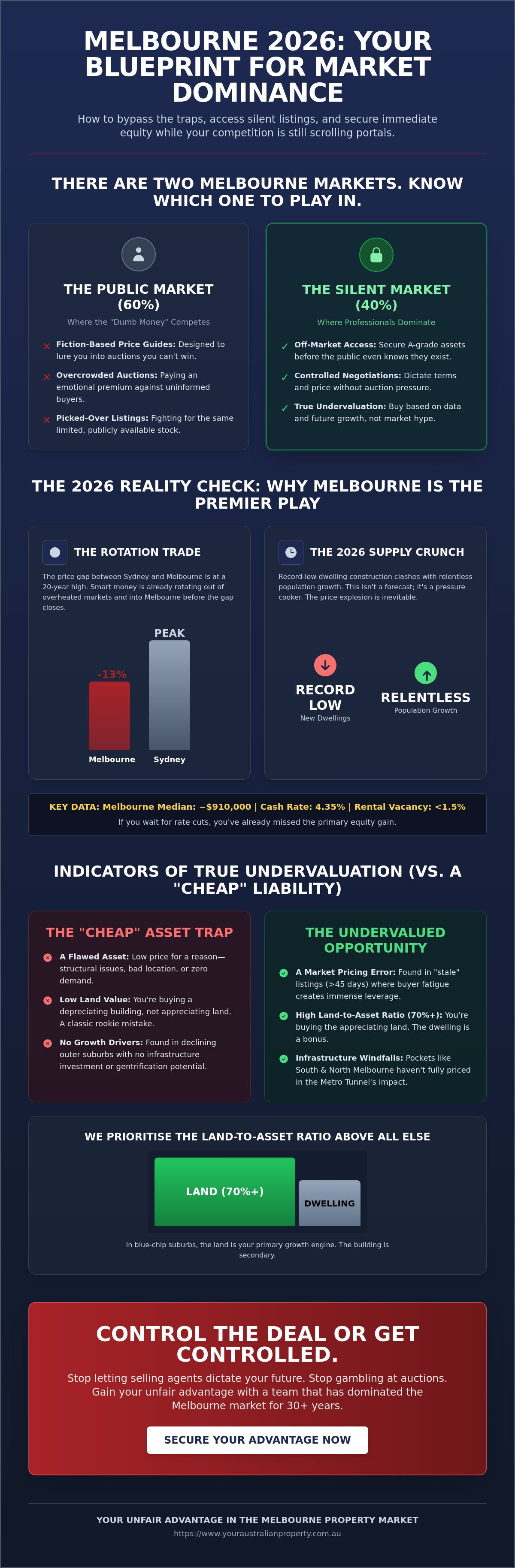
While the masses fight over the scraps on real estate portals, 40% of Melbourne’s high-growth assets never even hit the public market. You likely feel the frustration of arriving at an auction only to realise the price guide was a total fiction designed to lure you in. It is a common trap where "dumb money" pays a premium for the privilege of being outbid. If you are serious about finding undervalued property melbourne 2026, you must stop looking where everyone else is looking and start controlling the deal.
We understand the stakes are high when the median house price sits around $910,000 and the cash rate remains at 4.35%. You want an asset that delivers immediate equity, not a mortgage that feels like a liability. This guide reveals the professional framework for identifying gap value suburbs and accessing silent listings that your competitors do not even know exist. We will show you how to move from a state of uncertainty to a position of absolute market dominance through aggressive negotiation and superior asset selection.
Key Takeaways
- Understand why the 2026 supply crunch makes Melbourne the premier rotation play for serious investors.
- Distinguish between a “cheap” asset and true value by focusing on the land-to-asset ratio.
- Master the art of finding undervalued property melbourne 2026 by securing silent listings before the public even knows they exist.
- Stop letting selling agents dictate the terms and start controlling the deal through aggressive negotiation.
- Use three decades of Melbourne expertise to bypass auction traps and lock in immediate equity.
Table of Contents
Is Melbourne Actually Undervalued? The 2026 Reality Check
Undervaluation is not a low sticker price. It is the measurable gap between what you pay today and the asset’s intrinsic future value. In the current market, many buyers confuse "cheap" with "undervalued". We see this all the time. A property in a declining outer suburb is cheap; a blue-chip asset in a supply-constrained metropolitan pocket is undervalued. Finding undervalued property melbourne 2026 requires looking past the surface and identifying the economic triggers that indicate a recovery phase is already in motion. You either control the deal during this window or get controlled by the price surge later in the year.
To better understand the shifting landscape of the Victorian market, watch this helpful video analysis:
The 13% Price Gap and the Rotation Trade
The historical relationship between Sydney and Melbourne median prices is a primary indicator for smart acquisitions. Currently, the price gap between these two cities sits at a 20-year high. Historically, these markets move in Australian property market cycles where one eventually "catches up" to the other. Smart money is already rotating out of overheated markets like Perth and Brisbane and flowing back into Victoria. We are seeing sophisticated investors dominate the $1,000,000 to $3,000,000 bracket, recognising that Melbourne offers far superior long-term security. They aren’t waiting for the headlines; they are buying before the market corrects itself.
Supply vs Demand: The 2026 Crunch
The supply side is where the real pressure builds. New dwelling commencements are at record lows while metropolitan Melbourne’s population continues to swell. High construction costs have created a "floor" for established home prices. It simply costs too much to build new, making existing quality assets even more valuable by default. With rental vacancy rates pinned below 1.5%, the demand for housing is relentless. We predict price growth will accelerate sharply in the second half of 2026 as these factors converge. If you wait for the Reserve Bank to cut the 4.35% cash rate before acting, you’ve already missed the primary equity gain. You need a buyers agents melbourne specialist who understands these micro-market triggers. The goal is to secure the asset while the "dumb money" is still sitting on the sidelines.
Indicators of True Undervaluation in Metropolitan Melbourne
Don’t confuse a bargain with a liability. A cheap property is often priced low for a reason; usually a structural flaw, poor location, or lack of demand. True undervaluation is a pricing error where the market has failed to account for a property’s intrinsic future utility or scarcity. When finding undervalued property melbourne 2026, you must look for the "stale" listing. These are assets sitting on public portals for 45 days or more. Often, the initial marketing was poor or the vendor was over-ambitious. By the time the price corrects, the "herd" has moved on. That is when we strike. You either control the negotiation during this period of buyer fatigue or you end up overpaying at a crowded auction.
Infrastructure Windfalls: Beyond the Metro Tunnel
The Metro Tunnel is now fully operational, yet the full price uplift in specific pockets hasn’t been fully realised. We see this all the time. The market takes years to price in the "convenience premium" of new infrastructure. Suburbs like South Melbourne, North Melbourne, and Parkville now have direct, high-frequency access to the CBD through stations like Anzac and Arden. These areas are currently undervalued because the "lifestyle lag" hasn’t caught up to the technical reality of the commute. We track local council planning permits and rezoning applications to identify where the next wave of gentrification will hit. If you aren’t looking at the 5-year precinct plans, you aren’t seeing the full picture.
The Land Value vs Dwelling Ratio
We prioritise the land-to-asset ratio above all else. In blue-chip suburbs like Armadale or Toorak, the land should ideally represent 70% or more of the total purchase price. Shiny renovations and cosmetic upgrades depreciate the moment you settle. Dirt does not. Here is where buyers get it wrong: they fall in love with a $200,000 kitchen in a low-demand suburb and ignore the $2,000,000 block of land with a tired weatherboard house. Understanding the drivers behind these shifts is supported by the RBA Housing Market Model, which highlights how supply constraints and land scarcity historically drive the majority of capital growth. If you want to ensure your next purchase is a high-performing asset rather than a lifestyle liability, you can speak with our advocacy team to review your target list. We focus on the intrinsic value of the dirt, ensuring you aren’t paying a premium for someone else’s taste in tiles.
Off-Market Assets: Buying Below Public Market Value
Accessing the public market is essentially volunteering to pay a premium. The real strategy for finding undervalued property melbourne 2026 involves tapping into the "silent" market. This is where roughly 40% of transactions occur before a single photo is uploaded to a public portal. Sellers choose this path for privacy, speed, and to avoid the $10,000 to $15,000 marketing costs associated with a full campaign. We see this all the time. By the time a property hits your screen, the best value has already been negotiated away by professionals. You either gain access to this private tier of opportunities or you fight for the leftovers with the rest of the crowd.
Why Silent Listings Are Gold
Auctions are designed to trigger emotional fever that pushes prices 10% to 15% above the reserve. Off-market deals remove the theatre. In high-demand pockets like Brunswick and Fitzroy North, we often secure assets from discreet sellers who value a quiet, certain transaction over a public circus. These sellers might be dealing with a sensitive family matter or simply want to avoid hundreds of strangers walking through their home. You gain access to the "pre-market" window, allowing you to strike while the vendor is motivated and the competition is non-existent. This is how you manufacture equity on day one.
Bypassing the Public Auction Room
Auctions exist to serve the seller’s bottom line. Period. They create a false sense of urgency that forces buyers to make "dumb money" mistakes. Here’s where buyers get it wrong: they think they can outsmart a seasoned selling agent on the day. You can’t. To win, you must either secure the property off-market or use an expert Auction Bidding Service Melbourne to neutralise the room. An unconditional offer delivered at the right moment is a powerful weapon. It provides the seller with immediate certainty, often allowing us to secure the asset below what it would have fetched at a public auction. Control the deal or get controlled by the auctioneer’s gavel.
Here’s how this plays out in the real world:
Buyer: Interstate investor looking for a high-yield house in Reservoir.
Problem: Kept losing at auctions where properties were selling $80,000 over the high end of the quote range.
Strategy: We leveraged our local network to find a vendor needing a quick sale due to an interstate relocation. We negotiated a silent listing deal before the first open home.
Outcome: Secured the property for $890,000, which was $40,000 below its appraised market value.
Lesson: You either control the deal through off-market access or you get controlled by the auction crowd.
5 Steps to Secure an Undervalued Property in 2026
Success in the Melbourne market is a game of information asymmetry. If you have the same data as everyone else, you’ll pay the same price as everyone else. Finding undervalued property melbourne 2026 requires a disciplined, five-step tactical framework that moves you from a passive observer to a market leader. You either control the deal through a repeatable process or you get controlled by the market’s volatility. We’ve refined this strategy over 30 years to ensure our clients never pay a cent more than an asset’s intrinsic value.
Step 1: Define "Investment Grade" criteria. Stop looking at "nice" homes and start looking at scarcity. We prioritise land-to-asset ratios and architectural integrity over cosmetic trends.
Step 2: Leverage a 50+ agent network. You can’t find the best deals on a smartphone. You need to be the first person an agent calls when a vendor needs a discreet, fast exit.
Step 3: Deep-dive due diligence. For every stale listing, we investigate why it hasn’t sold. Is it a fixable floorplan issue or a fundamental location flaw?
Step 4: Execute a high-pressure offer. We use short-expiry, unconditional offers to force a vendor’s hand before they can reach the security of an auction date.
Step 5: Control settlement terms. Sometimes a 30-day or 120-day settlement is worth more to a seller than an extra $10,000. Use their timeline to lower your price.
Research and Relationship Building
Here’s where buyers get it wrong: they trust the price guide. In Melbourne, underquoting is a tactical tool used by selling agents to build auction momentum. We see this all the time. To find true value, you must ignore the guide and analyse the last six months of comparable sales within a 2km radius. You must also visit at least 20 properties in your target pocket to develop an "eye" for value. Ask the agent: "What is the vendor’s primary pain point?" If it’s a looming debt or a relocation, you have the leverage. If you aren’t asking the right questions, you’re just another face in the crowd.
The Kill: Negotiation and Due Diligence
Negotiation isn’t just about the number on the contract. It’s about using every piece of data as a lever. We use building and pest reports not just for peace of mind, but as a secondary negotiation tool to shave thousands off the final price. When the timing is right, we deploy a "take it or leave it" offer with a 24-hour sunset clause. This removes the seller’s ability to shop your offer around. If you want to ensure you’re the one holding the keys without overpaying, our Property Negotiation Service Melbourne provides the professional shield you need. You can book a strategy session with our team today to review your current targets and identify where the real equity is hiding.
Control the Deal or Get Controlled: The Buyers Agent Advantage
A Google search doesn’t give you leverage. It gives you the same noise that every other frustrated buyer is hearing. Finding undervalued property melbourne 2026 isn’t about browsing portals; it’s about relationships, raw data, and the ability to execute when the window of opportunity opens. We’ve spent 30 years building a network that bypasses the public market entirely. You either hire a professional shield to protect your interests or you walk into a negotiation room completely exposed to the tactics of a seasoned selling agent.
Here’s where buyers get it wrong: they focus on the fee rather than the result. Let’s be transparent about our percentage-based success fee model. It is designed to align our goals with your outcome. A fixed fee often leads to a "transactional" mindset where the agent just wants the deal done. Our model ensures we are incentivised to secure the highest quality asset at the best possible price. The real cost in the Melbourne market isn’t a professional fee; it’s the $100,000 or $200,000 you overpay at a crowded auction because you lacked the data to say no.
Our 30-Year Negotiation Edge
Selling agents fear professional buyer’s advocates because we know their playbook better than they do. We see the underquoting traps and the manufactured urgency before the first "open for inspection" sign is even put out. We see this all the time. Our independence is your greatest asset. We are fiercely loyal to the buyer, providing a necessary barrier against the emotional manipulation used to inflate prices. We manufacture equity by identifying properties with high land-to-asset ratios and negotiating based on intrinsic value rather than market hype. We don’t just find houses; we secure wealth-building assets.
Here’s how this plays out in the real world:
Buyer: An interstate investor looking for a high-yield Glen Waverley house.
Problem: Every auction was exceeding their $1,500,000 budget by $200,000.
Strategy: We identified an off-market deceased estate through our local network of agents.
Outcome: Secured the property for $1,450,000 before it ever hit the public market.
Lesson: Access to silent listings is the only way to avoid the "auction tax" that drains your capital.
Control is the only currency that matters in a rising market. If you want to maintain a pulse on the metropolitan landscape and see the data the public never gets, start using our Online Property Tracker. It is the same disciplined approach we use to ensure our clients stay ahead of the curve. Don’t wait for the market to tell you what a property is worth. Take control of the valuation, take control of the negotiation, and secure your future in Melbourne today.
Secure Your Melbourne Equity Position Before the 2026 Surge
The window for finding undervalued property melbourne 2026 is narrowing as the supply crunch intensifies and interstate capital flows back into Victoria. You either act with precision now or watch the median price climb beyond your reach while you wait on the sidelines. Success in this market requires more than just browsing public portals. It demands a shift toward high land-value assets and the discipline to ignore the manufactured theater of the public auction room. By focusing on intrinsic value rather than cosmetic renovations, you position yourself for immediate equity growth and long-term security.
We provide the professional shield you need to navigate these high-stakes acquisitions with 100% independent buyer advocacy. Our team leverages 30+ years of local Melbourne expertise to grant you exclusive access to silent off-market listings that never reach the general public. You don’t have to fight the crowd when you have an insider leading the way. Don’t leave your financial security to chance or the polished tactics of a seller’s representative. Secure your unfair advantage in the Melbourne market today. We look forward to helping you lock in a high-performing asset that serves your personal and financial aspirations.
Frequently Asked Questions
Is Melbourne property actually undervalued in 2026?
Yes, Melbourne is currently in a significant "reset" phase with the price gap between Melbourne and Sydney at a 20-year high. With median house prices between $910,000 and $930,000, the market is undervalued relative to its intrinsic future value. The combination of a 4.35% cash rate and a rental vacancy rate below 1.5% creates a pressure cooker environment. Smart money is already rotating back into Victoria to exploit this "catch-up" growth window before the next surge.
Which Melbourne suburbs have the most undervalued houses right now?
Focus on "gap value" suburbs that sit adjacent to blue-chip pockets but haven’t yet mirrored their price growth. We prioritise metropolitan areas in the South-East and Bayside where land value represents at least 70% of the asset price. Pockets near the now-operational Metro Tunnel stations also offer a convenience premium that hasn’t been fully priced in by the public. You either identify these infrastructure windfalls early or pay the premium once the "herd" arrives.
How do I find off-market properties in Melbourne without an agent?
True silent listings are almost impossible to access without an established professional network. While you can try door-knocking or cold-calling, 40% of high-growth deals happen behind closed doors through relationships between selling agents and advocates. Sellers choose this path to avoid $15,000 marketing fees and public scrutiny. Without an insider’s connection, you are restricted to the public scraps left on real estate portals.
What are the risks of buying property below market value?
The biggest risk is confusing a "cheap" asset with an "undervalued" one. A property might be priced low due to structural defects, poor orientation, or restrictive planning overlays that kill future capital growth. Here’s where buyers get it wrong: they fall in love with a low price and ignore the secondary nature of the asset. You must conduct rigorous due diligence to ensure you aren’t buying a lifestyle liability that will underperform for the next decade.
How much does a Melbourne buyer agent charge to find undervalued property?
Professional agencies typically operate on a percentage-based success fee model. This structure is the most transparent way to align an advocate’s performance with your financial outcome. It ensures your representative is motivated to secure a high-performing asset rather than just any property. When finding undervalued property melbourne 2026, the fee is an investment in avoiding the "auction tax" that often sees unrepresented buyers overpay by $100,000 or more.
Will the 2026 rate rises stop the Melbourne property recovery?
Interest rates are only one part of the equation and the 4.35% cash rate is already baked into market sentiment. The primary driver of the 2026 recovery is the massive dwelling shortage and record-low commencements. Demand for metropolitan land is so high that it is over-powering rate sensitivity. Scarcity drives value. As long as the supply crunch remains, prices in high-demand Melbourne pockets will continue to climb regardless of minor rate fluctuations.
How do I spot an underquoted property in Melbourne?
Ignore the price guide and focus exclusively on comparable sales from the last 90 days within a 2km radius. If the agent’s guide is 10% below these benchmarks, it is a deliberate trap designed to manufacture auction momentum. We see this all the time. To win, you must have the data to walk away from a rigged auction and the expertise to negotiate a deal on your terms before the hammer falls.
Is it better to buy a house or a unit for capital growth in 2026?
Houses with high land-to-asset ratios will always outperform units for capital growth. Land appreciates while buildings depreciate. While units might offer a slightly higher rental yield, they lack the scarcity that drives long-term wealth. In 2026, we prioritise established houses on metropolitan blocks because they offer total control over the asset’s future. You either buy the dirt and control the equity or buy a unit and get controlled by the body corporate.
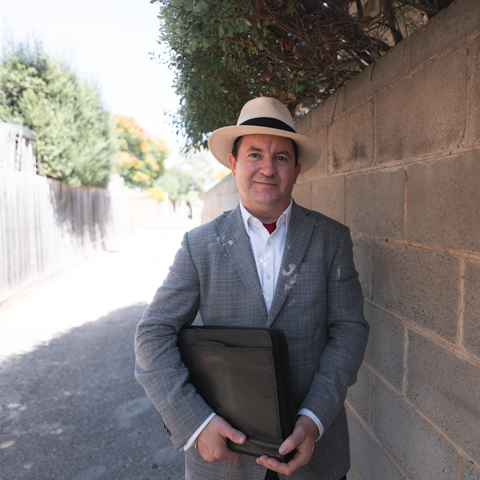
Article by
Zac Newbold – Founder & Managing Director – 30+ Years. Real Authority. Proven Results.
Zac Newbold is one of Melbourne’s most experienced Buyer’s Agents and a Fully Licensed Estate Agent since 2001.
With over 30 years inside the property market, Zac has seen exactly how buyers win – and exactly how they get overexposed, overbid, and overpay.
He’s worked across every layer of the industry – residential sales, boutique agencies, large franchise networks, property and asset management, corporate advisory, commercial real estate, and project management. That experience gives him a simple advantage: he knows how every player in the market thinks, moves, and negotiates.
At a certain point, he made a clear decision – stop working the system from all sides, and start working for one side only.
The buyer.
Because that’s where clarity matters. And that’s where deals are actually won.
Today, Zac represents buyers across Melbourne in residential and investment property, using a disciplined, strategy-led approach built on market intelligence, timing, and hard negotiation.
Through Your Australian Property Buyers Agents, Zac and his team give clients a real edge in the market – independent advice, structured strategy, and negotiation that’s designed to protect capital and win the deal.
His philosophy is simple: Treat every purchase like it’s your own money on the line – and never pay more than you have to.
Outside of property, Zac spends time with his wife and family and travels whenever the schedule allows.
If you’re serious about making your next property move, contact Zac Newbold and his team today to organise your confidential and complimentary Property Strategy Session.
Disclaimer
The information provided in this article is general in nature and is intended for educational and informational purposes only. It does not constitute financial, legal, or investment advice and should not be relied upon as such.
All property markets involve risk, and outcomes will vary based on individual circumstances. Readers should conduct their own due diligence and seek independent advice from qualified professionals before making any property or investment decisions.
While every effort has been made to ensure the accuracy of the information at the time of publication, Your Australian Property Buyers Agents makes no guarantees as to its completeness, reliability, or current relevance and accepts no responsibility for any loss or damage arising from reliance on this content.