

The reported clearance rate is a vanity metric that tells you almost nothing about what you should actually pay for a home. In reality, 85% of Melbourne buyers are looking at the wrong numbers and wondering why they keep losing out to more aggressive bidders. If you’re relying on the Sunday morning headlines to gauge auction results melbourne, you’ve already lost the game. We’ve spent 30 years watching buyers get crushed by underquoting and the confusing gap between "passed in" and "sold prior" results.
You want to stop the guesswork and finally feel in control of your financial future. We agree that the Melbourne market is a minefield of emotional traps designed to make you overpay. This guide will teach you how to decode raw data like a professional buyer’s advocate so you can identify market shifts before the general public even wakes up. We’re breaking down the exact insider framework we use to predict property values with pinpoint accuracy for 2026. It’s time to stop being the victim of the selling agent’s tactics and start dominating the deal.
Key Takeaways
Stop falling for vanity metrics and learn how to read real-time market sentiment like a professional buyer’s advocate to avoid being misled.
Master the "Micro-Market" effect to see why city-wide auction results melbourne data can be dangerously misleading for your specific target suburb.
Turn a "Passed In" result into your greatest advantage by learning how to dismantle the selling agent’s post-auction pressure tactics and secure the deal.
Apply our reverse-engineering formula to calculate the real-world "Underquoting Buffer" and set a definitive price ceiling that protects your capital.
Break the cycle of analysis paralysis and learn why having the data is useless unless you have the strategy to execute before prices rise further.
Table of Contents
Beyond the Numbers: What Melbourne Auction Results Really Tell You
The "Passed In" Phenomenon: Turning Failed Auctions into Secured Deals
Beyond the Numbers: What Melbourne Auction Results Really Tell You
Most buyers treat auction results melbourne data like a Sunday morning sports score. They look at the headline, see a big number, and assume the market is flying. That is a mistake that costs hundreds of thousands of dollars. These results are the only transparent indicator of real-time market sentiment we have, but you need to know how to strip away the noise. Total sales volume is a vanity metric used by selling agents to create hype. Clearance rates are the real pulse of the city.
To better understand how these dynamics play out on the ground, watch this live footage of a Melbourne auction in action:
We see this all the time: buyers misread the data, panic, and overpay for a B-grade property while the smart money waits for the right moment. In this market, you either control the deal, or you get controlled. Understanding the auction process is just the baseline. You need to decode what the numbers are intentionally hiding from you. If you don’t, you are bidding blind against professional selling agents who do this for a living.
The Three Main Indicators You Must Track
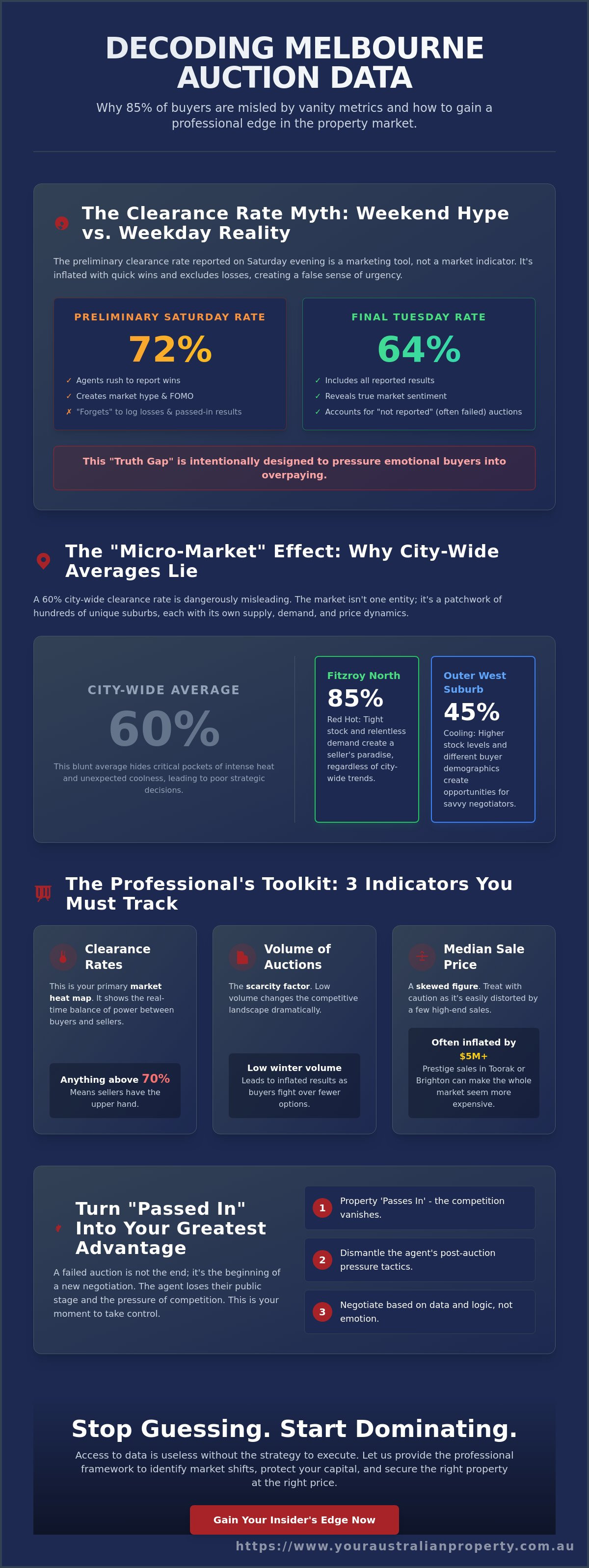
Clearance rates: This is the percentage of properties sold versus those scheduled. It is your primary heat map. Anything above 70% means the sellers have the upper hand.
Median sale price: Take this with a grain of salt. This figure is often skewed by a handful of A$5 million plus sales in Toorak or Brighton, making the broader market look more expensive than it actually is.
Volume of auctions: Scarcity in the winter months changes the competitive landscape. Low volume can lead to inflated auction results melbourne because desperate buyers are fighting over fewer scraps.
Preliminary vs. Final Results: The Truth Gap
The Saturday 5:00 PM clearance rate is a marketing tool, not a financial report. It is almost always higher than the final Tuesday figure because agents rush to report their wins and "forget" to log their losses. This creates a false sense of urgency. The role of "not reported" results is to hide market weakness; these are usually properties that passed in with zero bids. To find the real numbers before they are sanitised by the media, you need an auction bidding service that tracks the raw, unedited data from the coalface.
Stop following the herd. The media wants a headline, and the agents want a commission. We want you to secure the right asset at the right price. If you are relying on free apps and news snippets, you are already behind. Real power comes from knowing the final Tuesday morning reports before you set foot at an open inspection on Saturday.
The Clearance Rate Myth: Why 60% Isn’t the Same Everywhere
Stop looking at the Monday morning headlines. A 60% city-wide clearance rate is a statistical trap. It’s a blunt average of everything from a derelict unit in the outer west to a prestige estate in Toorak. It tells you nothing about the street you’re actually bidding on. We see buyers pull out of the market because they read a "cooling" headline, while the specific pocket they want is actually red hot. You either control the deal, or you get controlled by generic data that doesn’t apply to your search.
In 2026, the "Micro-Market" effect is the only metric that matters. While some suburbs lag, Fitzroy North often maintains an 85% clearance rate because stock is tight and demand is relentless. You need to understand the national housing market context to see how supply constraints drive these local spikes regardless of broader economic sentiment. When interest rates are announced on a Tuesday, the auction results melbourne produces the following Saturday reflect that sentiment instantly. We track these shifts in real-time to advise our clients to pivot. If your preferred suburb is hitting a ceiling, we move you two streets over where the data shows a temporary lull and better value. Understanding the broader melbourne property market 2025 trends and 2026 strategic outlook is essential before you can accurately interpret what suburb-level clearance rates are really telling you.
Suburb-Specific Performance in 2026
Bayside property values are shifting as we see a 12% increase in stock compared to the same period in 2025. High clearance rates in Melbourne’s inner-north indicate that buyer competition remains fierce for heritage homes. To spot a "buyer’s window," we look for suburbs where clearance rates have dipped below 55% for three consecutive weeks. This is where we find motivated vendors and significantly less competition for our clients.
Property Type Discrepancies
Family homes in elite school zones like Balwyn or McKinnon don’t care about the economy. They maintain 80% plus clearance rates year-round because the underlying demand is structural, not speculative. However, the data trend for unrenovated villas shows a 15% price gap compared to turnkey apartments in 2026. This is the "sweet spot" for first-home buyers. If you can handle a renovation, you can bypass the heat of the auction results melbourne is currently seeing for finished products. We see this all the time; buyers overpay for "shiny" properties while ignoring the equity potential in solid, older builds. Our auction bidding service ensures you don’t get caught up in the emotion of the crowd and only bid what the property is actually worth.
The "Passed In" Phenomenon: Turning Failed Auctions into Secured Deals
Most amateur buyers see a "Passed In" result as a red flag. They assume something is wrong with the property or that the price is far too high. That is a rookie mistake. For a professional buyer, a property passing in is the best news you can hear. It means the public competition has failed. The spotlight is gone. The crowd has dispersed. Now, it is just you and a vendor whose expectations have just been hit by a cold dose of reality. When you analyse auction results melbourne wide, you will notice that some of the best value is found in the "Sold After" category. This is where the real deals are made.
You must be wary of the "Passed In" trap. Selling agents are experts at manufacturing fake urgency the moment an auction ends. They will tell you three other parties are "ready to sign" or that a conditional buyer is making an offer on Monday. We see this all the time. It is a desperate attempt to regain the leverage they lost when the hammer stayed down. You need to rely on credible Australian housing research to understand true market value rather than listening to agent spin. In this market, you either control the deal, or you get controlled.
The difference between a "Sold Prior" and a "Sold After" result tells you everything about agent confidence. A property sold before auction suggests the agent knew they had hit the ceiling. A property sold after suggests a scramble. We use that scramble to your advantage. We don’t just wait for the agent to call; we dictate the terms of the engagement from the second the auctioneer steps off the box.
Why Properties Pass In (It’s Not Always the Price)
Vendor greed is the primary reason properties fail at auction. Many sellers set reserves based on outdated data or emotional attachment rather than current market conditions. Poor marketing campaigns also play a massive role. If an agent fails to build a diverse pool of bidders, even a high-quality asset will stall. Sometimes, a strategic "Pass In" is used by the agent to test the market floor. They want to identify the highest genuine bidder before moving into a private environment where they can apply more pressure. Knowing which scenario you are facing requires 30 years of experience on the ground.
The Post-Auction Negotiation Strategy
The first 24 hours after a failed auction are the most critical for a buyer. This is your window of maximum leverage. The vendor is often disappointed and vulnerable to a clean, unconditional offer. You need a professional property negotiation service to navigate this phase without overpaying. Our insider technique involves shutting down the competition before other conditional buyers can get their finance approved on Monday morning. We move fast, we move hard, and we ensure the auction results melbourne data shows a win for our client, not the selling agent.
Reverse-Engineering Results: 5 Steps to Predict Sale Prices
Most buyers walk into an auction with a hope and a prayer. We walk in with a spreadsheet. To win in 2026, you must stop looking at what a house is "worth" and start looking at what the market is actually paying. You need to reverse-engineer the last 28 days of auction results melbourne to find the real price ceiling. If you are looking at data from three months ago, you are already behind the curve.
The first rule of Melbourne real estate is that the "Statement of Information" is a marketing tool, not a valuation. We see this all the time. Agents quote a low range to lure in a crowd and create a bidding frenzy. To find the truth, you must apply an "Underquoting Buffer." In the current market, this typically means adding 10 to 15 per cent to the top end of the agent’s quoted range. If the agent says A$1.1M to A$1.2M, the real game starts at A$1.32M. Don’t walk in with A$1.15M and hope for a miracle; you are just helping the agent reach their reserve. To understand exactly which suburbs and agents are most guilty of this practice, study the melbourne underquoting hotspots property buyers need to avoid in 2026 before you set your maximum bid.
Tracking specific selling agents is your secret weapon. Every agent has a "quoted vs. sold" ratio. Some consistently sell 12 per cent over their high end, while others are more transparent. We maintain a database of these ratios to ensure our clients never walk into a lopsided fight. In this market, you either control the deal, or you get controlled. Don’t let a low quote trick you into wasting money on building inspections for a house you cannot afford.
Step 1: Identify Your Suburb Peers
You must find properties that mirror your target in land size, bedroom count, and renovation quality within the last four weeks. We adjust for "X-factors" that add premium value, such as a north-facing backyard or a position in a quiet cul-de-sac. A north-facing orientation can easily command a 5 per cent premium over a south-facing neighbour. Comparable Sales are the only data points that truly matter when determining your maximum bid.
Step 2: Calculate the Demand Ratio
Success is found in the numbers. Track the number of registered bidders at recent auctions. If you see four or more active bidders, the price will almost certainly exceed the reserve by a significant margin. Pay close attention to "Sold Prior" data. If a house sells two weeks before the auction, it usually means the buyer made an offer 5 to 10 per cent above the expected range to kill the competition. If auction results melbourne consistently show properties exceeding reserves by more than 10 per cent, the market is over-heated and you need to adjust your strategy immediately. Understanding where home prices in Melbourne are heading in 2026 is critical context for setting a realistic price ceiling before you register to bid.
Stop guessing what the hammer will fall at and start bidding with the confidence of an insider. Secure your property without the stress of overpaying today.
Control the Hammer: Why Data Access Isn’t Market Dominance
Reading the latest auction results melbourne doesn’t make you an expert. It makes you a reader. Anyone can scroll through a list of sold prices while eating breakfast. Very few people know how to use that data to crush the competition when the pressure is on. We see this all the time. Buyers spend six months "monitoring" the market only to find that the A$1.5M home they wanted now costs A$1.6M. That is called analysis paralysis. It’s a trap that costs you real money. While you’re busy studying the past, the market is moving into the future. You don’t need more data. You need a strategy to execute. Professional bidding is the only bridge between knowing the numbers and winning the keys.
The Value of a Professional Bidder
Our team brings 30 years of street-level experience to the curb. We don’t just look at a spreadsheet; we read the room. We identify the "dummy" bidders, spot the selling agent’s desperate tactics, and shut down momentum before the price spirals. Selling agents are trained to extract every cent from your pocket. They use psychological triggers to inflate results. We neutralise those tactics instantly. Our Auction Bidding service is designed to secure the property at the lowest possible price, regardless of what the clearance rate says. We know when to push and exactly when to walk away. That level of discipline is the difference between a dream home and a financial nightmare.
In this market, you either control the deal or you get controlled. Most buyers allow the auctioneer to set the pace. They bid in the increments the agent suggests and show their hand too early. We do the opposite. We dictate the terms of the engagement. By the time the hammer falls, the competition is exhausted and you are holding the contract. We work for you, not the agent. Our loyalty is 100% focused on your bottom line.
Your Next Move in the Melbourne Market
It is time to stop being a spectator and start being a buyer. The Melbourne market rewards those who take control. You can keep watching from the sidelines, or you can hire a professional to win the keys. Think of our property acquisition success fees as an investment in your future. We regularly save our clients from making a A$100,000 mistake by overpaying in the heat of the moment or buying the wrong asset entirely.
Take the first step toward securing your future and ending the cycle of missed opportunities. Don’t let another weekend of auction results melbourne pass you by while you remain empty-handed. Contact Zac Newbold and the team to take total control of your search today. We provide the expertise, the access, and the execution required to win in 2026.
You wouldn’t represent yourself in court; why represent yourself at a A$2M auction?
Take Control of the Hammer in 2026
Stop guessing and start winning. Most buyers are drowning in data but starving for real results. They see a clearance rate and think they’ve cracked the code. They haven’t. After 30 years in the trenches, we know that raw auction results melbourne are just the starting point, not the finish line. You either learn to decode the "passed in" signal or you keep losing out to those who do. We’ve seen it a thousand times: buyers who wait for the perfect data point usually end up paying a premium for someone else’s leftovers.
Real market dominance requires more than a spreadsheet. It demands independent advice and a strategy that prioritises your interests over the selling agent’s commission. We’ve spent three decades securing exclusive off-market opportunities and shielding our clients from high-pressure tactics. We don’t just find houses; we secure your financial future. You can either be the person who wonders what happened or the one who makes it happen. The choice is yours.
Your future home is waiting, and we’re ready to help you claim it with total confidence.
Frequently Asked Questions
What is a good clearance rate in Melbourne?
A clearance rate of 70% indicates a healthy, balanced market. When you see figures climb above 75%, sellers hold the cards and prices escalate rapidly. If the rate drops below 60%, the leverage shifts back to you. We’ve monitored these cycles for 30 years to ensure our clients never buy at the peak of a market frenzy.
How often are Melbourne auction results updated?
You will see auction results melbourne updated in real-time every Saturday afternoon as agents report their wins. While preliminary data flows in by 6:00 PM, the final, verified numbers don’t settle until the following Wednesday. We ignore the Saturday night hype and wait for the full data set to give you a clear picture of what’s actually happening.
Does a "Sold Prior" result mean the buyer overpaid?
A "Sold Prior" result doesn’t automatically mean you overpaid, but it often means the selling agent successfully manufactured a fear of missing out. We see this all the time. Agents use early offers to pressure buyers into paying a premium to avoid the auction floor. Without an advocate, you’re likely paying for the agent’s commission and then some.
Why are some auction prices withheld from the results?
Price withholding is a tactical move used by agents to protect their brand or the vendor’s privacy. If a property sells for less than expected, the agent hides the price to keep the local comparable sales data artificially high. We bypass these secrets by using our industry connections to find the actual sale price within 24 hours of the hammer falling.
How accurate are the preliminary auction results on Saturday night?
Preliminary results are often skewed and shouldn’t be taken as gospel. Agents are quick to report successful sales to boost their stats but are notoriously slow to report properties that passed in. This creates an artificial sense of market heat. We look past the Saturday night headlines to find the real opportunities that the general public misses every week.
Can I use auction results to challenge a bank valuation?
You can absolutely use recent sales data to challenge a conservative bank valuation. We provide our clients with a detailed analysis of three to five comparable auction results melbourne from the last 90 days to prove market value. Banks are cautious, but they can’t argue with hard evidence and a professional submission that demonstrates the property’s true worth in today’s climate.
What happens to a property if it is passed in at auction?
If a property is passed in, the highest bidder earns the exclusive right to negotiate with the vendor at their reserve price. This is where the real game begins and where most buyers lose their nerve. We step in to control the negotiation, ensuring you don’t pay a cent more than the property is actually worth under pressure.
How do interest rate changes affect Melbourne auction results?
Interest rate movements are the primary driver of buyer sentiment and borrowing capacity. A 0.25% increase can immediately reduce a buyer’s budget by roughly 2.5%, leading to lower attendance and more properties passing in. In this market, you either understand how to play the rate cycle or you get controlled by it. We help you navigate these shifts with total confidence.
Article by
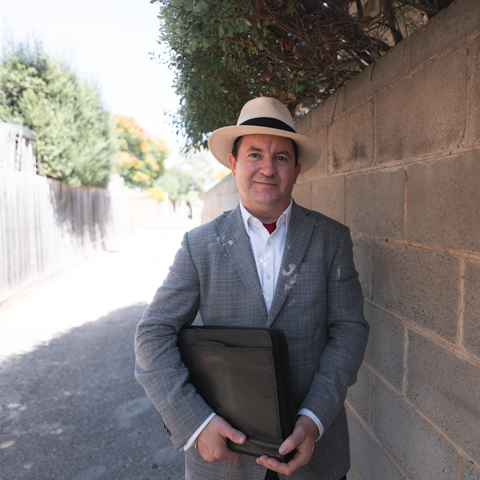
Zac Newbold – Founder & Managing Director – 30+ Years. Real Authority. Proven Results.
Zac Newbold is one of Melbourne’s most experienced Buyer’s Agents and a Fully Licensed Estate Agent since 2001.
With over 30 years inside the property market, Zac has seen exactly how buyers win – and exactly how they get overexposed, overbid, and overpay.
He’s worked across every layer of the industry – residential sales, boutique agencies, large franchise networks, property and asset management, corporate advisory, commercial real estate, and project management. That experience gives him a simple advantage: he knows how every player in the market thinks, moves, and negotiates.
At a certain point, he made a clear decision – stop working the system from all sides, and start working for one side only.
The buyer.
Because that’s where clarity matters. And that’s where deals are actually won.
Today, Zac represents buyers across Melbourne in residential and investment property, using a disciplined, strategy-led approach built on market intelligence, timing, and hard negotiation.
Through Your Australian Property Buyers Agents, Zac and his team give clients a real edge in the market – independent advice, structured strategy, and negotiation that’s designed to protect capital and win the deal.
His philosophy is simple: Treat every purchase like it’s your own money on the line – and never pay more than you have to.
Outside of property, Zac spends time with his wife and family and travels whenever the schedule allows.
If you’re serious about making your next property move, contact Zac Newbold and his team today to organise your confidential and complimentary Property Strategy Session.
Disclaimer
The information provided in this article is general in nature and is intended for educational and informational purposes only. It does not constitute financial, legal, or investment advice and should not be relied upon as such.
All property markets involve risk, and outcomes will vary based on individual circumstances. Readers should conduct their own due diligence and seek independent advice from qualified professionals before making any property or investment decisions.
While every effort has been made to ensure the accuracy of the information at the time of publication, Your Australian Property Buyers Agents makes no guarantees as to its completeness, reliability, or current relevance and accepts no responsibility for any loss or damage arising from reliance on this content.