

Most Melbourne investors are flying blind, relying on “gross yield” figures that aren’t worth the paper they’re printed on. You know that a property is only as good as the cash it actually puts in your pocket; however, the fear of overpaying for a low-performing asset keeps most buyers awake at night. We see this all the time. Selling agents talk up high percentages to close the deal, but they rarely mention the Victoria-specific land tax or the maintenance costs that eat your profit alive.
We work for you, not the agent, and that means giving you the hard truth about your numbers. This guide will show you exactly how to calculate rental yield using our no-nonsense, net-focused formula. You will master the Melbourne-specific variables and holding costs that others ignore, ensuring you never get burned by a bad deal. By the time you finish reading, you will have the insider confidence to separate the winners from the duds and secure your future. We are moving from uncertainty to a bulletproof investment strategy right now.
Key Takeaways
- Stop relying on generic bank calculators and master the professional formula to calculate rental yield with absolute Melbourne-market precision.
- Uncover the “hidden” Victorian expenses—from the 2026 Land Tax thresholds to high-end strata levies—that can quietly gut your net returns.
- Navigate the critical inverse relationship between high-yield cash flow and long-term capital growth to select the right suburb for your specific strategy.
- Learn how to instantly maximise your yield by accessing off-market opportunities and using aggressive negotiation tactics to buy below market value.
- Stop being controlled by selling agents and start using hard data to avoid the “yield traps” that lead to expensive investment blunders.
What is Rental Yield and Why Generic Calculators Fail Melbourne Investors
Rental yield isn’t just a percentage on a spreadsheet. It is the heartbeat of your investment. At its core, it measures the annual rental income your property generates relative to its market value. While the basic concept of financial yield is a standard investment metric, applying it to the volatile Melbourne landscape requires more than a basic online tool. Most bank calculators are garbage. They operate in a vacuum, assuming 100% occupancy and ignoring the brutal reality of holding costs.
In this market, you either control the deal or you get controlled. Generic calculators fail because they don’t account for Melbourne-specific variables like the current 2.1% vacancy fluctuations or the recent changes to Victorian land tax thresholds. We see this all the time; investors walk into a deal thinking they’ve secured a cash-flow cow, only to find the “math” they used was missing half the equation. Our philosophy at Your Australian Property is clear: numbers don’t lie, but incomplete data kills deals. If you want to calculate rental yield accurately, you need to look past the surface.
Gross Yield vs. Net Yield: The Great Investor Trap
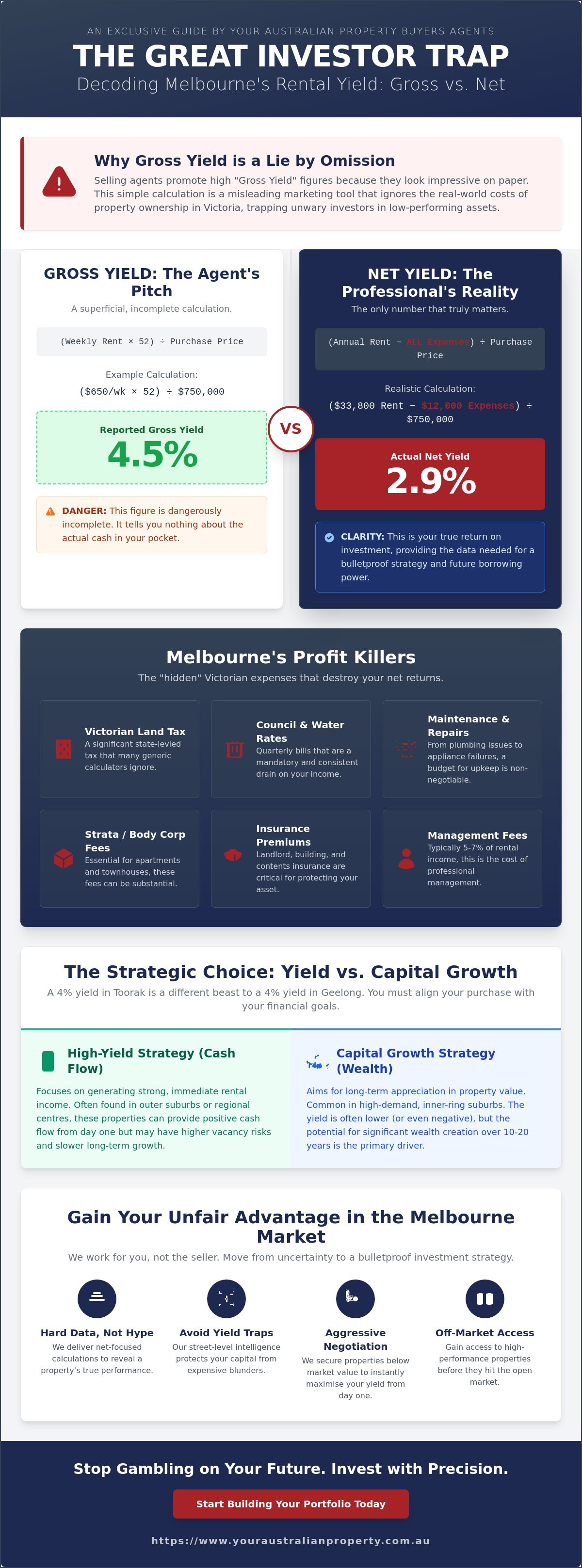
Selling agents love gross yield because it’s a shiny marketing tool. It’s a simple calculation: annual rent divided by purchase price. It looks great on a brochure, but it’s a lie by omission. Gross yield ignores the reality of being a landlord. Net yield is the “truth” that accounts for every cent leaving your pocket. This includes council rates, strata fees, management commissions, and maintenance. We see investors get burned constantly by focusing on a 5% gross figure, only to realise their actual net return is closer to 2.5% after outgoings. In Melbourne, ignoring the net figure is financial suicide.
The Melbourne Context: Why Location Changes the Math
A 4% yield in Toorak is a completely different animal than a 4% yield in Geelong. In high-end Melbourne suburbs, you often trade immediate yield for aggressive capital growth. In the outer suburbs, the yield might look higher on paper, but the vacancy risk is often far greater. You must also factor in infrastructure. Major projects like the Metro Tunnel or the North East Link can shift a suburb’s rental demand almost overnight. Using “average” Melbourne data is a recipe for disaster. You need street-level intelligence to calculate rental yield in a way that actually protects your capital. Every suburb has a different rhythm; if you don’t know it, you shouldn’t be buying in it.
The Step-by-Step Formula to Calculate Rental Yield Like a Pro
Stop guessing and start measuring. If you want to calculate rental yield like a veteran, you need two numbers: your total annualised rental income and the true cost of the asset. Most amateurs look at the price on the contract and stop there. That is a rookie mistake that leads to overpaying for sub-par assets. In the Melbourne market, you either control the numbers or the numbers control you.
We see this all the time; buyers get excited by a high weekly rent but ignore the underlying acquisition costs. To build a portfolio that actually performs, you must master both Gross and Net calculations. Gross yield is your quick filter for screening Melbourne listings, but Net yield is what dictates your lifestyle and your ability to borrow more from the bank.
Calculating Gross Rental Yield
Gross yield is the “back of the envelope” calculation. It is useful for a ten-second pulse check on a property during your Saturday morning inspection run. Follow these three steps to get your baseline:
- Step 1: Multiply the weekly rent by 52 to find your annual rental income. For example, A$650 per week equals A$33,800 annually.
- Step 2: Divide that annual sum by the purchase price of the property.
- Step 3: Multiply by 100 to find your percentage.
If you are looking at a A$750,000 apartment, that is a 4.5% gross yield. It is a start, but it does not tell the whole story. To ensure you are not buying a lemon, you need to dig deeper into the actual outgoings.
Calculating Net Rental Yield (The Professional Standard)
Net yield is the only figure that matters for your bank balance. This formula accounts for the reality of owning property in Victoria. You must subtract all annual outgoings from your income before you divide. This includes property management fees (usually 5% to 7% in Melbourne), insurance, council rates, and water levies. You should also account for deductible rental expenses to understand your true tax position.
Here is where buyers get it wrong: they use the “hammer price” as the denominator. A professional investor uses the Total Property Cost. In Melbourne, you must add stamp duty (roughly 5.5%), legal fees, and any immediate repair costs to the purchase price. If you pay A$1,000,000 at auction, your true cost is closer to A$1,060,000. Dividing your net income by this higher figure gives you the “Real Yield.” This level of transparency is exactly what we provide through our property negotiation service in Melbourne, ensuring you never fly blind into a deal. If the net yield does not stack up against your holding costs, walk away. There is always another deal, and we know exactly where to find it.
The “Hidden” Melbourne Expenses That Kill Your Net Yield
Gross yield is a vanity metric. It looks great on a real estate brochure, but it doesn’t pay your mortgage. To accurately calculate rental yield, you must look at the net figure. In Melbourne, the gap between gross and net is wider than most investors realise. If you don’t account for Victoria’s specific tax grabs and maintenance realities, your “high-yield” investment will quickly turn into a cash-flow drain. We see this all the time; investors buy based on a 4.5% gross return only to find their actual take-home pay is closer to 2.5% after the government and the Owners Corporation take their cut.
Victorian Specifics: Land Tax and Council Rates
The Victorian government has become increasingly aggressive with property taxes. The 2024 land tax changes dropped the tax-free threshold from A$300,000 to just A$50,000. By 2026, these thresholds will be firmly established as the new normal for every Victorian landlord. You need to price this into your holding costs today. Most Melbourne council rates are calculated based on the Capital Improved Value (CIV) of your property. This isn’t just the land; it includes the house and any improvements. Expect to pay between A$1,200 and A$2,500 annually for a standard residential asset.
Interstate and overseas investors face even steeper hurdles. The absentee owner surcharge is currently 4% in Victoria. This is a massive penalty that can instantly wipe out your profit margin if you aren’t prepared for it. For those eyeing those iconic Melbourne terrace houses, don’t get blinded by the heritage charm. These properties require constant upkeep. We always factor in a 1% maintenance buffer based on the property value for older period homes. If the house is worth A$1.5 million, set aside A$15,000 a year for repairs. It sounds high until the slate roof needs replacing or the damp starts rising.
Vacancy and Management Costs
Never calculate rental yield based on 52 weeks of income. That is a rookie error that leads to financial stress. A realistic Melbourne calculation uses 49 or 50 weeks to account for the inevitable 2-3 week vacancy period between tenancies. Even in a tight rental market, the time taken for cleaning, inspections, and admin adds up. You either control the vacancy—or the vacancy controls your bank balance.
Property management fees in metropolitan Melbourne typically range from 5% to 7% plus GST. If you head into regional centres like Geelong or Ballarat, expect those rates to climb toward 8% or 9%. Beyond the monthly percentage, you must budget for the “letting fee” (usually one or two weeks’ rent) and a “marketing fee” which often exceeds A$500 for professional photography and premium listings. At Your Australian Property, we vet these numbers daily to ensure our clients aren’t being overcharged by complacent agencies. You can learn more about us and how we protect your bottom line by looking at the hard data, not the agent’s promises.
- Owners Corporation Fees: Melbourne apartment towers with pools and gyms often have levies exceeding A$6,000 per year.
- Sinking Funds: Always check the maintenance fund balance; a low balance means a “special levy” is coming your way soon.
- Insurance: Landlord insurance is non-negotiable and usually costs between A$400 and A$800 annually in Victoria.
Yield vs. Capital Growth: Navigating Melbourne’s Suburb Dynamics
Most investors get blinded by a single number. They see a high percentage and think they’ve struck gold. They’re wrong. In the Melbourne market, yield and capital growth usually share an inverse relationship. If you want a 5.5% return on your money today, you’ll likely sacrifice the aggressive price appreciation of tomorrow. We see this all the time; buyers chase the rent and then wonder why their equity hasn’t moved in a decade.
You have to choose your lane. “Blue Chip” suburbs like Toorak or Brighton offer massive long-term capital growth but yields that often sit below 2.5%. These are for the wealthy who want to park cash. On the flip side, “Cash Flow” suburbs in Melbourne’s outer north or west might help you calculate rental yield at 4.5% or higher, but the capital gains are far less predictable. Here’s where buyers get it wrong: they don’t look for the “sweet spot.”
The sweet spot is where the rental income covers your mortgage and holding costs while the location does the heavy lifting for your net worth. Suburbs like Reservoir or Sunshine are currently outperforming the city average because they offer a blend of infrastructure and relative affordability. You aren’t just buying a house; you’re buying a financial engine. If that engine doesn’t have both parts, it’s eventually going to stall. Understanding which locations offer this balance is why knowing the best suburbs to invest in Melbourne is just as critical as mastering your yield formula.
The Regional Shift: Geelong and Ballarat Performance
Regional hubs like Geelong and Ballarat have changed the investment landscape. While inner-city Melbourne apartments might struggle to calculate rental yield above 4%, these regional cities often hit 4.8% or higher. The commuter effect keeps demand stable as people flee the CBD for lifestyle reasons. However, you must be careful. Chasing yield in a town with zero industry or population growth is a recipe for disaster. You’ll end up with a “zombie asset” that pays the bills but never grows in value. In this market, you either control the deal, or you get controlled by a stagnant asset.
Strategy: When to Prioritise Yield
Yield isn’t just about pocket money; it’s about your borrowing capacity. Lenders look at your rental income to decide if you can afford property number two or property number three. If your portfolio is “yield poor,” your investment journey stops at your first house. First-time investors often need that extra cash flow to satisfy strict bank servicing requirements. We help you map out this path through our investment property advisory. Don’t let the bank dictate your future because you bought a low-yield property you couldn’t afford to hold.
Stop guessing and start investing with the confidence of an industry insider. Secure your financial future today with a strategy that actually works.
How to Maximise Your Yield and Secure High-Performance Melbourne Property
You have run the numbers. You know how to calculate rental yield. But here is the hard truth: the math only works if you secure the right asset at the right price. In the Melbourne market, you either control the deal, or you get controlled by the selling agent. Most investors lose their yield before they even settle because they pay a “vanity premium” at auction. We see this all the time; a buyer sees a shiny apartment in South Yarra, gets emotional, and pays A$40,000 over market value. That single mistake can take five years of rent increases to recover.
To truly maximise your return, you need to buy below bank valuation or find properties with hidden value that others miss. This requires a disciplined, aggressive approach to the acquisition process. We focus on two primary levers to boost your yield immediately:
- Strategic Refurbishments: We focus on Melbourne-centric upgrades that actually move the needle. Installing a split-system air conditioner or replacing dated carpets with hard-wearing hybrid flooring can justify a A$50 to A$70 per week rent increase in suburbs like Preston or Reservoir.
- The Entry Price: Yield is a function of price. If you overpay by A$50,000 on a A$600,000 property, your yield drops instantly. We use 30 years of ground-level data to ensure you never pay a cent more than the asset is worth.
Securing Silent Listings in Melbourne
The highest-yielding properties in Melbourne rarely make it to RealEstate.com.au or Domain. When a property hits the public market, competition explodes. Competition leads to price bloating, and price bloating kills your yield. We provide exclusive access to off-market properties that most buyers never even hear about. These silent listings are the secret weapon of the professional investor. Because there is no public marketing campaign and no auction pressure, we negotiate based on logic rather than emotion. This ensures the figures you found when you first sat down to calculate rental yield actually hold up after settlement.
The Power of Professional Negotiation
DIY buyers almost always overpay. Selling agents are professional negotiators trained to extract every possible dollar from your pocket. They work for the vendor; we work for you. Our property negotiation service is designed to level the playing field. We know the agent’s scripts, we know their tactics, and we know exactly when to squeeze to get the price that makes the math work. Lowering the purchase price by just 5% can drastically improve your long-term wealth and cash flow. Don’t leave your financial future to chance or the “goodwill” of a selling agent. Secure your future with a strategy that actually works. Stop guessing and start dominating the Melbourne market with an expert advocate by your side.
Take Control of Your Melbourne Investment Portfolio
Success in the Melbourne market isn’t about luck; it’s about data and dominant positioning. You now have the tools to calculate rental yield with professional accuracy, accounting for the hidden local expenses that catch amateur investors off guard. Remember that yield is only one piece of the puzzle. To build real wealth, you must balance immediate cash flow with the capital growth required to maximise your long term returns across Melbourne’s unique suburb dynamics.
We see buyers get it wrong every single day by trusting generic calculators or biased selling agents. Your Australian Property provides the shield you need. With over 30 years of Melbourne market dominance, we give you the insider edge through exclusive off-market opportunities you won’t find on public listings. We are independent advocates who work strictly for you, not the seller. We ensure you never overpay and always secure high performance assets that others simply can’t access.
Your path to a high yield, low stress portfolio starts with one smart move. We are ready to help you secure your future with absolute confidence.
Frequently Asked Questions
What is a good rental yield in Melbourne for 2026?
A good rental yield in Melbourne for 2026 targets a range between 4.5% for houses and up to 6.2% for high-demand apartments. We see this all the time; investors get distracted by low-quality regional assets promising 8% while ignoring the capital stability of the Melbourne market. You should focus on suburbs where vacancy rates remain below 1.5% to ensure your income remains consistent and your asset stays occupied.
Does rental yield include the mortgage interest?
No, you do not include mortgage interest when you calculate rental yield at a gross level. Gross yield measures the property’s earning power relative to its purchase price, independent of your personal debt. To see your actual take-home profit, you must perform a net yield calculation that subtracts interest payments, management fees, and maintenance costs from your annual income.
How often should I recalculate the rental yield on my Melbourne property?
Recalculate your yield every six months or whenever a lease agreement is up for renewal. Melbourne’s rental market moves quickly, and relying on outdated figures means you are likely leaving money on the table. We help our clients monitor these shifts to ensure they maximise their returns rather than letting the property stagnate under the management of a passive agent.
Can I increase my rental yield without spending thousands on renovations?
You can boost your yield instantly by implementing a pet-friendly policy or offering longer lease terms to eliminate expensive vacancy periods. Simple cosmetic updates like professional steam cleaning or installing modern LED lighting often justify a A$20 to A$40 weekly rent increase. These small adjustments frequently deliver a better return on investment than a A$50,000 kitchen overhaul that fails to move the needle on market rent.
Is it better to have high rental yield or high capital growth in Victoria?
Capital growth is the true wealth creator in Victoria, but you need sufficient yield to hold the asset comfortably. Here’s where buyers get it wrong: they chase high yields in stagnant regional towns and miss the 7% average annual growth found in blue-chip Melbourne suburbs. We prioritise properties that offer a balanced total return so you can build equity while the rent covers your primary holding costs.
How do Melbourne’s new land tax rules affect my rental yield calculation?
The Victorian Government’s COVID Debt Repayment Plan directly reduces your net return by increasing your fixed annual holding costs. Since January 2024, the land tax threshold dropped from A$300,000 to A$50,000, meaning almost every investor in the state now faces higher tax bills. You must factor these increased levies into your expenses when you calculate rental yield to ensure your cash flow projections remain accurate.
Should I factor in stamp duty when calculating rental yield?
Yes, you must factor in stamp duty and all acquisition costs to understand the “yield on cost” and the true performance of your capital. A A$1,000,000 property in Melbourne actually requires an outlay of roughly A$1,055,000 once you include Victorian stamp duty and legal fees. If you ignore these entry costs, you are overestimating your actual return and making decisions based on incomplete data.
What is the average rental yield for a 2-bedroom apartment in Melbourne?
The average rental yield for a 2-bedroom apartment in Melbourne currently fluctuates between 4.8% and 5.4% across the inner-city ring. While certain high-density pockets might advertise higher gross figures, you must be wary of excessive body corporate fees that can strip away your profit. We target boutique apartment blocks with lower overheads to ensure a higher percentage of the rent stays in your bank account.
Article by
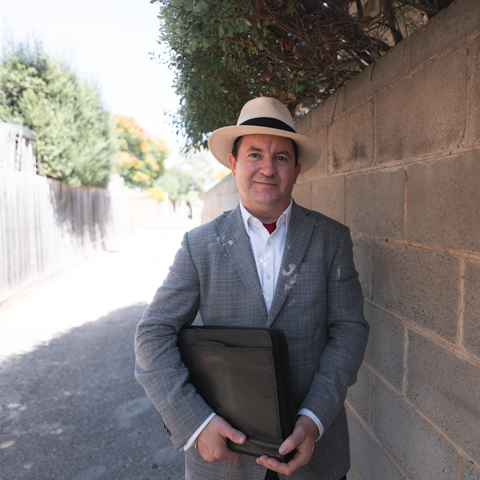
Zac Newbold – Founder & Managing Director – 30+ Years. Real Authority. Proven Results.
Zac Newbold is one of Melbourne’s most experienced Buyer’s Agents and a Fully Licensed Estate Agent since 2001.
With over 30 years inside the property market, Zac has seen exactly how buyers win – and exactly how they get overexposed, overbid, and overpay.
He’s worked across every layer of the industry – residential sales, boutique agencies, large franchise networks, property and asset management, corporate advisory, commercial real estate, and project management. That experience gives him a simple advantage: he knows how every player in the market thinks, moves, and negotiates.
At a certain point, he made a clear decision – stop working the system from all sides, and start working for one side only.
The buyer.
Because that’s where clarity matters. And that’s where deals are actually won.
Today, Zac represents buyers across Melbourne in residential and investment property, using a disciplined, strategy-led approach built on market intelligence, timing, and hard negotiation.
Through Your Australian Property Buyers Agents, Zac and his team give clients a real edge in the market – independent advice, structured strategy, and negotiation that’s designed to protect capital and win the deal.
His philosophy is simple: Treat every purchase like it’s your own money on the line – and never pay more than you have to.
Outside of property, Zac spends time with his wife and family and travels whenever the schedule allows.
If you’re serious about making your next property move, contact Zac Newbold and his team today to organise your confidential and complimentary Property Strategy Session.
Disclaimer
The information provided in this article is general in nature and is intended for educational and informational purposes only. It does not constitute financial, legal, or investment advice and should not be relied upon as such.
All property markets involve risk, and outcomes will vary based on individual circumstances. Readers should conduct their own due diligence and seek independent advice from qualified professionals before making any property or investment decisions.
While every effort has been made to ensure the accuracy of the information at the time of publication, Your Australian Property Buyers Agents makes no guarantees as to its completeness, reliability, or current relevance and accepts no responsibility for any loss or damage arising from reliance on this content.