

A Section 32 is not just a legal hurdle; it is a strategic map that reveals a property’s true value and the seller’s weaknesses. Most buyers treat this document as a tedious box-ticking exercise, but we view it as the ultimate shield against overpaying for a compromised asset. Mastery in understanding a section 32 statement victoria is the difference between securing a sound home and inheriting a legal nightmare of hidden easements or unauthorised building works. We understand the deep-seated fear that a missed detail in a zoning overlay or a restrictive covenant could derail your financial security.
You should enter every Melbourne property negotiation with total clarity and a sense of calm confidence. This guide will help you master the complexities of the Victorian Vendor’s Statement, identifying hidden risks while giving you a decisive competitive edge. We will break down the critical 2026 updates, including the $139 residential emergency services fund charge and the current land tax adjustment prohibitions for contracts under $10,700,000. You are about to move from a state of uncertainty to a position where you control the outcome of your purchase.
Key Takeaways
- Identify the mandatory disclosures required by the Sale of Land Act 1962 to ensure the vendor provides a complete and transparent history of the asset.
- Gain a strategic edge by understanding a section 32 statement victoria to uncover hidden easements or covenants that could restrict your future use of the land.
- Learn how to interpret complex zoning and heritage overlays that often serve as silent deal-breakers for extensions or rebuilds in Melbourne’s inner suburbs.
- Transform discovered red flags into negotiation leverage, using undisclosed defects or restrictive titles to drive down the final purchase price.
- Navigate the 2026 regulatory landscape with confidence, including new rules regarding land tax adjustments and updated property levies.
Table of Contents
What is a Section 32 Statement and Why Does it Dictate Your Success?
Essential Red Flags: What to Look for in a Victorian Vendor’s Statement
Turning Disclosures into Leverage: Strategic Due Diligence in 2026
What is a Section 32 Statement and Why Does it Dictate Your Success?
The Section 32, or Vendor’s Statement, is the most critical document in a Victorian property transaction. Mandated by the Sale of Land Act 1962, it requires a seller to disclose specific information to a buyer before a contract is signed. In the fast-moving 2026 Melbourne market, this document dictates whether you are buying a blue-chip asset or a financial liability. We don’t just read these statements; we deconstruct them to uncover the risks that selling agents often gloss over.
Transparency is the foundation of Vendor disclosure laws in Australia, yet many buyers treat the Section 32 as a mere formality. This is a dangerous mistake. In 2026, "standard" disclosures frequently mask complex problems like combustible cladding or restrictive heritage overlays that can halt a renovation before it starts. If a vendor provides an inaccurate or incomplete statement, you may have the legal right to rescind the contract before settlement. Our goal is to avoid that stress entirely by understanding a section 32 statement victoria before you commit to the purchase.
The Sale of Land Act 1962: Your Legal Shield
Section 32(1) of the Act is your primary protection. It legally obligates the vendor to disclose title details, land use, and financial outgoings like the 2026-27 emergency services fund charge of $139. We see this all the time: a vendor claims they "didn’t know" about a structural defect or an unauthorised pergola. Under Victorian law, ignorance is no excuse. If the information is required, it must be there. This legal framework ensures you aren’t walking into a deal blindfolded.
Why a ‘Standard’ Statement Doesn’t Exist
No two properties in Melbourne are identical. One might be hampered by a massive sewerage easement while another is governed by strict owners corporation rules in a high-rise complex. These unique encumbrances define the property’s true value. This is where experience matters. Professional due diligence involves looking past the certificates to see how these rules affect your lifestyle and future capital growth. By understanding a section 32 statement victoria, you gain the clarity needed to decide if a property truly fits your long-term goals.
Essential Red Flags: What to Look for in a Victorian Vendor’s Statement
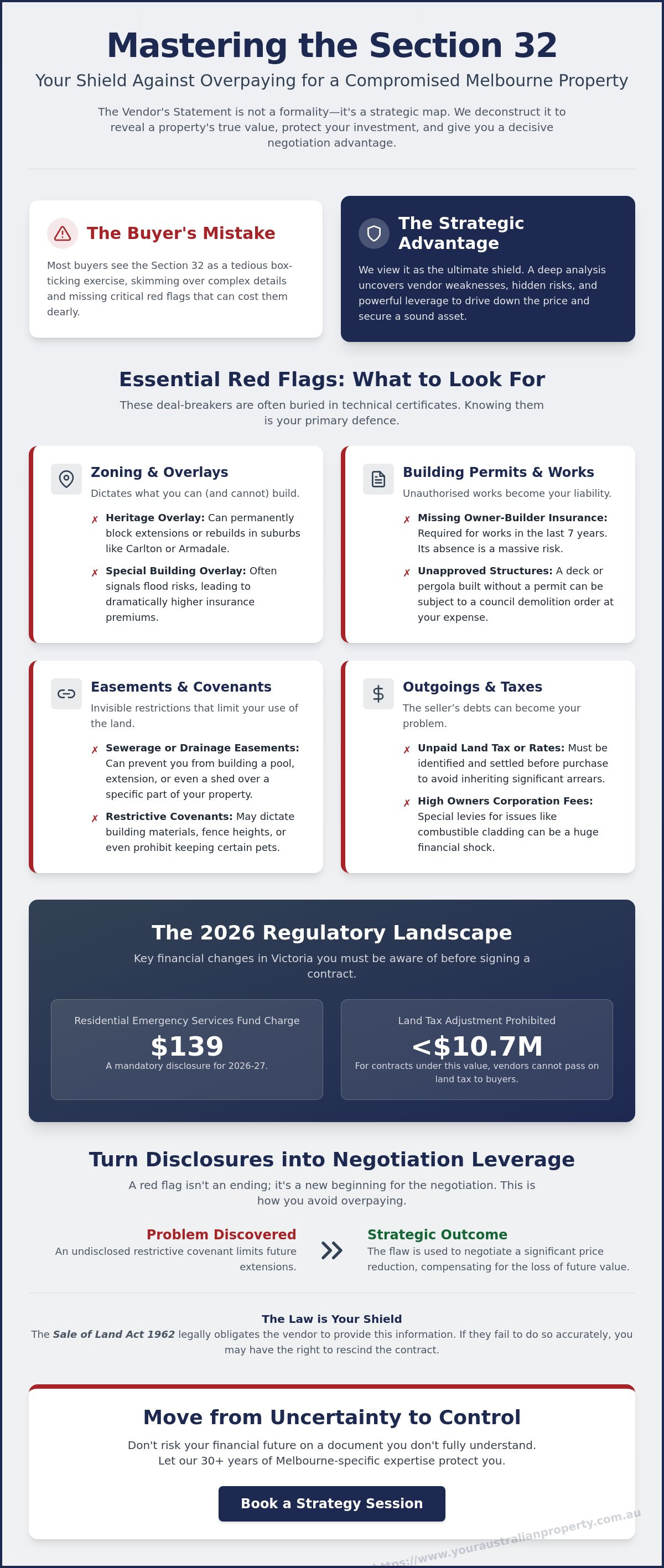
Most buyers focus on the kitchen or the view. We focus on the paper trail. A Section 32 statement can look clean while hiding property-killing restrictions. Understanding a section 32 statement victoria means knowing how to spot the deal-breakers before you attend the auction or sign the contract. These red flags are often buried in technical certificates that the average person skims over.
Zoning dictates your future. A "Heritage Overlay" in a suburb like Carlton or Armadale can permanently block your plans for a second story. Similarly, a "Special Building Overlay" often indicates flood risks, which can skyrocket your insurance premiums. Here’s where buyers get it wrong: they assume they can renovate because the neighbours did, only to find the rules have changed. We also scrutinise the outgoings. With land tax revenue in Victoria forecast to reach $6.5 billion in 2026-27, unpaid arrears can become a significant hurdle if not addressed at settlement.
Building permits are another critical area. If a vendor has performed owner-builder works within the last seven years, they must provide specific insurance and certificates of compliance. Unauthorised works are a massive liability. If the council orders a demolition of an unapproved deck, you inherit the bill and the headache. This is where experience matters in protecting your capital.
Decoding Easements and Covenants
The Plan of Subdivision is a map of your property’s limitations. An easement for a sewerage pipe across your backyard means you cannot build a permanent structure there. We see this all the time; buyers assume they can build a pool where an easement exists. They can’t. A restrictive covenant might even dictate your roof colour or building materials, stripping away your creative control. Always check for a "right of way" that might allow neighbours to traverse your land.
Owners Corporation (Body Corporate) Disclosures
When buying in a complex, the last two years of minutes are gold mines. This is where you find the truth about "combustible cladding" or looming legal battles over structural defects. If you are exploring Melbourne home buyers opportunities in high-rise buildings, reviewing these documents is non-negotiable to avoid massive special levies. Identifying these risks early requires a trained eye. To ensure your next purchase is secure, reach out to our team for a professional review.
Turning Disclosures into Leverage: Strategic Due Diligence in 2026
A red flag in a Section 32 isn’t always a reason to walk away. For a prepared buyer, it’s often a reason to lower the price. Most buyers see a restrictive covenant or a heritage overlay and immediately retreat, but we see an opportunity to negotiate a better deal. Understanding a section 32 statement victoria allows you to quantify the impact of these restrictions on the property’s market value and use that data as a powerful bargaining chip.
We control the process by looking beyond the standard certificates. While a conveyancer might tick the legal boxes, our due diligence goes thirty steps deeper. We cross-reference the Consumer Affairs Victoria’s due diligence checklist with local council archives and physical inspections. This is how you avoid overpaying for a property that looks perfect on paper but has underlying issues that limit its future potential. We act as your expert guide, shielding you from the high-pressure tactics of selling agents who want you to ignore the fine print.
Real-World Example: The Hidden Easement Trap
Here’s how this plays out in the real world:
Buyer: A young couple looking at a Northcote fixer-upper.
Problem: The Section 32 showed a clear title, but our deeper search found an unrecorded drainage easement.
Strategy: We used this discovery to prove the property could not be extended as advertised by the selling agent.
Outcome: Secured the property for $85,000 below the asking price.
Lesson: Never trust the marketing; trust the data we find.
Why Experience Matters in 2026
Success in the Melbourne market requires more than just reading a document. This is where experience matters. With over 30 years of local expertise, we spot "underquoting" patterns based on the complexity of the Section 32. We know which suburbs have specific infrastructure projects that might lead to future compulsory acquisitions or massive rate hikes. Our team identifies the risks that determine if a property becomes a successful investment or a costly mistake. Don’t leave your financial security to chance. Book a Strategy Session today to have your Section 32 professionally analysed by Melbourne’s leading independent buyer advocates.
Take Control of Your Melbourne Property Purchase
Mastery of the Vendor’s Statement is the ultimate differentiator between a successful acquisition and a costly mistake. By understanding a section 32 statement victoria, you move beyond the surface-level marketing to reveal a property’s true legal and financial DNA. You’ve seen how hidden easements can be turned into leverage and how complex zoning overlays can protect your future capital growth. This level of clarity is only possible when you have an expert guide who controls the process from start to finish.
We bring 30+ years of Melbourne property experience to your side of the table. Our team provides fiercely independent representation with no ties to selling agents; our loyalty is exclusively yours. We are specialists in identifying off-market opportunities and uncovering the hidden risks that determine your long-term financial security. This proactive approach ensures you never overpay for a compromised asset. It’s about replacing anxiety with a sense of calm confidence.
Ready to secure your next home with total precision and professional protection? Book a Strategy Session with Melbourne’s Expert Buyer Advocates today. Your property journey deserves the insight of an industry insider who is as invested in the outcome as you are.
Frequently Asked Questions
What is a Section 32 statement in Victoria?
A Section 32 statement is a mandatory legal disclosure document that a vendor must provide to a prospective buyer before a contract of sale is signed. Governed by the Sale of Land Act 1962, it contains essential information regarding the property’s title, zoning overlays, and financial outgoings like the $139 residential emergency services levy. Understanding a section 32 statement victoria is vital because it reveals the legal restrictions and encumbrances that define the property’s true value and future use.
Can I pull out of a property contract if the Section 32 is incorrect?
Yes, you may have the right to rescind the contract before settlement if the vendor provides false or incomplete information. Under the Sale of Land Act, failure to disclose a material fact, such as a major sewerage easement or an undisclosed owners corporation fee, can give a buyer the legal grounds to walk away. This is a complex legal area where precision matters. We see this all the time; missing details often provide the leverage needed to exit a compromised deal or renegotiate terms.
Who prepares the Section 32 statement?
The vendor’s legal practitioner or conveyancer is responsible for preparing the Section 32 statement. They compile certificates from various authorities, including council and water boards, to document the property’s status. While the legal professional drafts the document, the vendor remains ultimately responsible for its accuracy. This is why our due diligence goes thirty steps further. We verify the information provided against local Melbourne market data to ensure no hidden liabilities are being passed on to our clients.
Does a Section 32 show building defects?
No, a Section 32 statement typically does not disclose physical building defects like rising damp or structural cracks. It only lists building permits issued in the last seven years and relevant insurance for owner-builder works. To identify actual physical issues, you must commission a separate professional building and pest inspection. Understanding a section 32 statement victoria helps you identify the legal risks, while a physical inspection identifies the structural ones; both are non-negotiable for a secure purchase.

Article by
Zac Newbold – Founder & Managing Director – 30+ Years. Real Authority. Proven Results.
Zac Newbold is one of Melbourne’s most experienced Buyer’s Agents and a Fully Licensed Estate Agent since 2001.
With over 30 years inside the property market, Zac has seen exactly how buyers win – and exactly how they get overexposed, overbid, and overpay.
He’s worked across every layer of the industry – residential sales, boutique agencies, large franchise networks, property and asset management, corporate advisory, commercial real estate, and project management. That experience gives him a simple advantage: he knows how every player in the market thinks, moves, and negotiates.
At a certain point, he made a clear decision – stop working the system from all sides, and start working for one side only.
The buyer.
Because that’s where clarity matters. And that’s where deals are actually won.
Today, Zac represents buyers across Melbourne in residential and investment property, using a disciplined, strategy-led approach built on market intelligence, timing, and hard negotiation.
Through Your Australian Property Buyers Agents, Zac and his team give clients a real edge in the market – independent advice, structured strategy, and negotiation that’s designed to protect capital and win the deal.
His philosophy is simple: Treat every purchase like it’s your own money on the line – and never pay more than you have to.
Outside of property, Zac spends time with his wife and family and travels whenever the schedule allows.
If you’re serious about making your next property move, contact Zac Newbold and his team today to organise your confidential and complimentary Property Strategy Session.
Disclaimer
The information provided in this article is general in nature and is intended for educational and informational purposes only. It does not constitute financial, legal, or investment advice and should not be relied upon as such.
All property markets involve risk, and outcomes will vary based on individual circumstances. Readers should conduct their own due diligence and seek independent advice from qualified professionals before making any property or investment decisions.
While every effort has been made to ensure the accuracy of the information at the time of publication, Your Australian Property Buyers Agents makes no guarantees as to its completeness, reliability, or current relevance and accepts no responsibility for any loss or damage arising from reliance on this content.