

Table of Contents
- What a Buyers Agent Actually Does in Negotiations
- Real Estate Negotiation Tactics for Buyers That Actually Work
- What Not to Say to a Real Estate Agent (And Why It Costs You)
- How to Win at Property Auctions in Melbourne
- Avoiding Overpaying for Property: The Off-Market Advantage
- Negotiation Failure Scenarios: Where Buyers Get It Wrong
- Fee Structures vs. Negotiation ROI: Is It Worth It?
- How Buyers Agent Negotiations Work: Vetting the Right Advocate
Last Updated: August 5, 2026
So many buyers ask: can a buyers agent help with negotiations? The short answer is yes, and the difference between going it alone and having professional representation is often the difference between a great purchase and an expensive mistake. At Your Australian Property Buyers Agents, we’ve spent over 30 years watching buyers win and lose in Melbourne’s property market, and the negotiation phase is where most deals are made or broken.
What a Buyers Agent Actually Does in Negotiations
A buyer’s agent is a licensed property professional who represents the buyer exclusively in a real estate transaction. Their role goes well beyond submitting an offer, they control the process, the timing, the framing, and the outcome.
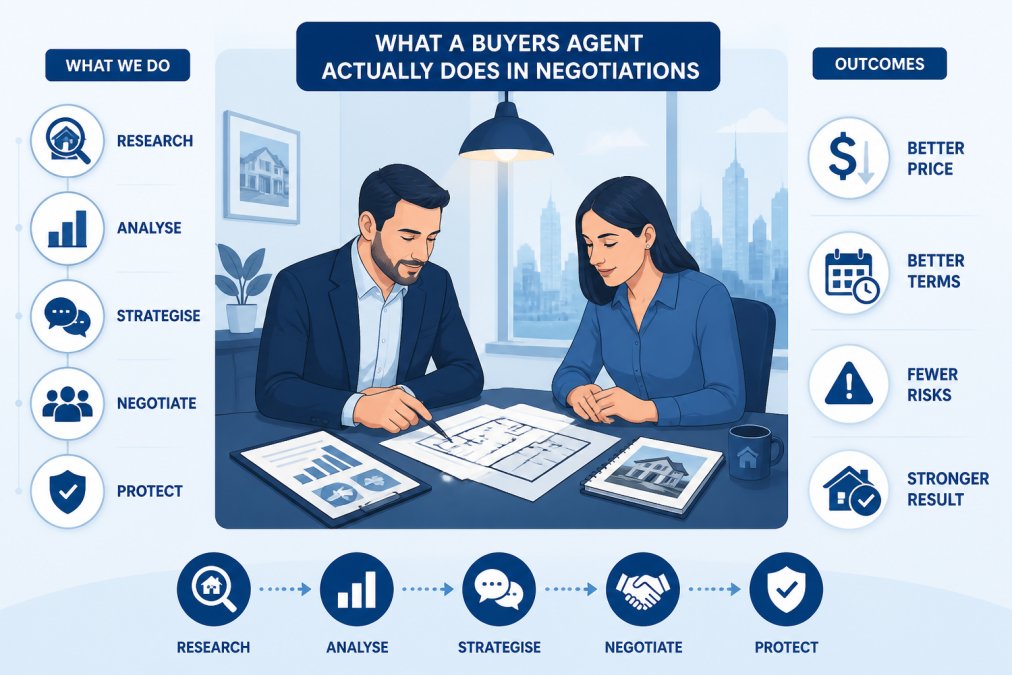
Most buyers think negotiation starts when they make an offer. It doesn’t. It starts the moment you first contact a sales agent. Every question you answer, every inspection you attend, every comment you make, the selling agent is gathering intelligence. They work for the vendor. Your job is to protect your interests. Without professional representation, you’re playing an away game with no coach.
Third-Party Representation Changes the Dynamic
When a buyer’s agent steps in, the entire dynamic shifts. Sales agents know they’re dealing with someone who understands market value, comparable sales, contract terms, and negotiation tactics. A buyer’s agent creates professional distance between you and the transaction. The selling agent can no longer read your emotional signals or use your enthusiasm against you. All communication goes through a professional with no emotional stake in the property.
Emotional Detachment as a Negotiation Tool
Here’s where buyers get it wrong, consistently: they fall in love with a property before they’ve secured it. When a vendor senses you’re attached, they know you’ll stretch. They’ll hold firm on price and manufacture competing interest to push you higher. A buyer’s agent removes that vulnerability. We’ve seen buyers save significant sums simply because the negotiation was conducted without the seller ever knowing how much the buyer wanted the property.
Never tell a selling agent this is your “dream home” or that you’ve “been looking for years.” That information costs you. A buyer’s agent handles all communication so your enthusiasm never becomes used against you.
Real Estate Negotiation Tactics for Buyers That Actually Work
Most buyers negotiate reactively. They wait for an asking price and make an offer close to the number they’ve been shown. That’s not negotiation, that’s acceptance with a small discount. Effective negotiation starts well before an offer is made.
Anchoring With Market Data and Comparable Sales
The most effective anchor in any negotiation is verifiable data. Before an offer goes in, a buyer’s agent analyses recent comparable sales in the area, properties of similar size, condition, land content, and location that have actually transacted. This is where market intelligence separates professional buyers from the rest.
According to Consumer Affairs Victoria’s guidance on property purchases, buyers are entitled to request a copy of the Section 32 Vendor Statement before making an offer. A buyer’s agent uses this document, combined with sales data, to identify risk factors that justify a lower offer or specific contract conditions. When you anchor your offer to market data, you’re not just making a number up, you’re presenting a position the selling agent has to argue against.
Conditional Offers, Settlement Terms and Contract Use
Price is only one lever. Settlement terms, deposit structures, and conditional offers are equally powerful negotiation tools, and most buyers never use them. A conditional offer tied to a building inspection or finance clause protects you during due diligence. But how those conditions are worded matters enormously.
Settlement terms are another underused tool. A vendor who needs a fast settlement or a longer one will often accept a lower price to get the terms they need. A buyer’s agent identifies what the vendor actually wants, not just what they’re asking for, and structures the offer accordingly. This is where experience matters.
| Negotiation Lever | What It Means | When to Use It |
|---|---|---|
| Comparable sales anchor | Offer grounded in real transaction data | Always, before any offer |
| Conditional offer | Subject to inspection, finance, or due diligence | When risk is unknown |
| Settlement flexibility | Shorter or longer settlement to suit vendor | When price flexibility is limited |
| Deposit structure | Varied deposit timing or amount | When vendor needs certainty |
| Unconditional offer | No conditions attached | Competitive situations with full due diligence done |
What Not to Say to a Real Estate Agent (And Why It Costs You)
Knowing what not to say to a real estate agent is just as important as knowing what to say. Sales agents are skilled at extracting information that weakens your position.
“We’ve been looking for a long time.” This signals desperation. “This is exactly what we’ve been looking for.” You’ve disclosed your walk-away point. “We can go higher if we need to.” You’ve revealed your ceiling. “What do you think we should offer?” The selling agent works for the vendor. “We need to move in by [date].” Deadline pressure is leverage.
A buyer’s agent handles all communication with the selling agent. None of these mistakes happen because we control what information is shared. We see this all the time, buyers who negotiate directly inadvertently reveal their position within the first conversation.
Asking a selling agent for negotiation advice is like asking the other team’s coach for your game plan. They are legally obligated to act in the vendor’s best interest.
How to Win at Property Auctions in Melbourne
Property auctions are a different negotiation environment entirely, and one where buyer psychology is most easily exploited. Winning at auction isn’t about bidding the most. It’s about bidding smart.

Bidding Strategy Before the Auction Starts
The auction is won or lost before the auctioneer opens their mouth. Here’s what needs to happen first:
- Establish your maximum bid, based on comparable sales and your financial position, not the vendor’s price guide
- Complete due diligence in advance, building inspection, legal review of the contract, title search
- Arrange unconditional finance, auctions are unconditional; you cannot bid subject to finance
- Understand the cooling-off period, in Victoria, there is no cooling-off period for properties purchased at auction, as confirmed by Consumer Affairs Victoria on buying at auction
- Attend prior auctions, study the auctioneer’s style and how competing bidders behave
- Decide on your bidding strategy, open strong, bid in confident increments, and know when to stop
A buyer’s agent manages all of this. Our Auction Bidding Service Melbourne handles the bidding on your behalf with authority and composure on auction day. Opening with a strong, confident bid signals intent and can discourage less committed buyers. Bidding in unconventional increments disrupts the auctioneer’s rhythm. Knowing when the property is on the market shapes how aggressively you bid.
Avoiding Overpaying for Property: The Off-Market Advantage
Avoiding overpaying for property starts with avoiding the most competitive situations entirely. That’s where off-market properties become a genuine strategic advantage. Off-market properties are homes sold without public advertising, no listing on major portals, no open-for-inspection queues, no auction day pressure.
Your Australian Property Buyers Agents has built relationships with over 500 real estate connections across Melbourne over 30+ years. Those relationships generate access to Off-Market Properties Melbourne before they hit the market, or properties that never will. Without competing buyers, you negotiate from a position of strength. The vendor wants a smooth, discreet transaction. You want the right property at the right price. Those interests align in a way that public campaigns rarely allow.
Off-market negotiation also allows for more creative deal structuring. Settlement terms, inclusions, and conditions can be discussed openly because there’s no competing offer forcing the vendor’s hand.
Off-market access isn’t just about finding properties others can’t see. It’s about negotiating without the pressure of a public campaign, which almost always produces better outcomes on price and terms.
Negotiation Failure Scenarios: Where Buyers Get It Wrong
Understanding where negotiations fail is as important as knowing what to do right. We see the same mistakes repeatedly.
Falling over on price without a fight. Many buyers accept the first counter-offer because they’re afraid of losing the property. A buyer’s agent holds the line when the data supports it. Ignoring contract terms. Buyers fixate on price and accept unfavourable settlement dates or poorly drafted conditions. Disclosing competing interest prematurely. If you mention you’re looking at another property, the selling agent may use it to rush you. Bidding emotionally at auction. Without a pre-set limit and a professional bidding on your behalf, buyers routinely exceed their budget. Skipping due diligence to move fast. In competitive markets, buyers skip building inspections to make an unconditional offer attractive. That’s a risk that can cost far more than any saving on price.
Real-World Example: The Hawthorn Buyer Who Almost Paid Too Much
A family relocating from Brisbane approached us after finding a property in Hawthorn they were serious about. The asking price was at the top of their budget and the selling agent was suggesting strong interest from other parties. We ran a comparable sales analysis on recent transactions within 500 metres. The property was priced above where the data supported. We made a conditional offer anchored to the comparable sales data. The vendor accepted a price meaningfully below the asking price, with a settlement date that suited both parties. The lesson: the “strong interest from other parties” was a pressure tactic. The data told a different story, and we used it.
Fee Structures vs. Negotiation ROI: Is It Worth It?
A buyer’s agent fee is not a cost, it’s a position in the negotiation. When professional representation routinely secures properties below asking price, achieves better contract terms, and prevents costly mistakes, the fee is offset by the outcome.
According to the Real Estate Buyers Agents Association of Australia, buyer’s agents are required to hold a current real estate licence and act exclusively in the buyer’s interest. That fiduciary duty, to you, not the vendor, is what makes the representation valuable. The alternative is negotiating alone against a professional selling agent who does this every day and has a financial incentive to achieve the highest price.
Your Australian Property Buyers Agents operates on a success-based fee structure, transparent and aligned with securing the right property at the right price. For specific fee information, contact us directly, we’re straightforward about how we charge and why. The buyers who question the fee most are often the ones who’ve already paid too much for a property without one.
How Buyers Agent Negotiations Work: Vetting the Right Advocate
Can a buyers agent help with negotiations? Yes, but only if you choose the right one. Here’s a practical checklist for vetting an agent’s negotiation capability:
- Do they hold a current Victorian Real Estate Licence?
- Do they work exclusively for buyers, no selling, no referral commissions from selling agents?
- Can they demonstrate access to comparable sales data and explain how they use it?
- Do they have documented experience negotiating in your target suburb or property type?
- Do they have a clear process for auction bidding, including pre-auction strategy?
- Can they explain how they handle off-market opportunities?
- Are their fees transparent and clearly explained upfront?
- Do they have verifiable testimonials or references from past clients?
Independence is non-negotiable. A buyer’s agent who also sells property or receives referral fees from selling agents has a conflict of interest that undermines the entire purpose of the representation.
Your Australian Property Buyers Agents holds Victorian Real Estate Licence Number 080186L and works exclusively for buyers. No selling. No conflicts. Just independent advice backed by 30+ years of Melbourne property experience. The question isn’t really whether a buyers agent can help with negotiations. The question is whether you can afford not to have one.
Frequently Asked Questions
What should you never say to a selling agent during a negotiation?
Never reveal your maximum budget, your emotional attachment to the property, or that you have no other options. Telling a sales agent ‘this is our dream home’ or ‘we’ve been looking for months’ hands them the upper hand immediately. The vendor’s agent works for the vendor, not for you. Every piece of information you share gets used to extract a higher price. A buyer’s advocate controls what is disclosed, protecting your position throughout the negotiation.
Is it worth hiring a buyer’s agent if I’ve already found a property?
Yes. Bringing in a buyer’s advocate after you’ve found a property is one of the most cost-effective decisions you can make. At that stage, the negotiation hasn’t started in earnest. An experienced advocate can assess market value using comparable sales, identify contract risks during due diligence, structure a competitive offer strategy, and negotiate price and settlement terms on your behalf. You don’t need to start the search from scratch to benefit from professional representation.
Can a buyer’s agent access off-market properties in Melbourne?
Yes, and this is one of the most significant advantages for Melbourne buyers. Off-market properties never appear on Domain or realestate.com.au. They’re transacted through agent networks and direct vendor relationships. With 500-plus real estate connections across Melbourne built over 30 years, we regularly access properties before they hit the open market. This reduces competition, removes the auction environment entirely, and often creates better conditions for negotiating price and terms without competitive bidding pressure.
How does a buyer’s agent remain objective during a high-stakes auction?
A buyer’s advocate enters every auction with a pre-agreed maximum bid based on property appraisal, comparable sales data, and your financial position. There is no emotional attachment to the outcome. Bidding strategy is set before the auction starts, including when to bid, how to respond to vendor bids, and when to walk away. This removes the in-the-moment pressure that causes buyers to overbid. We’ve seen buyers exceed their own limits by tens of thousands of dollars simply because they were emotionally invested on the day.
Melbourne’s property market rewards preparation and punishes emotion. If you’re about to make one of the largest financial decisions of your life, the negotiation phase deserves professional representation, not improvisation. Your Australian Property Buyers Agents controls the process, the negotiation, and the outcome, so you secure the right property at the right price. Book a free strategy session and find out what independent advocacy actually looks like in practice.
This article was written using GrandRanker