

Table of Contents
- What Does Buying Off the Plan Mean?
- The Real Advantages of Buying Off the Plan
- The Hidden Risks: What Buyers Miss
- Off the Plan Contract Risks You Need to Know
- Finance Approval for Off the Plan: What Changes
- How to Negotiate Off the Plan Property Deals
- Real-World Example: How One Buyer Avoided Overpaying
- Conclusion: Making the Right Call
Last Updated: August 28, 2026
What Does Buying Off the Plan Mean?
Buying off the plan means purchasing a property before it’s built or completed. You’re committing based on architectural plans, floor plans, 3D renderings, and a signed building contract, not a finished structure you can inspect. The developer owns the land and construction risk until practical completion, at which point you settle and take ownership.
This is fundamentally different from buying an established property. You’re buying a promise backed by a contract and a developer’s financial standing. Nearly one-third of new residential purchases in major Australian cities are off-the-plan developments, driven by rising property prices and limited housing supply (Off-the-Plan Property Australia market insights).
Here’s where it gets interesting: the contract locks in the purchase price, but construction timelines, design changes, financing conditions, and market value remain in flux. That’s where most buyers stumble.

The Real Advantages of Buying Off the Plan
You’re locking in today’s price in a rising market. If property values climb during construction, you capture that gain before settlement. That’s instant equity without doing anything.
Most developers require only 5%-10% deposit upfront, with the remaining balance due at settlement. This lower entry cost makes it accessible for first-home buyers. Your money stays in a trust account earning interest until completion, which provides financial protection.
Stamp duty concessions are substantial in Victoria. Off-the-plan purchasers can access stamp duty reductions of 70-90% for contracts signed by October 20, 2026. That’s meaningful cash savings at settlement.
New buildings come with modern design, energy-efficient systems, and zero maintenance surprises. Everything’s new, everything works, and the builder’s warranty covers defects for the first six years.
Investors benefit from significant tax advantages under the 2026 Federal Budget. New builds retain full negative gearing eligibility and the 50% Capital Gains Tax discount, regardless of purchase date. Established properties lose these benefits from July 1, 2027. For investors, that’s a material advantage.
The deposit structure matters more than most buyers realise. Negotiate whether your deposit sits in a trust account earning interest or in a bank guarantee. Some developers allow you to substitute a bank guarantee for cash deposit, which frees up capital while you wait for completion.
The Hidden Risks: What Buyers Miss
Here’s where experience matters. Construction delays have become the norm. Building approval rates don’t correlate with market performance (InvestorKit analysis of building risks), but delays absolutely correlate with cash flow pain. Construction time increased by 34% for houses and 17% for townhouses between 2020 and 2023. Your deposit sits idle for months or years longer than planned.
Developer insolvency is at historically high levels. Construction company insolvencies reached 2,832 in FY 2024-25 (Mozo report on building defects). If your developer collapses mid-construction, your deposit may be at risk depending on how it’s held and whether the project gets rescued or abandoned.
Building defects are endemic. NSW Government data shows 53% of apartment buildings registered between 2016 and 2022 had serious defects. Cracks in concrete, waterproofing failures, electrical issues, and structural problems aren’t cosmetic, they’re expensive to fix.
Market value can fall during construction. If the market softens, your bank may value the property lower than your purchase price at settlement. You’re still obligated to complete, but you’re borrowing against a lower valuation. That changes your loan-to-value ratio and may trigger additional lender mortgage insurance costs.
Finance approval isn’t guaranteed. Off-the-plan contracts are almost never conditional on finance. If interest rates rise, your serviceability changes. If your employment situation shifts, your bank may withdraw approval. You’re locked in, but your lender isn’t.
We see this all the time: a buyer signs an off-the-plan contract with a 3% interest rate assumption. Two years later, rates have moved to 5.5%. Their serviceability has deteriorated. One interest rate rise, one job change, one unexpected cost, and they’re in trouble.
Off-the-plan contracts are almost never conditional on finance approval. If you can’t secure a loan at settlement, you still must complete the purchase or forfeit your deposit. Get unconditional finance approval in writing before you sign the contract, not after.
Off the Plan Contract Risks You Need to Know
The contract is where the real game is played. Most buyers focus on the property and miss the contract entirely.
Sunset clauses set an expiry date for the developer’s obligation to complete. After that date, if the project isn’t finished, you can walk away and get your deposit back. Developers push for long sunset clauses (sometimes 5+ years). Negotiate shorter ones. A sunset clause of 2-3 years is reasonable.
Design changes are standard in the contract. The developer reserves the right to modify the design, materials, or specifications if they’re "substantially similar." That’s vague. You might sign up for marble countertops and get laminate instead. Nail down specifics in the contract. List fixtures, finishes, and materials explicitly.
Defects liability is usually capped at 6 years from practical completion. After that, you’re responsible for repairs. But the builder’s warranty is only as good as the builder’s solvency. Get a pre-settlement building inspection from a professional) to identify defects before you settle.
Cooling-off periods are shorter for off-the-plan than for established properties. You typically have 5 business days to withdraw without penalty. Use those 5 days aggressively to get a building inspector or lawyer to review the contract.
Deposit forfeiture is the nuclear option. If you breach the contract, fail to pay the deposit, miss a settlement date, or pull out after the cooling-off period, the developer can keep your deposit. Understand the payment schedule and settlement timeline before you commit.
Here’s where buyers get it wrong: they focus on the property, the location, the views, the finishes, and treat the contract as a formality. The contract is where you win or lose. We control the process by controlling the contract.
The contract terms matter more than the property features. A mediocre property with strong contract protections beats a beautiful property locked into a weak contract. Negotiate sunset clauses, design specifics, and defects liability before you sign.
Finance Approval for Off the Plan: What Changes
Banks lend against the valuation of the finished property, not the contract price. If you sign a contract for $600K and the bank values the completed property at $550K, you’ve got a valuation gap. You’re still obligated to complete at $600K, but the bank will only lend against $550K. You need to find the difference from your own funds.
Valuation gaps are common in oversupplied postcodes or when the market softens during construction. This is why location matters enormously in off-the-plan buying. Postcodes with strong underlying demand hold value better than those relying on new supply to drive growth.
Construction finance is different from standard home loans. During construction, the bank releases funds in stages as construction milestones are reached. This protects the bank but requires you to manage cash flow carefully if you’re an investor.
Interest rates are a moving target. If you sign a contract assuming a 4% rate and rates climb to 5.5% by settlement, your serviceability deteriorates. One rate rise after settlement, and you’re struggling. This is why getting unconditional finance approval early matters.
Lender mortgage insurance (LMI) kicks in if your loan-to-value ratio exceeds 80%. Off-the-plan valuations are often conservative, which pushes more buyers into LMI territory. Budget for this additional cost.
The Reserve Bank of Australia raised the cash rate to 4.35% in Q2 2026. Some economists predict potential rate movements later in 2026. If you’re on a tight serviceability margin, that risk is material.
Get unconditional finance approval in writing before you exchange contracts. Not pre-approval. Unconditional approval. This protects you if the valuation comes in lower than expected or if your circumstances change.
How to Negotiate Off the Plan Property Deals
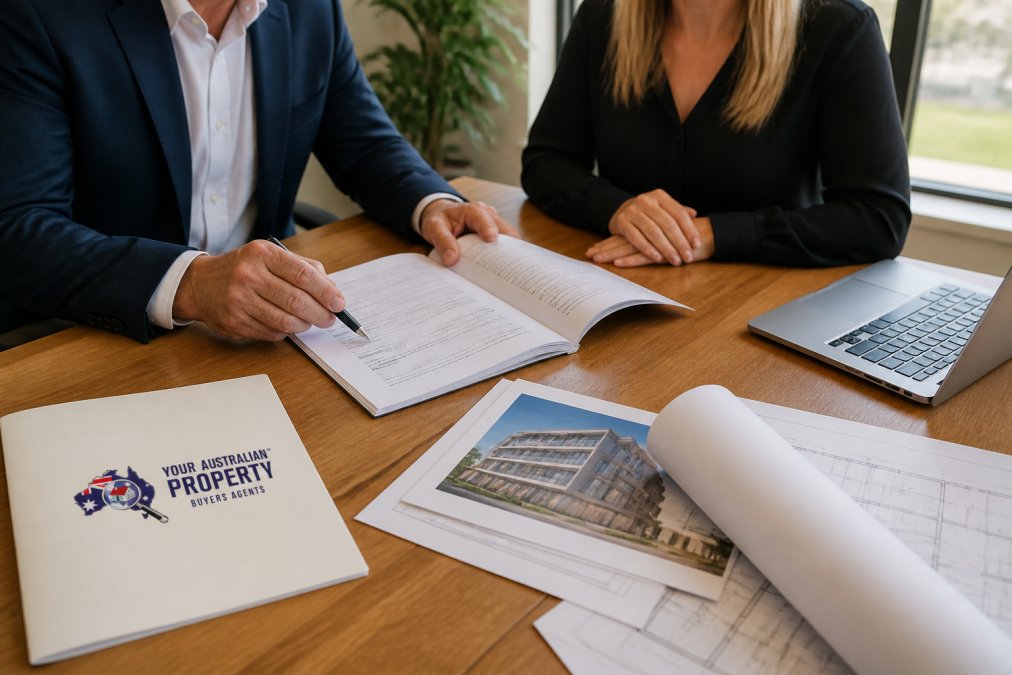
Most buyers don’t negotiate off-the-plan contracts. They assume the terms are fixed. They’re not.
Developers build negotiation room into their asking price and contract terms. They expect pushback on sunset clauses, design specifications, and payment schedules. If you don’t ask, you don’t get.
Price negotiation happens early. Before you exchange contracts, you have leverage. After you exchange, you have almost none. Developers are motivated to exchange contracts quickly. Use that window. In slower markets or if the developer has excess stock, there’s room to negotiate price or incentives.
Sunset clauses are your primary negotiation point. Push for 2-3 years maximum. Compromise at 3 years with a clause that extends if delays are caused by circumstances beyond the developer’s control. That’s reasonable and shows you understand their constraints.
Design and specifications need to be locked down. Get the developer to warrant specific finishes in writing. Don’t accept vague language like "or substantially similar." Specify marble, not stone. Specify stainless steel appliances, not equivalent.
Deposit terms are negotiable. Can you substitute a bank guarantee for cash? Can the interest earned on your deposit offset some of your holding costs? Can you negotiate a staged deposit schedule tied to construction milestones? These are worth asking.
Settlement terms matter. Can you negotiate a longer settlement period after practical completion to allow for inspections and repairs? Can you negotiate a retention amount (money held back until defects are rectified)? These protections cost the developer nothing and cost you everything if you don’t have them.
This is where experience matters. We’ve negotiated hundreds of off-the-plan contracts. We know what’s negotiable and which clauses matter. Most buyers are negotiating for the first time. That’s a disadvantage you don’t have to accept. A Property Negotiation Service Melbourne can guide you through these conversations and ensure you’re not leaving value on the table.
Real-World Example: How One Buyer Avoided Overpaying
A buyer from Sydney was relocating to Melbourne for work. She’d found an off-the-plan apartment in an inner-suburb development at $650K. Construction was scheduled for 2 years.
Her problem: she didn’t know Melbourne, didn’t understand the local market, and was worried about valuation risk.
Her strategy: she brought in a Buyer Agents Melbourne service to analyse the postcode, review the contract, and negotiate terms. The advocate identified that the developer was offering similar apartments at $630K in another tower. The market was softening. The sunset clause was 5 years, excessive.
The outcome: the advocate negotiated the price down to $625K, shortened the sunset clause to 2.5 years, and locked in specific finishes in writing. When the valuation came in lower, she was prepared with unconditional finance approval and market knowledge. She completed confidently.
The lesson: most buyers focus on the property and miss the contract. The real negotiation happens in the terms, not the price. One buyer’s advocate saved significant money and protected against downside risk.
Buying off the plan isn’t inherently good or bad. It’s a strategy that works brilliantly in some markets and some timing, and creates real risk in others. The difference between success and regret isn’t the property, it’s the process.
Most buyers see the property and make an emotional decision. We see the contract, the market cycle, the developer’s track record, and the finance structure. We control the process. We control the negotiation. We control the outcome.
If you’re considering an off-the-plan purchase in Melbourne, don’t navigate this alone. Your Australian Property Buyers Agents has 30+ years of experience negotiating these deals, identifying market risk, and protecting buyers from costly mistakes. We work exclusively for you, no conflicts, no developer relationships, just independent advice on whether this property, at this price, with these terms, makes sense for your situation.
Book a free strategy session to discuss your off-the-plan opportunity. We’ll review the contract, analyse the market, and show you exactly what you’re taking on.
=== FAQ ANSWERS (audit these too, same rules) ===
[1] Q: What are the main risks of buying off the plan in Australia?
A: The biggest risks are construction delays (which have increased by 34% for houses since 2020), valuation shortfalls if the market falls during building, and developer insolvency. With 2,832 construction insolvencies in FY 2024-25 and 53% of apartments registered in NSW between 2016 and 2022 having serious defects, you’re committing money to a property that doesn’t exist yet. Finance approval can also become difficult at settlement if interest rates rise or your circumstances change. We see buyers tie up deposits for years only to find their property worth less than the purchase price.
[2] Q: Can you negotiate the price on an off-the-plan contract?
A: Yes, but it’s different from negotiating established property. Developers embed marketing costs, sales commissions, and profit margins into the asking price. You can negotiate on inclusions (fixtures, fittings, parking), request upgrades, or ask for deposit terms to be stretched. Some developers offer incentives like stamp duty contributions or free upgrades. The key is understanding what’s built into that price and where there’s room to move. This is where experience matters.
[3] Q: What stamp duty concessions apply to off-the-plan purchases?
A: Victoria’s off-the-plan stamp duty concession can reduce duty by 70-90% for contracts signed by 20 October 2026. Other states and territories offer varying concessions. First-home buyers may access additional grants. The savings can be substantial. However, these concessions have expiry dates and eligibility criteria. You need to understand whether your purchase qualifies and plan your settlement timing accordingly. This is one of the genuine financial advantages of buying off the plan, but only if you’re eligible and the timing works.
[4] Q: What happens if property values drop before my off-the-plan settlement?
A: If the property value falls during construction, your bank may lend against a lower valuation, creating a ‘valuation gap’. You’ll need to cover the shortfall at settlement or renegotiate your finance. This is a real risk. Your deposit is at risk if you can’t secure finance at settlement. This is why pre-settlement inspections by a professional building inspector and understanding the sunset clause protections in your contract are critical.
Frequently Asked Questions
What are the main risks of buying off the plan in Australia?
The biggest risks are construction delays (which have increased by 34% for houses since 2020), valuation shortfalls if the market falls during building, and developer insolvency. With 2,832 construction insolvencies in FY 2024-25 and 53% of apartments registered in NSW between 2016 and 2022 having serious defects, you're committing money to a property that doesn't exist yet. Finance approval can also become difficult at settlement if interest rates rise or your circumstances change. We see buyers tie up deposits for years only to find their property worth less than the purchase price.
Can you negotiate the price on an off-the-plan contract?
Yes, but it's different from negotiating established property. Developers embed marketing costs, sales commissions, and profit margins into the asking price. You can negotiate on inclusions (fixtures, fittings, parking), request upgrades, or ask for deposit terms to be stretched. Some developers offer incentives like stamp duty contributions or free upgrades. The key is understanding what's built into that price and where there's room to move. This is where experience matters.
What stamp duty concessions apply to off-the-plan purchases?
Victoria's off-the-plan stamp duty concession can reduce duty by 70-90% for contracts signed by 20 October 2026. Other states and territories offer varying concessions. First-home buyers may access additional grants. The savings can be substantial. However, these concessions have expiry dates and eligibility criteria. You need to understand whether your purchase qualifies and plan your settlement timing accordingly. This is one of the genuine financial advantages of buying off the plan, but only if you're eligible and the timing works.
What happens if property values drop before my off-the-plan settlement?
If the property value falls during construction, your bank may lend against a lower valuation, creating a 'valuation gap'. You'll need to cover the shortfall at settlement or renegotiate your finance. This is a real risk. Your deposit is at risk if you can't secure finance at settlement. This is why pre-settlement inspections by a professional building inspector and understanding the sunset clause protections in your contract are critical.
This article was written using GrandRanker