

Chasing the recent growth spikes in Adelaide might seem like the smartest move for your portfolio in 2026, but you could be walking straight into a yield trap while ignoring a generational entry point in Melbourne. When weighing up Melbourne vs Adelaide property investment, we see this all the time; investors get distracted by short-term headlines and lose sight of the deep market liquidity that actually secures long-term wealth. It’s natural to feel uneasy when Adelaide’s median house price hits $975,000 while Melbourne’s sits at $958,361. You don’t want to overpay in a recovering market, but you also can’t afford to be stuck in a city where capital growth is prone to sudden stalls.
This strategic comparison cuts through the confusion of conflicting data to show you why market depth offers superior security over temporary yield spikes. You’ll gain a clear framework for choosing between these two cities, giving you the confidence that your 2026 purchase will outperform the national average. We’ll examine the hidden factors like infrastructure and off-market assets that determine whether a property becomes a successful asset. This is where experience matters. We’ll help you avoid costly mistakes and ensure you control the process, the negotiation, and the ultimate outcome of your investment.
Key Takeaways
- Identify the “yield trap” where Adelaide’s short-term rental returns often hide the risk of stalled capital growth in secondary locations.
- Discover why Melbourne’s market depth and land scarcity offer a secure “safe haven” for your capital in a fluctuating 2026 economy.
- Learn how to navigate the risks of interstate investing by focusing on property quality and long-term liquidity rather than just headline data.
- Gain a clear framework for your Melbourne vs Adelaide property investment to ensure you choose security over temporary market spikes.
- Understand how exclusive access to off-market assets and professional negotiation provides a 30-step advantage that most buyers miss.
Table of Contents
The 2026 Data Duel: Adelaide’s Yield vs. Melbourne’s Market Depth
The Risks of Interstate Investing: Where Buyers Get it Wrong
The 2026 Data Duel: Adelaide’s Yield vs. Melbourne’s Market Depth
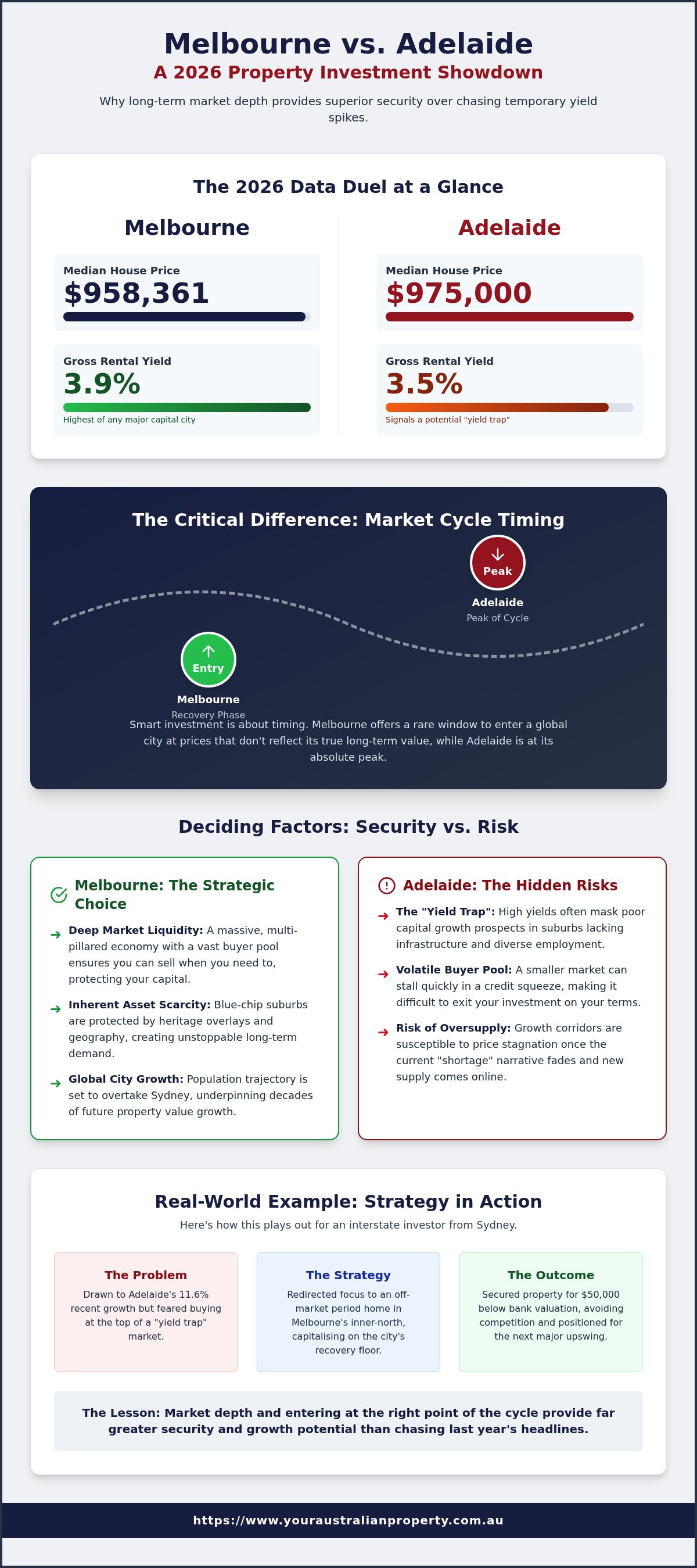
The Australian property landscape has shifted dramatically in 2026. For the first time in decades, Adelaide’s median house price of $975,000 has overtaken Melbourne’s $958,361. While headline-grabbing growth in South Australia has caught the eye of many, the smart money is looking closely at the fundamentals of Melbourne vs Adelaide property investment. We see this all the time; investors rush toward the city with the most recent "win" without realising they are buying at the absolute peak of a cycle. Melbourne is currently at the bottom of its recovery phase, offering a rare window to enter a global city at prices that don’t reflect its true long-term value.
The core difference between these two markets is depth. Melbourne is a massive, multi-pillared economy with a population trajectory set to overtake Sydney. Adelaide, while resilient, operates with a much smaller and more volatile buyer pool. This becomes critical during Australian property market cycles where liquidity is your greatest shield. In a credit squeeze, selling a premium asset in Melbourne is a matter of weeks. In Adelaide, that same exit strategy can stall for months as the pool of local buyers dries up. This is where experience matters. We focus on property investment Melbourne strategies that prioritise capital preservation over temporary hype.
Why High Yields Can Be a Value Trap
Adelaide’s gross rental yields of 3.5% for dwellings might look attractive on a spreadsheet, but they often signal a "value trap." High yields frequently correlate with suburbs that lack the infrastructure, diverse employment hubs, or gentrification potential required for sustained capital growth. Melbourne’s current yield of 3.9% is actually the highest of any major capital city in 2026, yet it’s backed by superior land value. Here’s where buyers get it wrong: they chase an extra $50 a week in rent and sacrifice hundreds of thousands in multi-generational wealth because they ignored the land-to-asset ratio.
The Scarcity Factor in Melbourne Blue-Chip Suburbs
Melbourne’s inner-north and bayside suburbs possess a level of scarcity that Adelaide simply cannot replicate. The supply levels in Adelaide’s growth corridors make them susceptible to price stagnation once the current "shortage" narrative fades. In contrast, blue-chip Melbourne assets are protected by strict heritage overlays and geographical constraints. This inherent scarcity ensures that even when the broader market fluctuates, your asset remains in high demand. We control the process by identifying these specific pockets before they reach the general public.
Here’s how this plays out in the real world:
Buyer: An interstate investor from Sydney looking for high-growth potential in 2026.
Problem: They were initially drawn to Adelaide’s recent 11.6% annual growth but feared they were buying at the top of a "yield trap" market.
Strategy: We redirected their focus to a quiet, off-market period-style home in Melbourne’s inner-north, capitalising on the city’s recovery floor.
Outcome: Secured the property for $50,000 below bank valuation through disciplined negotiation, avoiding a heated auction.
Lesson: Market depth and entering at the right point of the cycle provide far greater security than chasing last year’s headlines. While Adelaide’s growth began to plateau, this Melbourne asset is positioned for the next major upswing.
The Risks of Interstate Investing: Where Buyers Get it Wrong
Investing across state lines often feels like a shortcut to better returns, but it’s where many portfolios go to die. The biggest danger in the current Melbourne vs Adelaide property investment debate is the "Blind Buy" risk. Adelaide’s recent growth data looks impressive on a screen, but it often masks poor-quality stock in secondary locations that lack long-term appeal. Here’s where buyers get it wrong: they rely on high-level statistics without understanding the street-level reality. A high yield means nothing if the property is located in a pocket with no secondary demand or limited exit strategies.
Liquidity is the hidden engine of a successful investment. According to official property value data, Melbourne’s total residential value remains a cornerstone of the national economy, providing a safety net of transaction volume. In contrast, Adelaide’s market can become incredibly thin during a credit squeeze. If you need to sell a premium asset quickly, you need a deep pool of buyers. Melbourne offers that depth; Adelaide often doesn’t. This is where experience matters.
Melbourne presents its own hurdles, specifically the notorious issue of underquoting. Interstate investors frequently miss out on quality assets because they take the selling agent’s guide at face value. We bypass this competition through off-market properties, giving our clients access to unlisted assets before the public even knows they exist. We control the process to ensure you aren’t just another out-of-towner overpaying for a B-grade asset.
The Hidden Costs of Distance
Travel expenses and a lack of a local network create what we call the "Interstate Tax." You end up paying more because you don’t know which side of the street is more desirable or which infrastructure projects are actually funded. A Melbourne buyer’s agent levels the playing field by acting as your local eyes and ears. We see this all the time; distance leads to compromises that eventually eat your profit.
Market Volatility: Adelaide’s Historic "Boom and Bust" Cycles
When considering Melbourne vs Adelaide property investment, it’s vital to look at historic volatility. Adelaide has a history of sharp spikes followed by long periods of stagnation, whereas Melbourne maintains a steadier upward trajectory. Melbourne’s market depth is defined by its projected population of 6 million by 2030, creating a massive, permanent base of housing demand that Adelaide’s smaller economy cannot match. If you want to discuss how to secure your future in a more stable market, feel free to reach out to our team.
Here’s how this plays out in the real world:
Buyer: An expat investor living in Singapore.
Problem: They were about to purchase a "high-yield" house in an Adelaide suburb they had never visited.
Strategy: We performed due diligence and discovered the property was located in a high-density social housing pocket with zero historical capital growth. We pivoted their strategy to a Melbourne townhouse in a gentrifying inner-west suburb.
Outcome: Secured an off-market deal for $820,000 in a high-demand school zone.
Lesson: Headline yields are a distraction. Real wealth is built on land value and market depth, which requires local boots on the ground to verify.
The Winner: Why Melbourne is the Strategic Choice for 2026
Melbourne is the clear strategic winner for investors seeking security in 2026. While Adelaide has enjoyed a period of rapid price growth, Melbourne remains the ultimate "Safe Haven" for capital preservation. In a fluctuating global economy, you need an asset that offers more than just a temporary yield spike. Melbourne’s recovery phase provides a rare entry point into A-Grade suburbs at the bottom of the cycle. When evaluating Melbourne vs Adelaide property investment, the smart money prioritises the long-term land value that only a primary global city can provide.
We see this all the time; investors get distracted by short-term data and forget about market depth. Most buyers only see five steps in the purchasing process. We control the other thirty that happen behind the scenes. This "30-Step" Advantage is what separates a lucky purchase from a calculated wealth-building asset. It involves rigorous due diligence and leveraging deep industry relationships to secure property investment Melbourne opportunities that never reach the public portals.
Real-World Example: Securing a Melbourne Asset
Here’s how this plays out in the real world:
Buyer: An interstate investor looking for a blue-chip addition to their portfolio.
Problem: They were repeatedly priced out of public auctions and felt frustrated by Melbourne’s notorious underquoting.
Strategy: We initiated an exclusive off-market search in Fitzroy North, targeting period homes with high land-to-asset ratios.
Outcome: We secured a renovated terrace house for $50,000 under the bank valuation before it ever hit the open market.
Lesson: Access beats luck every time. By removing the property from the public arena, we eliminated the emotional bidding wars that lead to overpaying.
How to Control the Outcome in 2026
Success in a recovering market requires disciplined property negotiation. This is where experience matters. Zac Newbold’s 30-year perspective on Melbourne cycles allows us to see through the noise of daily headlines. We act as your protective expert guide, ensuring your 2026 purchase is positioned for maximum capital growth. We control the process, the negotiation, and the outcome to give you total peace of mind. If you’re ready to identify Melbourne’s 2026 growth pockets and avoid the "yield traps" of smaller markets, book a strategy session with our team today.
Secure Your 2026 Property Future
Adelaide’s recent price spikes have dominated the headlines, but the fundamentals of 2026 point toward Melbourne as the superior engine for long-term wealth. You now understand that chasing short-term yields often means sacrificing the security of market depth and liquidity. Choosing between Melbourne vs Adelaide property investment requires looking beyond the surface data to see where the smart money is actually landing. It’s about entering the market at the right phase of the cycle and securing A-Grade assets protected by scarcity.
We provide the shield you need against underquoting and market volatility. With over 30 years of industry experience, we ensure you gain exclusive access to silent listings and off-market properties that the general public never sees. Our independent advocacy means your interests are always the absolute priority. We control the process to ensure you don’t overpay for your future.
Take the next step with confidence. Your path to a high-performing Melbourne portfolio starts with a clear strategy and a protective expert guide by your side.
Frequently Asked Questions
What does a buyer’s agent do in Melbourne to beat interstate competition?
A buyer’s agent in Melbourne secures a competitive edge by providing exclusive access to silent listings and off-market properties that never reach public portals. We handle the thirty steps that happen behind the scenes, from rigorous due diligence to disciplined negotiation, ensuring you aren’t misled by the city’s notorious underquoting. This local representation is vital for interstate investors who cannot physically inspect every street-level nuance or attend every auction.
Is Adelaide property still a good investment in 2026 compared to Melbourne?
Adelaide property can offer short-term rental returns, but it often lacks the long-term capital security found in Melbourne’s deeper market. When weighing up Melbourne vs Adelaide property investment in 2026, the primary risk in South Australia is the "yield trap" where high returns mask poor capital growth potential. Melbourne’s recovery phase offers a more secure entry point for those prioritising land value and capital preservation over temporary spikes.
How do I know I am not overpaying for a Melbourne investment property?
We ensure you don’t overpay by conducting rigorous property due diligence and using 30 years of local transaction data to verify true market value. This independent analysis ignores the selling agent’s marketing spin and focuses on the land-to-asset ratio. By targeting off-market assets, we also remove the emotional pressure of public bidding wars, which is how you avoid overpaying in a recovering market.
Can’t the selling agent help me buy a property in Adelaide or Melbourne?
The selling agent cannot help you because their loyalty belongs entirely to the vendor who pays their commission. Their legal obligation is to achieve the highest possible price for the seller, making them your direct opposition in any negotiation. To protect your financial interests, you need an independent advocate who works exclusively for you. We control the process and the negotiation to ensure your outcomes are the only priority.

Article by
Zac Newbold – Founder & Managing Director – 30+ Years. Real Authority. Proven Results.
Zac Newbold is one of Melbourne’s most experienced Buyer’s Agents and a Fully Licensed Estate Agent since 2001.
With over 30 years inside the property market, Zac has seen exactly how buyers win – and exactly how they get overexposed, overbid, and overpay.
He’s worked across every layer of the industry – residential sales, boutique agencies, large franchise networks, property and asset management, corporate advisory, commercial real estate, and project management. That experience gives him a simple advantage: he knows how every player in the market thinks, moves, and negotiates.
At a certain point, he made a clear decision – stop working the system from all sides, and start working for one side only.
The buyer.
Because that’s where clarity matters. And that’s where deals are actually won.
Today, Zac represents buyers across Melbourne in residential and investment property, using a disciplined, strategy-led approach built on market intelligence, timing, and hard negotiation.
Through Your Australian Property Buyers Agents, Zac and his team give clients a real edge in the market – independent advice, structured strategy, and negotiation that’s designed to protect capital and win the deal.
His philosophy is simple: Treat every purchase like it’s your own money on the line – and never pay more than you have to.
Outside of property, Zac spends time with his wife and family and travels whenever the schedule allows.
If you’re serious about making your next property move, contact Zac Newbold and his team today to organise your confidential and complimentary Property Strategy Session.
Disclaimer
The information provided in this article is general in nature and is intended for educational and informational purposes only. It does not constitute financial, legal, or investment advice and should not be relied upon as such.
All property markets involve risk, and outcomes will vary based on individual circumstances. Readers should conduct their own due diligence and seek independent advice from qualified professionals before making any property or investment decisions.
While every effort has been made to ensure the accuracy of the information at the time of publication, Your Australian Property Buyers Agents makes no guarantees as to its completeness, reliability, or current relevance and accepts no responsibility for any loss or damage arising from reliance on this content.