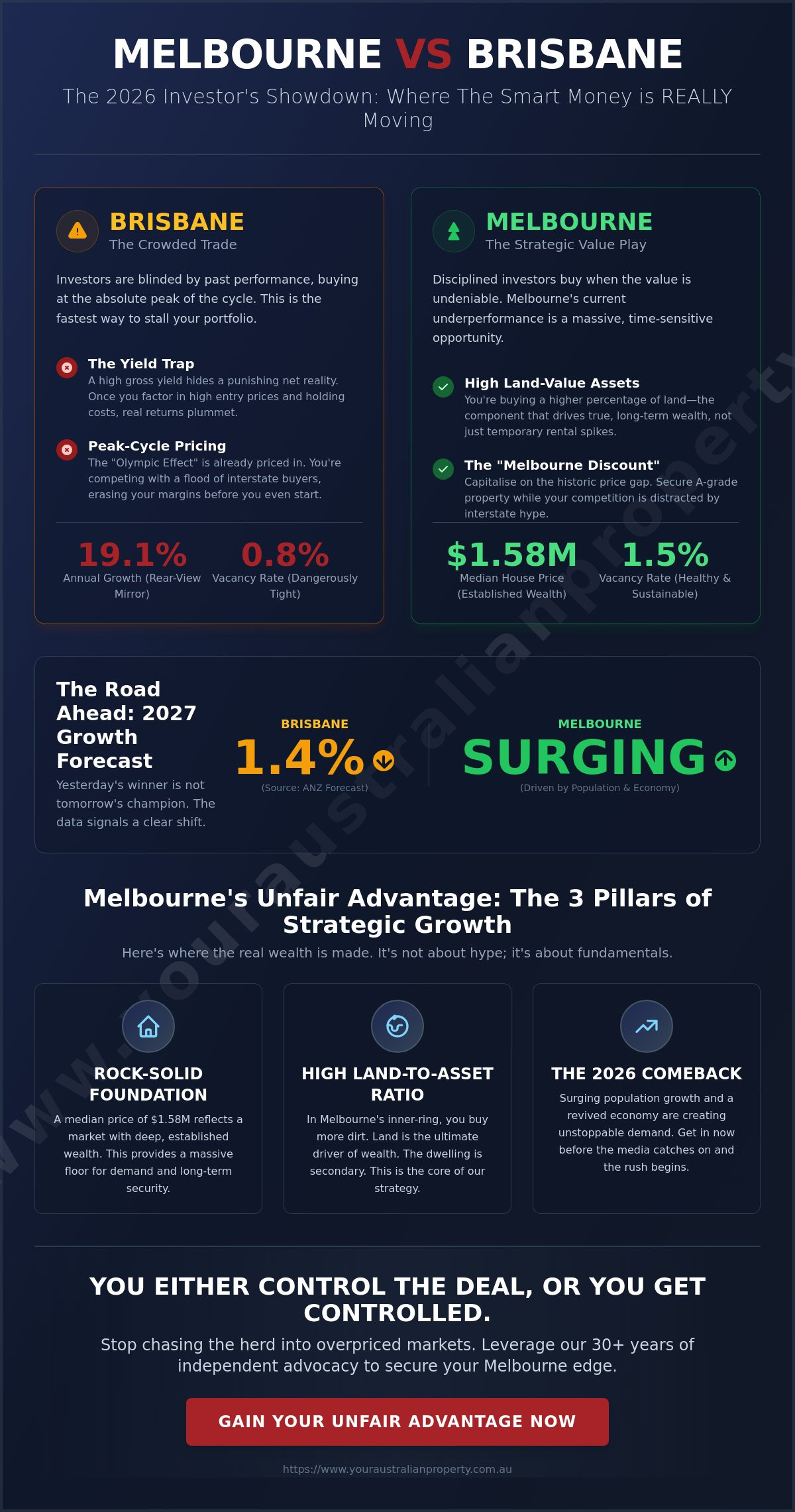
Buying into Brisbane right now might be the most expensive mistake you make this decade. We see this all the time; investors are blinded by Brisbane’s recent 19.1% annual growth while ignoring that the market is hitting a cycle peak. You are likely feeling the interstate FOMO, worried you have missed the boat in Queensland while being simultaneously spooked by Melbourne’s land tax headlines. It is a classic trap where buyers overpay for low-quality assets just to "get in" to a hot market, often at the exact moment the smart money is looking elsewhere.
This article cuts through the noise to show you why Melbourne vs Brisbane property investment returns are shifting in favour of the Victorian capital as a strategic value play for 2026. We agree that the headlines look grim, but for the disciplined investor, Melbourne’s current underperformance is a massive opportunity to secure high-performance assets at a discount. You will learn how to navigate the real impact of the COVID Debt Levy and why Melbourne’s median house price of $1,579,396 offers more long-term security than the yield traps currently plaguing Brisbane. We are going to break down the data, expose the risks of the "crowded trade," and provide a clear strategy to ensure you don’t make a $1,000,000 mistake.
Key Takeaways
Stop chasing the herd into overpriced markets; learn why buying during the hype phase is the fastest way to stall your portfolio growth.
Breakdown the data behind Melbourne vs Brisbane property investment returns to see why a 4% gross yield often hides a much lower net reality.
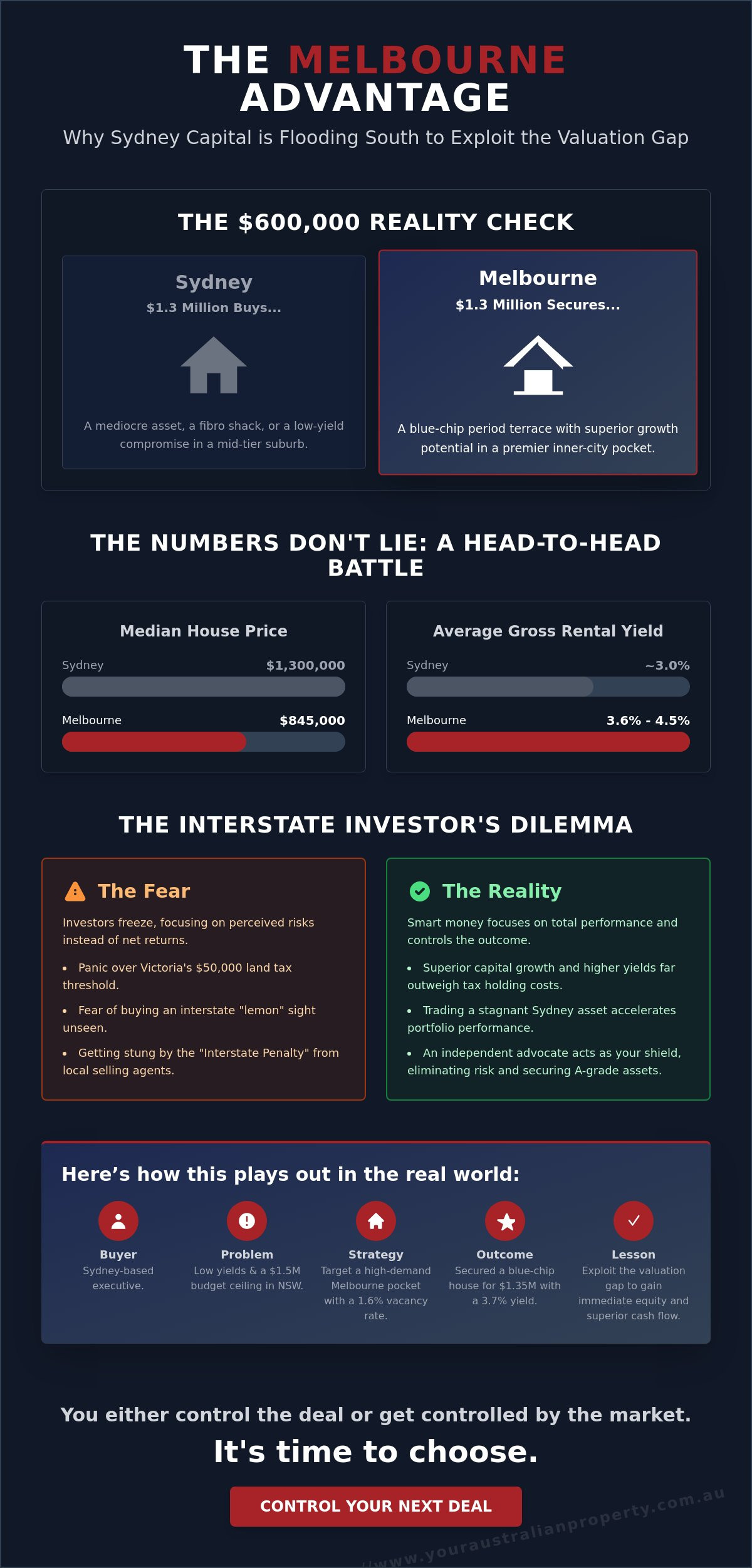
Capitalise on the historic price gap between Sydney and Melbourne before the window for this 2026 strategic value play closes.
Identify high-performance assets that offer long-term security instead of falling for the yield traps currently plaguing the Brisbane market.
Gain total control over your next acquisition by leveraging 30 years of independent advocacy and exclusive off-market access.
##The Great Debate: Brisbane Hype vs Melbourne Resilience in 2026
Investors are hitting a wall in 2026. We see this all the time; people are looking in the rearview mirror instead of at the road ahead. If you are comparing Melbourne vs Brisbane property investment returns, you need to understand that the crowd is usually wrong. A standard Australian property market overview shows that markets move in waves. You either control the deal or get controlled by the hype. Rookies buy when it feels safe, but the professional investor buys when the value is undeniable.
Why Brisbane Is Currently a Crowded Trade
The "Olympic Effect" has become the new fool’s gold for interstate buyers. Most of the potential upside in Brisbane’s blue-chip ring is already baked into the current prices. Supply is incredibly tight, but when every buyer from Sydney and Melbourne is fighting for the same three-bedroom house in a "hot" suburb, your margins vanish. This is the definition of an overheated market. Here’s where buyers get it wrong: they assume a hot market today guarantees growth tomorrow, ignoring that they are buying at the very top of a cycle.
The Case for Melbourne’s 2026 Comeback
Melbourne is the resilient play that the smart money is quietly moving back toward. While others are distracted by the sunshine, the fundamentals in Victoria are hitting a 2026 peak. Population growth is surging and the education economy is back at full strength, creating a massive floor for demand. The "Melbourne discount" is a rare gift for savvy investors. You can secure high-quality, high-land-value assets while your competition is looking elsewhere. We focus on getting you the right property at the right price before the media headlines catch up and the rush begins.
##Comparing Returns: Yields, Growth, and the 2026 Data Reality
Numbers don’t lie, but they certainly mislead. We see this all the time; investors fixate on Brisbane’s 19.1% annual growth and assume the trajectory is permanent. It isn’t. When evaluating Melbourne vs Brisbane property investment returns, you have to look at the net reality. Brisbane’s tight 0.8% vacancy rate is impressive, but the yield trap is real. High entry prices for secondary assets in Brisbane often result in net returns as low as 2% once you account for holding costs and the lack of long-term capital growth potential in those specific pockets. You either control the deal by buying quality or get controlled by chasing temporary spikes.
Melbourne’s vacancy rate sits at 1.5%, which remains significantly below the 3% threshold for a balanced market. Here’s where buyers get it wrong: they ignore the land value ratio. In Melbourne’s inner-ring, you are buying a higher percentage of land value compared to the dwelling itself. This is the dirt that drives actual wealth over decades. Official data in the ABS Total Value of Dwellings report highlights that while mean prices can be volatile, the sheer volume of wealth tied to established capital city assets is staggering. Melbourne’s median house price of $1,579,396 reflects a market that has consolidated, offering a far more attractive entry point than a Brisbane market that has surged 80.6% in five years.
Rental Yields: Is Brisbane Still the King?
Brisbane currently holds the title for gross yields, but the 2026 rental squeeze in Melbourne’s middle-ring is closing the gap. Land tax changes in Victoria have spooked the amateurs, but for the professional, it’s just another line item in a superior growth strategy. A high yield in a secondary Brisbane location won’t save you if the capital growth stalls. ANZ forecasts suggest exactly that, with Brisbane’s growth predicted to drop to 1.4% by 2027. If you want to avoid these traps, it pays to partner with an independent buyers agent who understands the ground reality.
Capital Growth Forecasts for 2026 and Beyond
Melbourne is the legacy play. While Brisbane has the Cross River Rail, Melbourne’s Metro Tunnel and massive infrastructure pipeline are geared toward a population that will soon make it Australia’s largest city. Migration patterns are already pivoting. The massive influx into South East Queensland is meeting its limit as infrastructure struggles to keep up and affordability vanishes. Melbourne’s education economy and diverse job market are drawing back the high-income earners who drive the top end of the market. Melbourne’s 2027 price growth is forecast at 2.9%, doubling Brisbane’s pace. Real wealth is built where the long-term fundamentals are strongest, not where the headlines are loudest.
##Why Melbourne is the Strategic ‘Value Play’ of 2026
The price gap between Sydney and Melbourne hasn’t been this wide in decades. History tells us this window never stays open for long. While the media is obsessed with Queensland’s sun and games, sophisticated investors are quietly pivoting back to the Victorian capital. Here’s where buyers get it wrong: they wait for the headlines to turn positive before they start looking. By the time the evening news tells you Melbourne is booming, the value has already been sucked out of the market. You either anticipate the cycle or you pay a premium to join the tail end of it.
Analysing the Melbourne vs Brisbane property investment returns requires a look at the broader macroeconomic picture. The RBA’s economic Chart Pack shows that while credit conditions remain tight, household wealth in established markets is resilient. We are seeing a massive "Value Gap" where Melbourne’s blue-chip assets are priced lower than historical norms relative to Sydney. Tactical acquisition in 2026 isn’t about following the herd; it’s about identifying "A-grade" assets in Melbourne’s bayside and northern corridors that are currently flying under the radar due to short-term sentiment.
Beating the 2026 rush requires a level of access the general public simply doesn’t have. We use off-market properties to bypass the noise and underquoting tactics that plague the public listing portals. This allows our clients to secure high-performance assets without the emotional heat of a crowded bidding war. Control the deal, or the deal will control you.
The Sydney-Melbourne Price Convergence
Melbourne eventually tracks Sydney’s growth; it is a fundamental law of the Australian property landscape. In 2026, we are at the starting gun of this convergence. Smart money is moving because they recognise that Melbourne’s current "discount" is an anomaly driven by temporary tax changes and sentiment, not a lack of demand. Securing a property in an undervalued Melbourne pocket today means you are positioned for the inevitable upswing that occurs when the price disparity becomes too great for buyers to ignore.
Exposing the Brisbane Yield Trap
Entry costs in Brisbane have spiked so aggressively that the "affordability" argument is dead. In 2026, buying into the Brisbane fringe means you are likely overpaying for a secondary asset with limited growth potential. Maintenance and insurance costs in Queensland are the hidden killers of your net return. We see this all the time; an investor chases a 5% yield in a stagnant Brisbane suburb only to find their cash flow wiped out by rising premiums and repairs. A 3% yield in a high-growth Melbourne inner-ring suburb is a far superior play when you factor in the 30-year track record of capital appreciation. If you want to build real wealth, you need to look past the gross yield and focus on the net result. For expert guidance on navigating these nuances, contact an independent buyers agent who prioritises your bottom line over a quick commission.
##Real-Life Scenario: Yield Chasing vs. Strategic Growth
We see this all the time. Investors get blinded by a high gross yield on a spreadsheet and ignore the depreciating building sitting on the land. When analysing Melbourne vs Brisbane property investment returns, the "yield trap" usually involves a new-build apartment or a house in a secondary location with infinite land supply. You either control your capital by selecting scarcity or you get controlled by the market’s inevitable correction. Real wealth isn’t built on a 5% rental return that gets eaten by Brisbane’s rising insurance premiums; it’s built on the dirt.
Here’s how this plays out in the real world:
Buyer: Strategic Investor Sarah had $900,000 to deploy in early 2025.
Problem: She was torn between a shiny new-build on the Brisbane fringe promising a 5% yield and an established period cottage in Melbourne’s inner-west.
Strategy: We advised her to ignore the temporary tax benefits of the new-build and pivot to the high-land-value Melbourne asset. We identified an off-market opportunity with a land-to-asset ratio above 70%.
Outcome: While her initial yield was 1.5% lower than the Brisbane option, the Melbourne property outperformed in capital growth, netting her $120,000 more in equity within just 18 months.
Lesson: In property, you pay for the land and the location, not the hype. In the battle of Melbourne vs Brisbane property investment returns, the asset with the higher land-to-value ratio wins the long game every time.
Strategic growth requires a disciplined approach. You cannot rely on generic data subscriptions or interstate "experts" who have never walked the streets of Melbourne’s inner suburbs. You need a framework that prioritises long-term wealth over short-term rental ticks.
The 5-Step Selection Framework for 2026
Step 1: Define your 10-year goal. Are you building a legacy of wealth or just chasing a few hundred dollars in monthly income? Wealth requires capital growth.
Step 2: Assess the land-to-asset ratio. If the building represents more than 50% of the purchase price, you are buying a depreciating asset. We target properties where the land does the heavy lifting.
Step 3: Verify the ‘silent’ demand. Who else wants this property? We look for assets that appeal to owner-occupiers, not just other investors. This protects your exit strategy.
Step 4: Execute with a professional auction bidding service. Don’t let emotion or agent tactics blow your budget. You need someone to control the room and secure the deal at the right price.
Step 5: Secure the acquisition through independent negotiation strength. Ensure your interests are the only priority at the table.
If you are still chasing the 2025 hype, you are already behind. Success in 2026 belongs to those who recognise the value gap in Melbourne’s established suburbs and act before the next wave of FOMO hits. Don’t leave your portfolio to chance when you can secure your Melbourne edge with an expert consultation today.
##Secure Your Melbourne Edge with Independent Advocacy
Data is a commodity in 2026. Anyone can download a spreadsheet of historical Melbourne vs Brisbane property investment returns. But spreadsheets don’t win negotiations and data doesn’t reveal structural risks or subtle zoning shifts. We see this all the time; investors mistake a generic report for actual market insight. Real success in the Melbourne market requires 30 years of ground truth. You either control the deal with local expertise or you get controlled by a selling agent who is trained to extract every cent of your equity.
Your Australian Property Buyers Agents operates with total independence. We have zero loyalty to the seller and a fierce commitment to the buyer. This is the only way to secure a high-performance asset without the interference of conflicting interests. While the general public is fighting over scraps on public listing websites, our clients are accessing a private tier of opportunities. The best Melbourne deals never hit the open market; they are traded in the off-market space where we hold the keys. Controlling the negotiation in a rising 2026 market means knowing exactly when to push and when to walk away.
The Power of an Independent Buyer’s Agent
Here’s where buyers get it wrong: they treat the selling agent as a source of information. You must remember that the selling agent is a professional representative of the vendor. Their job is to create manufactured urgency through underquoting and tactical pressure. We act as your shield against these tactics. Our investment property advisory service doesn’t just find you a house; it creates a tailored roadmap for your entire portfolio. We analyse the land-to-asset ratio and the "silent" demand that generic data simply cannot capture. This level of nuance is what separates a $1,000,000 mistake from a high-performance acquisition.
Your Next Move in the 2026 Market
The window for Melbourne’s strategic value play is moving. Don’t be the investor who sits on the sidelines only to say "I should have bought in Melbourne back in 2026" when the next cycle peaks. Success belongs to those who recognise the disparity in Melbourne vs Brisbane property investment returns and act with precision. We invite you to book a strategy session to see the properties the public isn’t being shown. You will gain access to our proprietary network of unlisted assets and our 30-year track record of negotiation strength. Secure your Melbourne investment advantage today and take total control of your financial future.
##Secure Your Strategic Advantage in Melbourne
Chasing the Brisbane hype is a rookie error that leaves your portfolio vulnerable to the next cycle correction. We see this all the time; investors follow the crowd into overheated markets only to realise they’ve paid a premium for a secondary asset. When you evaluate Melbourne vs Brisbane property investment returns, the strategic choice for 2026 is clear. Melbourne’s historic value gap relative to Sydney represents a rare window to acquire A-grade assets before the next growth phase begins. You either anticipate the market move or you pay for the privilege of joining it late.
Winning in Melbourne requires more than just a generic data subscription. It demands 30+ years of market dominance, 100% independent advocacy, and exclusive access to off-market assets. We provide the protective shield you need to avoid the sales agent trap and secure the right property at the right price. Stop letting the market control your outcomes and start dictating your own terms with an expert guide by your side. We ensure you don’t make a $1,000,000 mistake by following the herd.
Which city has better capital growth history, Melbourne or Brisbane?
Melbourne holds the superior 30-year track record for consistent capital growth. While Brisbane experienced a significant 80.6% surge over the last five years, Melbourne’s market resilience is built on decades of outperforming the national average. You either buy for a temporary spike or you buy for a legacy of wealth. Melbourne’s current median house price of $1,579,396 reflects a consolidated market positioned for the next major cycle.
Is Brisbane still affordable for property investors in 2026?
Brisbane’s reputation for affordability is largely a myth in 2026. With the median dwelling price hitting $1,126,149, the entry point for blue-chip assets has moved beyond the reach of many retail investors. This forces buyers into secondary locations with high supply and low growth potential. Here’s where buyers get it wrong: they overpay for "Olympic hype" while ignoring the eroding margins caused by rising insurance and maintenance costs.
How do Melbourne’s land tax changes affect my investment returns?
Land tax is a manageable holding cost that shouldn’t distract you from equity creation. The COVID Debt Levy is legislated until June 2033; however, A-grade Melbourne assets often appreciate by more in a single month than the annual tax bill costs. We focus on high-performance properties where the capital gains far outweigh these regulatory line items. Professional investors treat tax as a line item, not a reason to miss a growth cycle.
What is the average rental yield for a Melbourne house vs a Brisbane house in 2026?
Brisbane offers higher gross yields, but Melbourne’s 1.5% vacancy rate is driving superior rental growth in middle-ring suburbs. When comparing Melbourne vs Brisbane property investment returns, you must focus on the net figure. Brisbane’s 4% gross yield can quickly drop to 2% after accounting for higher insurance premiums and management fees. Melbourne’s tighter market ensures consistent cash flow without the same hidden cost traps found in Queensland.
Should I buy a house or an apartment for the best returns in Melbourne?
Houses with a high land-to-asset ratio always outperform for long-term capital growth. Apartments can provide higher initial yield, but they lack the scarcity that drives actual wealth. We prioritise properties where the land represents at least 70% of the purchase price. This "dirt" is what appreciates over time, whereas the building itself is a depreciating asset. You either buy scarcity or you buy a lifestyle product that won’t move the needle.
Can a buyer’s agent help me find properties in both Melbourne and Brisbane?
We are strictly Melbourne specialists because you cannot be an expert in every market simultaneously. We acquire property exclusively within metropolitan Melbourne to ensure our clients gain the full benefit of our 30 years of local ground truth. Interstate generalists often rely on generic data subscriptions; however, we rely on physical due diligence and deep relationships with local selling agents to secure exclusive off-market assets for our clients.
What are the best suburbs in Melbourne for capital growth in 2026?
Growth in 2026 is concentrated in inner and middle-ring suburbs with high owner-occupier demand and limited supply. Bayside pockets and established northern corridors currently offer the best land value ratios for strategic investors. We target suburbs where infrastructure projects are hitting completion and drawing high-income earners. These areas provide the best protection against market volatility and ensure your asset remains in high demand regardless of the economic climate.
How much does a buyer’s agent cost for an investment property purchase?
Our agency uses a transparent, percentage-based success fee model that aligns our interests with your financial outcomes. This ensures we are incentivised to secure the highest-quality asset at the most competitive price, rather than just closing a deal. We don’t believe in fixed fees that reward mediocrity. Our model reflects a 30-year commitment to independent advocacy, where we aim to save you more through expert negotiation than the cost of our service.
Article by
Zac Newbold – Founder & Managing Director – 30+ Years. Real Authority. Proven Results.
Zac Newbold is one of Melbourne’s most experienced Buyer’s Agents and a Fully Licensed Estate Agent since 2001.
With over 30 years inside the property market, Zac has seen exactly how buyers win – and exactly how they get overexposed, overbid, and overpay.
He’s worked across every layer of the industry – residential sales, boutique agencies, large franchise networks, property and asset management, corporate advisory, commercial real estate, and project management. That experience gives him a simple advantage: he knows how every player in the market thinks, moves, and negotiates.
At a certain point, he made a clear decision – stop working the system from all sides, and start working for one side only.
The buyer.
Because that’s where clarity matters. And that’s where deals are actually won.
Today, Zac represents buyers across Melbourne in residential and investment property, using a disciplined, strategy-led approach built on market intelligence, timing, and hard negotiation.
Through Your Australian Property Buyers Agents, Zac and his team give clients a real edge in the market – independent advice, structured strategy, and negotiation that’s designed to protect capital and win the deal.
His philosophy is simple: Treat every purchase like it’s your own money on the line – and never pay more than you have to.
Outside of property, Zac spends time with his wife and family and travels whenever the schedule allows.
If you’re serious about making your next property move, contact Zac Newbold and his team today to organise your confidential and complimentary Property Strategy Session.
Disclaimer
The information provided in this article is general in nature and is intended for educational and informational purposes only. It does not constitute financial, legal, or investment advice and should not be relied upon as such.
All property markets involve risk, and outcomes will vary based on individual circumstances. Readers should conduct their own due diligence and seek independent advice from qualified professionals before making any property or investment decisions.
While every effort has been made to ensure the accuracy of the information at the time of publication, Your Australian Property Buyers Agents makes no guarantees as to its completeness, reliability, or current relevance and accepts no responsibility for any loss or damage arising from reliance on this content.
Why are you still fighting for 3% yields in a saturated Brisbane market when the Melbourne recovery cycle is handing you a $200,000 entry discount on a silver platter? It sounds counterintuitive until you look at the raw data. With Brisbane median house values now surging past $1.2 million, savvy profit-cyclers are moving their capital south to secure superior value. We see exactly where Brisbane investors are buying in Melbourne right now, and it isn’t in the overhyped suburbs plastered across the news. They are targeting specific high-growth pockets where the price gap between the two cities is at a historical peak.
You likely feel the sting of high entry costs at home and the nagging fear of Victoria’s complex land tax regime. We understand the hesitation of managing a high-value acquisition from interstate. However, in this market, you either control the deal or get controlled by it. This guide will show you how to dominate the Melbourne landscape in 2026 by identifying tactical suburbs and securing off-market assets that most buyers never see. We will break down the exact strategies used to mitigate Victorian-specific risks while positioning your portfolio for the next major growth cycle.
Key Takeaways
Cycle your Brisbane equity into the start of the Melbourne recovery phase to capitalise on a historically wide price gap between the two capitals.
Identify exactly where Brisbane investors are buying in Melbourne right now, specifically targeting high-growth corridors in the inner-north and bayside.
Discover how a $1,000,000 budget delivers superior land value and asset quality in Melbourne compared to the current Queensland peak.
Learn the tactical approach to Victorian land tax and rental reforms to ensure your interstate portfolio remains profitable and compliant.
Secure exclusive access to off-market assets by building a local team of advocates who understand the nuances of the Melbourne market.
The Great Profit Cycle: Why Brisbane Money is Moving South
Brisbane has reached its peak. The growth over the last few years was exceptional, but the smart money is already looking for the exit. We see this all the time: investors clinging to a high-performing asset long after the growth curve has flattened. Right now, sophisticated profit-cyclers are extracting equity from their Queensland holdings and moving it into undervalued Victorian assets. It’s a calculated move based on timing. You either control the deal by moving before the masses or get controlled by a stagnant market. A quick Australian property market overview reveals that while Brisbane values have skyrocketed, Melbourne has been quietly consolidating, creating a massive value gap.
Timing the Melbourne Recovery in 2026
The window of opportunity in Melbourne is wide open, but it won’t stay that way. As we move through 2026, the market is bracing for the full effect of interest rate cuts. Currently, the price gap between Melbourne and Sydney sits at a staggering $600,000. This isn’t just a statistic; it’s a loud buy signal. Melbourne is historically undervalued. For those asking where Brisbane investors are buying in Melbourne right now, the answer lies in the suburbs that offer the most headroom for growth before the next cycle peaks. We help our clients identify these entry points before the general public catches on and drives prices back up.
The Shift from Yield to Capital Growth
Brisbane was the darling of the yield-seekers for years, but that story has changed. High entry costs have compressed yields in the north, making Melbourne’s growth potential far more attractive. Population growth in Victoria remains a primary driver, with demand for housing consistently outstripping supply. Investors are now prioritising long-term capital gains over immediate cash flow. By positioning your portfolio in the Melbourne market today, you are securing an interest in the next five years of Victorian growth. This is about building wealth through asset appreciation in a city that is fundamentally built for expansion. To navigate this shift effectively, engaging a specialist Buyers Agent Melbourne ensures you don’t overpay during the transition.
Here’s how this plays out in the real world:
Buyer: A seasoned investor with two properties in New Farm, Brisbane.
Problem: Their portfolio was equity-rich but growth-stagnant as the Brisbane market plateaued in early 2026.
Strategy: We facilitated an equity release to fund the acquisition of an off-market period home in Melbourne’s inner-north.
Outcome: The client secured a high-performing asset at a 15% discount to its 2021 peak price before the local recovery cycle accelerated.
Lesson: Don’t marry your location. Cycle your capital to where the growth is starting, not where it has already finished.
The Melbourne Value Play: Comparing Assets to the Brisbane Peak
The price gap between Brisbane and Melbourne has reached a twenty-year high. For the astute investor, this is the ultimate buy signal. While Brisbane median house values have surged past $1.2 million, Melbourne’s median sits closer to $982,876. This discrepancy creates a unique window where you can acquire premium inner-ring assets in a global city for less than the cost of a middle-ring property in Queensland. According to recent Australian housing statistics, the cost of entry in Melbourne is currently trading at a significant discount relative to its long-term growth trajectory.
Identifying the “sweet spot” requires looking past the headline figures. The real opportunity lies in Melbourne assets that are currently undervalued but primed for the 2026 recovery. You either control the deal by securing these assets now or get controlled by the price hikes once the wider market wakes up. This is exactly where Brisbane investors are buying in Melbourne right now to maximise their capital growth potential without overextending on entry costs.
Inner-Ring Melbourne vs Outer-Ring Brisbane
Here is where buyers get it wrong: they assume a new build on the Brisbane fringe offers better prospects than an older asset in Melbourne. It doesn’t. A period cottage in Melbourne’s inner-north carries a scarcity factor that a cookie-cutter home in a Brisbane growth corridor can never match. Land-rich Melbourne assets are the ultimate prize because they are finite. Melbourne rents are rapidly catching up to the north, with vacancy rates hovering around 1.4%. You are buying better land, closer to the CBD, with a rental market that is tightening by the day. It is a logical shift for anyone looking to protect their wealth over the next decade.
Off-Market Advantages for Interstate Buyers
Managing a purchase from Brisbane is difficult if you are only looking at public listings. The best deals in Melbourne never make it to realestate.com.au. Using our access to off-market properties allows you to bypass the local auction heat and negotiate directly with sellers. This is the only way to secure a property at the right price without the emotional volatility of a public bidding war. If you want to see what is currently available behind the scenes, you can speak with our team about current silent listings.
Here’s how this plays out in the real world:
Buyer: A high-income professional based in Brisbane looking to diversify a portfolio currently heavy on Queensland assets.
Problem: The client was consistently outbid on low-quality properties in Brisbane’s outer suburbs and felt they were chasing a market that had already peaked, while simultaneously fearing they would miss the start of the Melbourne recovery cycle.
Strategy: We implemented a strategic acquisition plan using our 30 plus years of experience to identify a high-scarcity, off-market Victorian terrace in a gentrifying Melbourne pocket. By utilising our network of silent listings, we bypassed the public auction heat entirely and negotiated a deal based on logic rather than emotion.
Outcome: The client secured a premium inner-ring asset for $1,050,000, which represented a 4.2% yield and significant land-value growth potential.
Lesson: Local knowledge and independent representation are the only ways to secure the right asset at the right price without the stress of interstate travel.
Tactical Suburbs and Real-Life Acquisition Scenarios
Success in the Melbourne market isn’t about luck; it’s about tactical positioning. While the general public chases headlines, sophisticated investors focus on specific demand drivers like elite school zones, established transport links, and lifestyle hubs that ensure long-term scarcity. We see this all the time: interstate buyers getting distracted by “cheap” price tags in the outer suburbs while ignoring the lack of capital growth potential. This is exactly where Brisbane investors are buying in Melbourne right now to protect their capital while chasing the start of a new growth cycle. You either control the deal by targeting high-demand corridors or you get controlled by a stagnant asset in a low-demand area.
Gentrifying pockets in the west are also attracting significant interest from Brisbane developers. These areas offer the land value and infrastructure investment required for high-density projects. The key is knowing which street carries the prestige and which one carries the risk. Without local expertise, you are essentially flying blind.
Top 3 Suburbs Brisbane Investors are Targeting
Fitzroy North: This is the blue-chip choice for those prioritising capital growth. It offers a unique blend of heritage charm and proximity to the CBD. Demand here is driven by affluent professionals who value lifestyle, ensuring that property values remain resilient even in broader market fluctuations.
Footscray: This is a pure infrastructure play. With the $1.5 billion Footscray Hospital precinct nearing completion and massive gentrification upside, it is attracting investors who want to enter a market before it fully matures. It is the gateway to the west and offers significant value compared to eastern counterparts.
Beaumaris: For long-term family demand, this bayside asset is hard to beat. The primary driver here is the Beaumaris Secondary College zone, which has seen property prices within the catchment area consistently outperform the wider market. It is a land-rich, high-scarcity play.
Real-Life Scenario: The Brisbane Equity Cycle
Here’s how this plays out in the real world:
Buyer: A Brisbane-based investor with $450,000 in accessible equity from a property in Paddington.
Problem: The Brisbane market felt saturated, and they couldn’t find a high-quality entry point that didn’t require significant compromise on location or yield.
Strategy: They engaged an independent buyers agent Melbourne to identify an off-market villa unit in Northcote, a suburb with high rental demand and strong historical growth.
Outcome: We secured the property for $950,000, which was $80,000 below the bank’s market appraisal, by negotiating directly with a silent seller.
Lesson: Having on-the-ground representation is the only way to win from interstate; it allows you to access unlisted opportunities and negotiate from a position of strength.
Neutralising the Victoria Factor: Tax and Rental Reforms
The headlines love to scream about Victorian property taxes. We see this all the time: amateur investors getting spooked by a $500 land tax bill while ignoring a $200,000 capital growth opportunity. You either control the deal by understanding the math or get controlled by fear. For the professional, these taxes are simply a cost of doing business in a high-performance market. The smart money knows that in premium locations, long-term growth always outpaces the annual tax bill. This clarity is exactly where Brisbane investors are buying in Melbourne right now, moving into a market that others are too afraid to touch.
Understanding the regulatory environment is a key part of deciding where Brisbane investors are buying in Melbourne right now to ensure sustainable returns. While the 2026-27 Victorian Budget maintained existing stamp duty rates, the extension of the off-the-plan concession until April 2027 provides a tactical opening for those looking to minimise upfront costs on apartments and townhouses.
The Truth About Victorian Land Tax
Victoria’s land tax threshold starts at $50,000. For holdings between $50,000 and $100,000, you pay a flat rate of $500. While this is a different landscape compared to Queensland, the trade-off is the entry price. When you are buying into the Melbourne recovery cycle at a historical discount, that land tax is a rounding error compared to the equity gain. From 1 July 2026, the fixed charge for the Emergency Services Levy on residential investment properties will also increase to $136 per annum. The “exit of the amateurs” triggered by these minor costs is creating the best buying conditions we have seen in a decade. It removes the competition and leaves the best assets for those with a long-term vision.
Navigating New Rental Standards
Rental reforms have shifted the balance, but they haven’t broken the investment model. You must ensure your property meets minimum standards, including fixed heaters, weatherproof structures, and secure locks. From 31 March 2026, standardised rental application forms become mandatory, limiting the personal information you can request. These are hurdles, not deal-breakers. By budgeting for compliance and understanding the 90-day rent increase notice period, you ensure long-term tenant retention and asset protection. Our Melbourne property market 2026 analysis provides a deeper dive into how these regulations impact your bottom line. If you want a clear strategy to navigate these reforms, you can speak with our advisors.
Here’s how this plays out in the real world:
Buyer: A Brisbane-based medical professional with a high-value portfolio who was initially hesitating due to the 2026 Victorian land tax changes.
Problem: They were concerned that the perceived “tax drag” in Victoria would erode their returns, almost causing them to pass on a prime acquisition in a high-growth bayside suburb despite the obvious value gap between Melbourne and Brisbane.
Strategy: We performed a rigorous, data-led comparative cost-of-ownership analysis using our 30 plus years of industry experience. We demonstrated that the Melbourne asset’s forecast capital growth outperformed the projected tax burden by a factor of eight to one over a five-year holding period, proving the tax was negligible in the context of total wealth creation.
Outcome: The client secured the property with absolute confidence, accepting the tax as a minor operational cost for a major capital gain that far exceeded any available Queensland opportunities.
Lesson: Don’t let a small tax bill distract you from a large capital gain; math beats emotion every time when you have the right expert guidance.
Executing the Move: How to Buy Melbourne from Brisbane
Buying property from 1,700 kilometres away is a high-stakes game that most investors lose before they even make an offer. We see this all the time: Brisbane buyers treating a weekend trip to Melbourne as a due diligence exercise. A “fly-in, fly-out” approach is for tourists, not serious wealth builders. You cannot learn the nuances of a street, the quality of a local school zone, or the true value of an asset in 48 hours. Understanding exactly where Brisbane investors are buying in Melbourne right now is only half the battle; the other half is having the local muscle to execute the deal. You either control the deal with a permanent on-the-ground presence or you get controlled by the local sales agents who view interstate area codes as easy targets.
Building a local team is not optional. You need solicitors who understand Victorian contracts, inspectors who know what to look for in period homes, and an advocate who has the ear of every major agency in the city. Without this, you are just another name on a database. If you want to stop guessing and start securing high-performance assets, it is time to contact us for a strategic consultation.
The Interstate Investor Roadmap
Step 1: Strategy and Budget Alignment. We start by looking at your Brisbane equity and cash flow requirements. We don’t just find a house; we find an asset that fits your specific financial trajectory and risk profile.
Step 2: On-the-Ground Search. This is where the magic happens. We shortlist unlisted and off-market assets that never hit the public portals, giving you a clear run at the best stock before the crowd arrives.
Step 3: Disciplined Negotiation. We handle the auction bidding and private treaty negotiations. We remove the emotion and ensure you pay the right price, not the “interstate premium” that sales agents try to extract.
Why an Independent Buyer Agent is Mandatory
Here’s where buyers get it wrong: they trust the person selling the house. A sales agent’s loyalty is to the vendor, not you. They are trained to highlight the gloss and hide the structural or legal flaws that could cost you tens of thousands later. An independent advocate acts as your shield, providing total due diligence on every asset. This ensures that your capital is protected and your peace of mind is guaranteed. Knowing where Brisbane investors are buying in Melbourne right now is useless if you don’t have a professional to navigate the negotiation from a position of total control.
Here’s how this plays out in the real world:
Buyer: A Brisbane-based professional couple with a $1,200,000 budget looking to diversify into the Victorian market.
Problem: They spent over $5,000 on flights and accommodation over three consecutive weekends only to find themselves outbid at auctions they didn’t fully understand, realizing that a “fly-in” strategy left them at a massive disadvantage against local experts and seasoned bidders.
Strategy: We shifted their approach from reactive searching to a proactive local acquisition strategy, leveraging our 30 plus years of experience to identify a superior period home in a quiet inner-north street that hadn’t hit the public market yet.
Outcome: We secured the asset for $1,150,000, avoiding a public bidding war and saving them from further expensive travel and emotional exhaustion.
Lesson: Weekend trips are for tourists; serious acquisitions require a permanent, independent on-the-ground presence to control the deal and secure the best property at the right price.
Take Control of the 2026 Melbourne Recovery
The window to cycle your Brisbane equity into Melbourne’s undervalued inner-ring won’t stay open forever. You understand that the $600,000 price gap with Sydney and the relative affordability compared to Brisbane’s peak represent a generational buy signal. You either act now while the amateurs exit or wait until the crowd returns and drives prices back up. Success requires more than just knowing where Brisbane investors are buying in Melbourne right now; it requires the discipline to execute with absolute precision.
We provide the on-the-ground muscle to ensure you don’t overpay for an inferior asset. With 30+ years of expertise and a 100% independent buyer advocacy model, we give you exclusive access to off-market assets that never reach the public portals. Stop guessing from interstate and start negotiating from a position of total strength. Secure your Melbourne investment strategy today and position your portfolio for the next major growth wave. Your future wealth is built on the moves you make while the market is quiet.
Frequently Asked Questions
Is Melbourne a better investment than Brisbane in 2026?
Melbourne currently offers superior capital growth prospects because it is entering a recovery cycle while Brisbane is consolidating at its peak. With Brisbane median house values exceeding $1.2 million, Melbourne’s relative affordability provides a much larger window for equity gains. You are buying into a market with significant headroom rather than chasing the tail end of a boom.
What are the best Melbourne suburbs for interstate investors right now?
Strategic investors are targeting high-scarcity pockets in the inner-north like Fitzroy North and gentrifying hubs in the west like Footscray. These areas combine infrastructure growth with consistent tenant demand. Bayside suburbs like Beaumaris also remain a top choice for those seeking long-term family demand driven by elite school catchments.
How much is the land tax for an investment property in Victoria?
Land tax in Victoria starts once the total taxable value of your land holdings reaches $50,000. For holdings between $50,000 and $100,000, you pay a flat rate of $500 per year. While higher than some states, this cost is a minor operational expense when compared to the $200,000 value gap currently available to buyers moving capital from the Brisbane market.
Can I buy a property in Melbourne without being there in person?
You can successfully acquire Melbourne property from interstate if you have independent, on-the-ground representation. Buying “blind” based on internet listings is a recipe for disaster. We act as your eyes and ears, conducting rigorous due diligence and off-market searches to ensure you secure a high-performance asset without ever boarding a flight.
How does the Melbourne auction process differ from Brisbane?
Melbourne auctions are more frequent and aggressive, often serving as the primary method of sale for premium assets. Unlike Brisbane, there is no cooling-off period for properties purchased at auction in Victoria. This makes it critical to have a professional advocate handle the bidding to ensure you don’t get swept up in the emotion and overpay.
What is the current rental yield for houses in Melbourne inner-ring suburbs?
Rental yields in Melbourne’s inner-ring are strengthening as the vacancy rate sits at a tight 1.4%. While yields vary by asset type, the focus for most interstate buyers is the 5.7% annual growth in national rents. You are securing a reliable income stream in a market where demand for quality housing consistently outstrips supply.
Why are Brisbane investors moving their money to Melbourne in 2026?
Smart money is profit-cycling equity out of a peaked Brisbane market to take advantage of Melbourne’s historical undervaluation. By identifying where Brisbane investors are buying in Melbourne right now, these individuals are positioning themselves for the next major growth phase. It is a logical shift from a low-growth, high-entry market to a high-growth, high-value one.
What are the risks of buying property in Melbourne from interstate?
The primary risks include overpaying for “investment grade” stock that locals won’t touch and failing to account for Victorian-specific rental standards. Without local expertise, it’s easy to miss structural flaws or legal encumbrances. You either control these risks through professional due diligence or you get controlled by an underperforming asset that drains your capital.
Article by
Zac Newbold – Founder & Managing Director – 30+ Years. Real Authority. Proven Results.
Zac Newbold is one of Melbourne’s most experienced Buyer’s Agents and a Fully Licensed Estate Agent since 2001.
With over 30 years inside the property market, Zac has seen exactly how buyers win – and exactly how they get overexposed, overbid, and overpay.
He’s worked across every layer of the industry – residential sales, boutique agencies, large franchise networks, property and asset management, corporate advisory, commercial real estate, and project management. That experience gives him a simple advantage: he knows how every player in the market thinks, moves, and negotiates.
At a certain point, he made a clear decision – stop working the system from all sides, and start working for one side only.
The buyer.
Because that’s where clarity matters. And that’s where deals are actually won.
Today, Zac represents buyers across Melbourne in residential and investment property, using a disciplined, strategy-led approach built on market intelligence, timing, and hard negotiation.
Through Your Australian Property Buyers Agents, Zac and his team give clients a real edge in the market – independent advice, structured strategy, and negotiation that’s designed to protect capital and win the deal.
His philosophy is simple: Treat every purchase like it’s your own money on the line – and never pay more than you have to.
Outside of property, Zac spends time with his wife and family and travels whenever the schedule allows.
If you’re serious about making your next property move, contact Zac Newbold and his team today to organise your confidential and complimentary Property Strategy Session.
Disclaimer
The information provided in this article is general in nature and is intended for educational and informational purposes only. It does not constitute financial, legal, or investment advice and should not be relied upon as such.
All property markets involve risk, and outcomes will vary based on individual circumstances. Readers should conduct their own due diligence and seek independent advice from qualified professionals before making any property or investment decisions.
While every effort has been made to ensure the accuracy of the information at the time of publication, Your Australian Property Buyers Agents makes no guarantees as to its completeness, reliability, or current relevance and accepts no responsibility for any loss or damage arising from reliance on this content.
The smart money isn’t chasing the peak in Queensland anymore; it’s already crossing the border. Identifying the best Melbourne suburbs for Brisbane investors (2026) requires more than just a map; it requires an on-the-ground understanding of a market that has finally reached its counter-cyclical floor. You’ve likely seen your Brisbane yields compress as prices hit record highs, leaving you wondering where the next genuine capital growth phase will come from. We see this all the time. While amateur buyers are scared off by headlines about land tax, seasoned investors are looking at Melbourne’s $812,621 median dwelling price as a rare opportunity to buy before KPMG’s projected 6% price surge takes hold.
This guide cuts through the confusion of the new $50,000 land tax threshold and the 1.5% vacancy rate to show you exactly where the capital is flowing. You’ll discover why the Melbourne pivot is the most strategic move for your portfolio this year and which specific inner-ring pockets offer the highest growth potential. We’re breaking down the tax regulations, the infrastructure drivers, and the exact suburbs that our team is currently targeting for high-value acquisitions. It’s time to stop watching the Brisbane market peak and start controlling the deal in a city primed for recovery.
Key Takeaways
Understand why the property cycle has flipped, making Melbourne the premier counter-cyclical play for those exiting the peaked Brisbane market.
Identify the best Melbourne suburbs for Brisbane investors (2026) that leverage the “school zone premium” to secure long-term capital growth.
Learn how to bridge the “interstate blind spot” by using local expertise to outmanoeuvre competing buyers at Melbourne’s aggressive auctions.
Discover the methodology for accessing silent listings and unlisted assets that never hit the public portals.
Gain a clear strategy for redeploying Queensland equity into Victorian assets positioned for the projected 2026 recovery phase.
##Why Brisbane Investors are Pivoting to Melbourne in 2026
Brisbane’s property market has reached its logical conclusion for this cycle. With annual price growth hitting 19.1%, the entry point for quality assets is now prohibitively high. We see this all the time: investors holding onto a market because it was good, rather than looking at where it’s going. In 2026, the smart move is redeploying that equity south. Identifying the best Melbourne suburbs for Brisbane investors (2026) is the priority for those looking to escape the QLD yield trap. Melbourne currently offers a rare window where the median dwelling price sits at $812,621, providing a significant value gap compared to the now-bloated Brisbane market.
To better understand this concept, watch this helpful video:
The Yield Trap in Brisbane vs. Melbourne Recovery
Brisbane yields have compressed to roughly 3% in many blue-chip pockets. That doesn’t cover a 4.35% cash rate. Melbourne is different. With a vacancy rate of 1.5% and rents forecast to grow by up to 4%, the numbers finally stack up for interstate buyers. Identifying the best Melbourne suburbs for Brisbane investors (2026) is about finding the point where capital growth potential outweighs the holding costs. A counter-cyclical play for 2026 investors is the strategic acquisition of undervalued assets during a market lull to maximise capital gains when the inevitable recovery cycle begins.
Population Growth: The Unstoppable Melbourne Engine
Victoria added roughly 105,000 residents in the last financial year alone. This isn’t just a statistic; it’s a massive supply-demand imbalance that will force prices up. Melbourne is on track to hit 9 million residents by 2051, supported by Melbourne’s economic fundamentals which remain the most diverse in the country. Key infrastructure projects like the Suburban Rail Loop are hitting major milestones in 2026, creating immediate price pressure in specific middle-ring corridors. You either buy before the ribbon-cutting or you pay the "latecomer tax" later. Here’s where buyers get it wrong: they wait for the "all clear" signal from the media. By then, the 6% growth projected by KPMG is already priced in. You either control the deal or get controlled.
##The 2026 Melbourne Growth Framework: What Brisbane Eyes Miss
Buying property in Melbourne from 1,700km away is a high-stakes game. Brisbane investors often approach the Victorian market with a Sunshine State mindset, and that is where the trouble starts. Identifying the Best Melbourne suburbs for Brisbane investors (2026) requires looking past the glossy photos on property portals. You either control the deal or get controlled. In Melbourne’s aggressive auction culture, interstate buyers are frequently controlled by local agents who use psychological tactics to drive prices far beyond fair market value. We see this all the time. A Brisbane buyer thinks they have won a bargain, only to realise they have overpaid for a secondary asset in a primary suburb.
School zones carry a premium here that dwarfs anything seen in Queensland. A single street can represent a $200,000 price difference simply because it falls within a specific secondary college boundary. While many investors fixate on the 2026 land tax threshold of $50,000, they often ignore the potential for massive capital growth. Do not let a few thousand dollars in annual tax blind you to a six-figure equity gain. If you want to navigate these nuances without the stress, you need a buyers agent Melbourne who knows the boundaries that actually drive value.
Melbourne vs. Brisbane: Buying Mechanics
Underquoting is a Melbourne-specific sport. If a property is guided at $900,000, do not expect to buy it for that. Here’s where buyers get it wrong. They rely on the statement of information without verifying the comparable sales themselves. The Section 32 statement is your most powerful tool, providing a transparency level that QLD contracts lack. However, it also hides traps for the untrained eye. Many B-grade properties, such as those on main roads or with poor floor plans, are dressed up to look like A-grade opportunities online. Without on-the-ground due diligence, you are just guessing.
The 2026 Infrastructure Map
Infrastructure lag represents a strategic entry point where investors can secure assets at current valuations before the completed project triggers a permanent step-change in local property prices. The Suburban Rail Loop is already reshaping the value proposition of middle-ring suburbs like Glen Waverley and Box Hill. Simultaneously, the West Gate Tunnel completion in 2026 is set to slash commute times for the inner-west, making suburbs like Yarraville and Footscray even more attractive to high-income professionals. These are not just road projects; they are catalysts for gentrification that the data has not fully captured yet. You need to identify these signals before the rest of the market wakes up.
##Top Melbourne Suburbs for Capital Growth vs. Rental Yield
Brisbane investors often chase the lowest entry price, but in Melbourne, that is a rookie mistake. Real wealth comes from land value and scarcity. We see this all the time: interstate buyers picking up "cheap" regional-style houses in the outer fringes while the inner-ring assets do the heavy lifting. Identifying the best Melbourne suburbs for Brisbane investors (2026) requires matching your specific financial goals to the right investor avatar. You don’t just buy a property; you buy a strategy. If your Brisbane portfolio is already yield-heavy, you need the aggressive capital growth found in Melbourne’s blue-chip recovery zones.
Blue-Chip Growth: The 2026 Powerhouses
The Inner East and North are leading the 2026 recovery. Fitzroy North and Clifton Hill are prime examples where heritage constraints protect your capital. You aren’t just buying a house; you’re buying a finite piece of history that cannot be replicated. These heritage overlays prevent the oversupply that plagues many Brisbane high-density pockets. In the south, Beaumaris and the Bayside corridor are capitalising on the "flight to quality" following the 2024 market correction. High-income families are flooding back to these zones, driving demand for premium family homes in elite school catchments. Here is how the numbers stack up for the top performers:
Suburb
2026 Yield Forecast
2026 Growth Forecast
Fitzroy North
3.1%
7.8%
Glen Waverley
3.7%
6.5%
Hampton Park
4.4%
4.2%
Yield-Focused Hubs: Cash Flow for the Brisbane Portfolio
If you need to service existing debt in Queensland, you need yield. Hampton Park and Cranbourne are the engine rooms for cash flow. These areas are seeing infrastructure-led growth that supports yields above 4%, a rarity in a market with an $845,000 median house price. In the north, Epping is benefiting from the Northern Knowledge Economy, with massive tenant demand from the health and education sectors. However, be careful with Meadow Heights. Value-hunting in the north requires extreme due diligence. One street is a goldmine; the next is a liability. You either control the deal with local data or get controlled by a bad postcode choice.
The Western Corridor is no longer an industrial wasteland. It is an investor goldmine. Suburbs like Sunshine and Altona North are evolving rapidly as the "ripple effect" from the CBD pushes professional couples further out. This is where $850,000 can still secure a house with a genuine land component and proximity to the city. The West is the last frontier of inner-ring affordability, and the window to buy before the full gentrification surge is closing fast. Don’t wait for the data to catch up; the smart money is already on the ground.
##Real-Life Scenario: The Brisbane-to-Melbourne Portfolio Shift
Moving capital across state lines requires surgical precision. Many Queenslanders watch their equity sit idle while the local market plateaus. We see this all the time. Investors who are asset rich but strategy poor. Identifying the Best Melbourne suburbs for Brisbane investors (2026) is about more than just reading a suburb profile. It is about understanding the hidden mechanics of the Victorian market that do not show up on a standard data feed. You either control the deal with local intel or get controlled by the selling agent’s hype.
Here’s how this plays out in the real world:
Buyer: A Brisbane-based couple with $600,000 equity in a Hendra property.
Problem: Stagnant yields in their local portfolio and a growing concern that the Brisbane market had reached its price ceiling. They needed to diversify into a high-growth environment but were terrified of buying a lemon from 1,700km away.
Strategy: We bypassed the public portals entirely. We identified an off-market townhouse in Melbourne’s inner-west. This specific pocket was chosen due to a major 2026 infrastructure trigger that the general public had yet to price in.
Outcome: We secured the property for $150,000 below bank valuation. The asset delivered a 4.2% yield from day one, providing immediate cash flow while positioned for aggressive capital appreciation.
Lesson: Local representation is not an expense; it is a shield. Without on-the-ground advocacy, this couple would likely have bought a secondary asset at a premium price.
The Strategy Behind the Move
This buyer succeeded because they avoided the hotspotting traps seen in generic news reports. Most interstate investors chase yesterday’s growth. Our 30+ years of experience allowed us to spot a valuation gap that others missed. We knew the vendor was motivated and that the property’s true worth was obscured by a lack of public marketing. This is how you manufacture equity at the point of purchase.
Securing a $150,000 discount is not luck. It is the result of having a Buyers Agent Melbourne who knows which agents are desperate to close a deal and which properties have silent flaws. If you want to replicate this success and stop guessing about your next move, you need the representation of an Independent Buyers Agent Melbourne. We do not just find houses; we acquire high-performance assets that align with your long-term wealth goals. Do not let your equity sit stagnant in a peaking market when you could be dominating the Melbourne recovery.
##Securing the Deal: Why an On-the-Ground Melbourne Advocate is Non-Negotiable
Buying from Brisbane without a local shield is financial suicide. We see this all the time. Interstate investors scroll through portals thinking a 3D tour replaces thirty years of local intelligence. It does not. When you are 1,700km away, you are the preferred target for selling agents looking to offload secondary stock at primary prices. Identifying the Best Melbourne suburbs for Brisbane investors (2026) is only half the battle. The real work begins when you step into the arena of the transaction. You either control the deal or get controlled by a process designed to extract every cent of your equity.
Negotiation is a weapon and we use it to dominate the room. We do not just find houses; we dominate the transaction. Our expertise in the Melbourne market isn’t just about calling out numbers at an auction. It is about psychological warfare and tactical positioning. We know which agents are bluffing and which vendors are desperate to settle. Beyond the auction floor, our networks provide access to silent listings that never hit the public eye. These are the assets where the real money is made, secured before the general public even knows they are for sale. Moving from interested to owner in 2026 requires an insider’s edge.
The Independence Factor
Independence is our greatest asset. Your Australian Property Buyers Agents never takes kickbacks from developers, project managers, or selling agents. Our loyalty is exclusive and unwavering. Here is where buyers get it wrong. They trust free advice that is actually paid for by the seller. Our percentage-based success fee model is fair, transparent, and perfectly aligned with your outcomes. We only win when you win. We focus on a three-part value proposition that protects your most vital resources: Time, Money, and Sanity. We handle the due diligence, the contract reviews, and the aggressive back-and-forth so you do not have to.
Take Control of Your Melbourne Investment
Waiting until 2027 to enter the Melbourne market will be an expensive mistake. The entry-level pricing for premium pockets is moving fast. Delaying your move could easily cost you an additional $100,000 in acquisition costs for the same quality asset. The supply-demand imbalance is real and the window to buy at the bottom of the recovery curve is closing. Stop watching the market and start participating in it with the strength of a seasoned advocate behind you. The first step for any serious Brisbane investor is a professional consultation to align your equity with the right Victorian assets. Visit our homepage to engage an Independent Buyers Agent Melbourne and ensure your portfolio is positioned for the 2026 growth cycle.
##Dominate the Melbourne Market Before the 2026 Surge
The window to capitalise on the Melbourne floor is closing fast. You’ve seen how the Brisbane market has hit its ceiling, while Melbourne’s fundamentals are just beginning to reset. Identifying the Best Melbourne suburbs for Brisbane investors (2026) is the first step; executing with precision is the second. We see this all the time: investors wait for the perfect headline and end up paying a $100,000 premium for their hesitation. You either control the deal now or get controlled by a rising market later.
Your Australian Property Buyers Agents provides the shield you need against the interstate blind spot. We leverage 30+ years of Melbourne market dominance and 100% independent advocacy to ensure your interests are the only ones on the table. Through our exclusive access to off-market silent listings, we find the high-performance assets that never reach the public portals. Don’t leave your wealth to chance in a city you don’t live in. Our team is ready to help you navigate the 1.5% vacancy rate and secure long-term capital growth.
Is Melbourne property a better investment than Brisbane in 2026?
Melbourne represents the superior counter-cyclical play because the Brisbane market has already experienced its major growth surge. While Brisbane yields are compressing as prices peak, Melbourne’s $812,621 median dwelling price offers a strategic entry point before the projected 6% recovery takes hold. You either buy at the bottom of the Melbourne curve or chase the peak in Queensland.
What are the best Melbourne suburbs for long-term capital growth?
Identifying the best Melbourne suburbs for Brisbane investors (2026) involves targeting inner-east heritage pockets and middle-ring suburbs like Glen Waverley. These areas benefit from the school zone premium and major infrastructure triggers like the Suburban Rail Loop. Scarcity and land value are the only true drivers of long-term wealth in this city.
How much does a buyers agent cost in Melbourne for interstate investors?
Fees for professional advocacy typically follow a percentage-based success model that aligns the advocate’s interests with your specific acquisition goals. This ensures you aren’t paying for effort but for a result that secures the right asset at the right price. Investors should verify the specific fee structure during their initial consultation to ensure total transparency.
Can I buy off-market properties in Melbourne from Brisbane?
You can absolutely access off-market silent listings from Brisbane by leveraging a local advocate’s industry relationships. A significant portion of high-quality Melbourne transactions happen without ever reaching public portals. We secure these unlisted assets for our clients before the general public even knows they exist, removing the competition and the auction stress entirely.
What are the risks of investing in Melbourne property in 2026?
The primary risks include buying B-grade assets on main roads and miscalculating the $50,000 land tax threshold for individuals. Here’s where buyers get it wrong: they focus on the annual tax bill while ignoring the potential for six-figure capital growth. Underquoting also remains a significant trap for those without on-the-ground representation to verify true market value.
Do I need to visit Melbourne to buy an investment property?
Visiting is unnecessary if you have a protective expert guide handling the due diligence and physical inspections for you. We provide detailed video walk-throughs and logical asset evaluations that go far beyond a standard real estate listing. You save time and money while we maintain total control over the negotiation process from 1,700km away.
How do Victorian rental laws affect Brisbane investors?
Victorian rental laws require strict compliance and include a 7.5% levy on short-stay bookings, but the 1.5% vacancy rate provides a massive safety net for landlords. Tenant demand is at an all-time high due to population growth adding roughly 105,000 residents annually. The regulatory environment is manageable for those who treat property as a professional business.
What is the average rental yield in Melbourne suburbs in 2026?
Average rental yields in Melbourne currently sit between 3% and 4% per annum according to KPMG forecasts. Gross yields for CBD apartments are typically higher, ranging from 4% to 5% in early 2026. While yields are important for cash flow, the primary driver for the best Melbourne suburbs for Brisbane investors (2026) remains the capital growth recovery.
Article by
Zac Newbold – Founder & Managing Director – 30+ Years. Real Authority. Proven Results.
Zac Newbold is one of Melbourne’s most experienced Buyer’s Agents and a Fully Licensed Estate Agent since 2001.
With over 30 years inside the property market, Zac has seen exactly how buyers win – and exactly how they get overexposed, overbid, and overpay.
He’s worked across every layer of the industry – residential sales, boutique agencies, large franchise networks, property and asset management, corporate advisory, commercial real estate, and project management. That experience gives him a simple advantage: he knows how every player in the market thinks, moves, and negotiates.
At a certain point, he made a clear decision – stop working the system from all sides, and start working for one side only.
The buyer.
Because that’s where clarity matters. And that’s where deals are actually won.
Today, Zac represents buyers across Melbourne in residential and investment property, using a disciplined, strategy-led approach built on market intelligence, timing, and hard negotiation.
Through Your Australian Property Buyers Agents, Zac and his team give clients a real edge in the market – independent advice, structured strategy, and negotiation that’s designed to protect capital and win the deal.
His philosophy is simple: Treat every purchase like it’s your own money on the line – and never pay more than you have to.
Outside of property, Zac spends time with his wife and family and travels whenever the schedule allows.
If you’re serious about making your next property move, contact Zac Newbold and his team today to organise your confidential and complimentary Property Strategy Session.
Disclaimer
The information provided in this article is general in nature and is intended for educational and informational purposes only. It does not constitute financial, legal, or investment advice and should not be relied upon as such.
All property markets involve risk, and outcomes will vary based on individual circumstances. Readers should conduct their own due diligence and seek independent advice from qualified professionals before making any property or investment decisions.
While every effort has been made to ensure the accuracy of the information at the time of publication, Your Australian Property Buyers Agents makes no guarantees as to its completeness, reliability, or current relevance and accepts no responsibility for any loss or damage arising from reliance on this content.
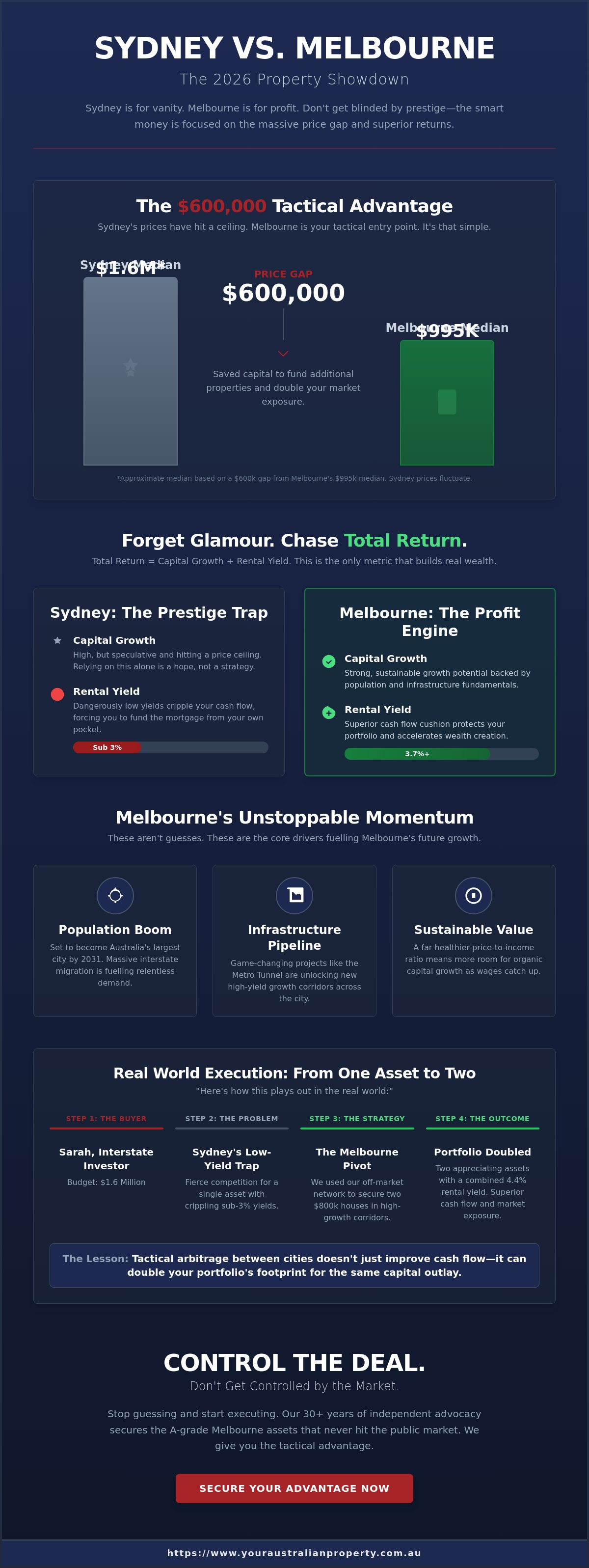
Sydney is for vanity, but Melbourne is for profit. While the harbour city captures the headlines, the smart money is focused on the massive $600,000 price gap that has opened up between these two markets. When you analyse Melbourne vs Sydney property investment returns in 2026, the data is clear; Sydney is hitting a price ceiling while Melbourne offers a tactical entry point with significantly lower capital requirements. We see this all the time; investors get blinded by prestige and miss the actual margin.
We know the hesitation. You’re likely worried about overpaying in a peaking Sydney market or feeling stuck in analysis paralysis over Victorian land tax changes. It’s a common hurdle, but you either control the deal or get controlled by the market. This article cuts through the noise to show you why Melbourne’s $995,000 median house price creates a superior total return profile. We will identify the specific suburbs with the highest growth potential and show you how our 30 years of independent advocacy secures the assets that never hit the public portals. It’s time to stop guessing and start executing with confidence.
Key Takeaways
Leverage the $600,000 price gap to enter the Melbourne market at a tactical discount while Sydney prices reach an unsustainable peak.
Analyse Melbourne vs Sydney property investment returns to see how higher rental yields and lower entry costs create a superior total return profile for 2026.
Navigate Victorian land tax changes like a professional by focusing on sustainable price to income ratios and long-term asset selection.
Discover how independent advocacy and off-market access allow you to bypass auction fever and secure exclusive assets before they hit the public market.
Master the A-grade asset rule to identify specific Melbourne suburbs that offer the best resilience and future capital growth potential.
##The $600,000 Gap: Why Melbourne is the Tactical Choice in 2026
Sydney prices are gasping for air while Melbourne is primed for a marathon. The gap between these two cities has stretched to a staggering $600,000. This isn’t just a rounding error; it’s a fundamental shift in how the Australian property market overview reveals tactical opportunities for the next decade. When you analyse Melbourne vs Sydney property investment returns, you see that Sydney has hit a psychological and financial ceiling. Investors chasing Sydney growth often find themselves with zero cash flow and a massive mortgage. We see this all the time; people buy for vanity and pay for it in liquidity. Melbourne is currently deeply undervalued relative to its population trajectory and infrastructure pipeline.
Analysing the Median Price Arbitrage
The numbers are clear. As of June 2026, the Melbourne median house price sits at $995,000. In Sydney, you are looking at significantly higher entry points for comparable assets. This $600,000 difference represents a once in a decade entry point for portfolio builders. It allows you to secure high quality assets without the crippling debt levels seen north of the border. Here’s where buyers get it wrong; they wait for the "perfect" time and miss the value window. That $600,000 in saved capital could easily fund the deposits for additional investment properties in high growth corridors, effectively doubling your market exposure for the same initial outlay.
Population Growth and Demand Fundamentals
Melbourne is on track to become Australia’s largest city by 2031. This isn’t speculation; it’s a demographic certainty fueled by massive interstate migration and a robust infrastructure pipeline. Projects like the Metro Tunnel are physically reshaping the city, creating new high yield pockets in suburbs that were previously overlooked. The price to income ratio in Melbourne is far more sustainable than in Sydney. This means more room for capital growth as wages catch up. You either control the deal by buying where the value is, or you get controlled by a market that has already peaked. Our Buyer Agents Service focuses on these high demand fundamentals to ensure long term security.
Here’s how this plays out in the real world:
Buyer: Sarah, an interstate investor with a $1.6 million budget.
Problem: She originally wanted a single house in Sydney’s inner west but found the yields were sub 3 percent and the competition was fierce.
Strategy: We pivoted her strategy to Melbourne. We identified two separate $800,000 houses in high demand growth corridors using our off market network.
Outcome: Sarah now holds two appreciating assets with a combined rental yield of 4.4 percent, significantly outperforming the single Sydney asset.
Lesson: Tactical arbitrage between cities can double your portfolio footprint while improving cash flow.
##Total Returns Breakdown: Sydney Growth vs Melbourne Yield
Total return is the only metric that matters in this game. It is the simple sum of capital gain and rental yield. While Sydney often offers prestige capital growth, it typically suffers from sub-3 percent yields that can cripple a portfolio’s momentum. Melbourne provides a superior cash flow cushion, with house yields frequently exceeding 3.7 percent and certain unit pockets reaching much higher. You either control the cash flow or the market controls your lifestyle. When assessing Melbourne vs Sydney property investment returns, the smart money looks past the glamour of the harbour and focuses on the bottom line.
The Reality of Sydney’s Low Yield Environment
Low yields make Sydney properties incredibly difficult to hold during periods of high interest rates. When the official cash rate sits at 4.35 percent, a 2.5 percent yield leaves a massive financial gap that you must bridge out of your own pocket every single month. This is the classic negative gearing trap that catches amateur investors in expensive metropolitan Sydney suburbs. They bet everything on speculative growth while their monthly liquidity bleeds out. This volatility is often exacerbated by government housing market interventions that can shift tax benefits or supply overnight. Relying purely on capital gains is not a strategy; it is a hope. And hope is not a plan for wealth.
Melbourne’s Rental Surge and Cash Flow Advantage
Vacancy rates in Melbourne are at record lows, which is driving aggressive rent increases across the city. We see this all the time; investors are shocked to find house yields of 4.3 percent in suburbs like Wollert and Coolaroo, while units in the CBD or Travancore can hit 7.26 percent and 7.86 percent respectively. These numbers provide a genuine shield against rate hikes. Over a 10 year cycle, a 4 percent yield in Melbourne consistently outperforms a 2.5 percent yield in Sydney because it protects your borrowing capacity. Banks look at your ability to service debt. If your property pays for itself, you can go again and buy property number two, three, and four. If you are stuck subsidising a Sydney mortgage, your journey ends at one. You can reach out to our team to see how we identify these high yield opportunities before they hit the open market.
Here’s how this plays out in the real world:
Buyer: David, a high income professional looking to expand his portfolio.
Problem: He was looking at a blue chip Sydney unit, but the sub-3 percent yield meant he would be out of pocket $1,500 every month after expenses.
Strategy: We pivoted him to a Melbourne CBD asset with a 7.26 percent yield. We utilised our 30 years of experience to vet the building for structural integrity and high tenant demand.
Outcome: David secured a cash flow neutral asset that doesn’t rely on his salary to survive. His borrowing capacity remained intact for his next purchase.
Lesson: When comparing Melbourne vs Sydney property investment returns, yield is the engine of a property portfolio. Without it, you aren’t an investor; you’re just a homeowner with two mortgages.
##The Melbourne Value Window: Risks and Tax Reforms
Here’s where buyers get it wrong: they see a tax increase and run away from a bargain. While the mainstream media screams about Victorian land tax changes, savvy investors recognise this as a sentiment-driven discount. When the crowd flees, the smart money moves in. Analysis of Melbourne vs Sydney property investment returns proves that capital growth in high-demand pockets far outpaces the additional tax burden. Professional due diligence identifies properties where the growth trajectory remains untouched by legislative shifts. Smart money buys when sentiment is soft and sells when the crowd eventually returns.
Navigating Victorian Land Tax and Tenancy Laws
Let’s look at the facts without the hysteria. The Victorian land tax threshold for 2026 is $50,000, which is significantly lower than the NSW threshold of $1,075,000. The COVID-19 Debt Temporary Surcharge adds a fixed fee and an additional percentage to your tax bill until 2033. This increases holding costs, but it also suppresses competition from amateur buyers who can’t do the maths. RBA data on housing investors shows that sophisticated owners focus on long-term equity rather than minor cash flow fluctuations. We see this all the time; pro-tenant laws actually increase the value of high-quality, well-maintained assets because they attract stable, long-term tenants. High-grade properties in Melbourne are currently selling at a relative discount because of these hurdles, creating a massive tactical advantage for those who see past the next financial year.
Avoiding the Underquoting Trap
You either control the deal or get controlled by the selling agent. Melbourne is notorious for underquoting hotspots where the ‘statement of information’ is often a work of fiction. These figures skew your return calculations and lead to wasted weeks on properties you can’t afford. You must ignore the agent’s guide and rely on independent data. We use 30 years of experience to identify the real selling price before the auction starts. Our Property Negotiation Service Melbourne strips away the marketing fluff to reveal the true market value. This ensures you don’t overpay in a market that is currently offering genuine value.
Here’s how this plays out in the real world:
Buyer: Mark, an investor spooked by the Victorian land tax surcharge.
Problem: He was ready to walk away from a prime asset because of increased holding costs.
Strategy: We provided a detailed 10-year forecast comparing the tax cost against the $200,000 price advantage this property held over comparable Sydney assets.
Outcome: Mark secured the property with zero competition, locking in a high-growth asset at a cyclical low.
Lesson: A hurdle is not a wall; professional analysis turns tax scares into buying opportunities.
##Suburb Selection Strategy: Where the Best Returns Hide
Buying the market is a rookie mistake. Serious investors don’t buy averages; they buy scarcity. When you analyse Melbourne vs Sydney property investment returns, the real advantage lies in your ability to secure A-grade assets in suburbs that are simply out of reach for most in the Sydney market. Location is the only factor you cannot change. We see this all the time; buyers get seduced by shiny new builds in the middle of nowhere and wonder why their capital growth is stagnant. In Melbourne, the smart money is flowing into established pockets where demand is high and supply is physically capped.
The Blue-Chip Powerhouses: Toorak and Armadale
Toorak is the benchmark for a reason. It remains the ultimate capital growth hedge in Australia because prestige is permanent. A Toorak asset doesn’t just grow; it protects your wealth during market fluctuations. Nearby, Armadale offers a unique combination of high-end retail and prestigious residential demand. In these zones, period homes on substantial land always outperform modern, high-density apartments. The land-to-asset ratio is the only metric that guarantees long-term dominance. If you aren’t buying land in these postcodes, you aren’t playing the same game as the elite.
High-Growth Corridors: Fitzroy North and Brunswick
Gentrification is a predictable wave if you have the data to read the signs. The transformation of Fitzroy North has pushed rental yields and capital values into a new tier. It appeals to a high-income demographic that demands lifestyle, culture, and proximity to the CBD. Brunswick follows a similar trajectory. The demand for well-located townhouses among young professionals is relentless. To spot the next ripple effect suburb, you look for where the overflow from these established hubs is landing. You either control the entry point now or you pay the premium later when the crowd arrives.
Strategic Opportunities in Elsternwick and Caulfield
Family demand is the most resilient driver in the Melbourne market. The family-friendly appeal of Elsternwick is built on elite school zones and premium transport links. It offers a much safer risk-adjusted return than many equivalent suburbs in Sydney’s inner west because the entry price is more grounded. Caulfield North provides large land holdings with significant subdivision potential. These are the assets that provide multiple exit strategies. If you want to secure an A-grade asset in these competitive zones before they hit the open market, talk to our Melbourne buyer advocates today.
Here’s how this plays out in the real world:
Buyer: James and Elena, looking for a $1.5 million investment.
Problem: They were looking at generic new-build houses in the outer suburbs because they wanted the maximum "house" for their money.
Strategy: We redirected them to a period cottage in Brunswick with renovation potential. We focused on the scarcity of the land and the proximity to the city.
Outcome: They secured the property off-market. Within 18 months, the asset grew by 15 percent, significantly outperforming the outer-suburb averages.
Lesson: Scarcity always beats size. Buy the best location you can afford, not the biggest house.
##Winning the Deal: How Independent Advocacy Secures Returns
You either control the deal or get controlled by the selling agent. This is the final and most critical hurdle in the investment journey. While the data shows that Melbourne vs Sydney property investment returns favour the southern capital in 2026, those returns only materialise if you buy at the right price. Disciplined negotiation is where your first $100,000 of profit is made. Melbourne property is a contact sport; we make the hits so you don’t have to. We see this all the time; investors do the research but crumble when they face a seasoned agent in a high stakes negotiation.
The Off-Market Advantage
In a flat market, the best assets often never see a public listing. Our deep relationships with local agents grant us access to "silent listings" that are shielded from the general public. Sellers often choose to sell off-market properties Melbourne to avoid high marketing costs or to ensure a discreet transaction. This benefits your bottom line by eliminating the "auction fever" premium. You aren’t competing with 50 emotional buyers on a Saturday morning; you are negotiating in a controlled environment where we hold the leverage. This access is the proprietary key to securing value while others are fighting for scraps on realestate.com.au.
Tactical Auction Bidding and Negotiation
Eliminating emotion from the bidding process is the only way to avoid overpaying. We use the psychology of negotiation to force the seller to meet your price, not the other way around. Our auction bidding service Melbourne is designed to protect your capital. We control the room, set the pace, and read the body language of the competition to ensure you never bid against yourself. Here’s where buyers get it wrong: they think they can handle the pressure, but they end up paying a "prestige tax" that eats into their future returns. We provide a necessary shield against the tactics of opposing market representatives.
Here’s how this plays out in the real world:
Buyer: An interstate investor looking for a high-yield house in Melbourne’s south-east.
Problem: The property was quoted at $1,600,000 but had significant interest and multiple registered bidders.
Strategy: We identified a structural defect during our property due diligence and used it as a tactical lever to negotiate a pre-auction offer before the competition could react.
Outcome: Secured the property for $1,400,000 while similar homes in the area sold for $1,555,000 at auction.
Lesson: Expert due diligence is a profit-making tool, not just a safety check. It provides the leverage needed to win the deal on your terms.
##Master the Melbourne Value Window
The data is undeniable. Sydney has reached a price ceiling while Melbourne’s $600,000 median price gap offers a tactical entry point that only comes around once a decade. When you weigh up Melbourne vs Sydney property investment returns, the combination of higher yields and lower entry costs creates a clear path to portfolio expansion. You either control the asset selection process now or you get controlled by a market that has already peaked. Here’s where buyers get it wrong: they wait for the "perfect" headline while the smart money is already moving into high-demand corridors.
Success in 2026 requires more than just reading data; it requires aggressive execution. We provide the protective shield you need against the tactics of selling agents through our 30 plus years of deep Melbourne market experience. Our independent advocacy ensures there are zero seller conflicts; our loyalty remains strictly with you. By gaining exclusive access to off-market silent listings, you bypass the auction fever and secure assets based on logic, not emotion. Don’t let analysis paralysis or fear of tax changes cost you the next growth cycle. It’s time to stop watching the market and start owning it.
Is Melbourne property a better investment than Sydney in 2026?
Yes, Melbourne offers a superior tactical entry point due to the $600,000 price gap between the two cities. While Sydney prices are reaching a ceiling, Melbourne’s $995,000 median house price allows for better capital allocation. When you analyse Melbourne vs Sydney property investment returns, Melbourne wins on sustainability and entry value. You either buy at the bottom of the cycle or pay the prestige tax in a peaking market.
What is the average rental yield for Melbourne houses vs Sydney?
Melbourne houses are currently recording yields of 4.3 percent in high demand suburbs like Wollert, Coolaroo, and Hastings. This significantly outperforms many metropolitan Sydney suburbs where yields often struggle to clear 3 percent. For investors focused on cash flow, Melbourne units are the clear winners, with Travancore hitting 7.86 percent and the CBD recording 7.26 percent. We see this all the time; investors ignore yield and find themselves unable to service their debt when rates hold at 4.35 percent.
How much does a buyer’s agent cost for an investment property in Melbourne?
We operate on a fair and transparent percentage based success fee model that aligns our interests with your financial outcome. This model ensures we are incentivised to secure the best possible asset at the lowest possible price. You aren’t just paying for a service; you are investing in 30 years of market expertise and negotiation power. The profit is usually made at the buying table, and our fee reflects the value of the hundreds of thousands of dollars we save our clients through due diligence and off market access.
Can I buy off-market properties in Melbourne without an agent?
It is technically possible but highly unlikely in practice. Selling agents guard their "silent listings" for trusted advocates who have a proven track record of closing deals quickly and without fuss. Here’s where buyers get it wrong: they think they can find these deals on public portals or by cold calling. Without the established relationships we have built over three decades, you will only see the stock that no one else wanted. You either have the network or you don’t.
What are the best suburbs in Melbourne for capital growth in 2026?
Focus on suburbs with capped supply and high lifestyle appeal like Toorak, Armadale, and Fitzroy North. These blue chip areas act as a hedge against market volatility and consistently attract high income tenants. For those seeking the "ripple effect," Brunswick and Elsternwick offer strong growth profiles driven by family demand and gentrification. Don’t buy averages; buy scarcity. Assets in these zones are physically limited, which is the only guaranteed driver of long term capital appreciation.
How do Victorian land tax changes affect property investment returns?
Victorian land tax changes increase holding costs but also create a "value window" by thinning out amateur competition. The $50,000 threshold and the COVID 19 Debt Temporary Surcharge have made some investors nervous, leading to softer sentiment. This is exactly when the smart money moves in. We identify properties where the capital growth trajectory and rental increases far outweigh the tax surcharge. A hurdle is not a wall; it’s a filter that rewards sophisticated investors who understand the math.
Is it worth buying an investment property in Melbourne right now?
Absolutely, because Melbourne is currently undervalued relative to its massive population growth and infrastructure pipeline. The city is on track to become Australia’s largest by 2031, yet it remains significantly cheaper than Sydney. Buying now allows you to exploit the current market slowdown before the next growth cycle begins. You either control the deal while sentiment is low, or you get controlled by the crowd when prices start to climb again. Our Buyer Agents Service ensures you pick the winners and avoid the duds.
What is the difference between a buyer’s advocate and a buyer’s agent?
The terms are used interchangeably in the industry, but both represent the buyer exclusively with zero seller conflicts. We prefer the term "advocate" because it more accurately describes our role as your protective shield in a contact sport. While a selling agent’s job is to get the highest price for the vendor, our job is to secure the lowest price and the best terms for you. We provide independent advocacy, total transparency, and a client first philosophy that prioritises your long term security.
Article by
Zac Newbold – Founder & Managing Director – 30+ Years. Real Authority. Proven Results.
Zac Newbold is one of Melbourne’s most experienced Buyer’s Agents and a Fully Licensed Estate Agent since 2001.
With over 30 years inside the property market, Zac has seen exactly how buyers win – and exactly how they get overexposed, overbid, and overpay.
He’s worked across every layer of the industry – residential sales, boutique agencies, large franchise networks, property and asset management, corporate advisory, commercial real estate, and project management. That experience gives him a simple advantage: he knows how every player in the market thinks, moves, and negotiates.
At a certain point, he made a clear decision – stop working the system from all sides, and start working for one side only.
The buyer.
Because that’s where clarity matters. And that’s where deals are actually won.
Today, Zac represents buyers across Melbourne in residential and investment property, using a disciplined, strategy-led approach built on market intelligence, timing, and hard negotiation.
Through Your Australian Property Buyers Agents, Zac and his team give clients a real edge in the market – independent advice, structured strategy, and negotiation that’s designed to protect capital and win the deal.
His philosophy is simple: Treat every purchase like it’s your own money on the line – and never pay more than you have to.
Outside of property, Zac spends time with his wife and family and travels whenever the schedule allows.
If you’re serious about making your next property move, contact Zac Newbold and his team today to organise your confidential and complimentary Property Strategy Session.
Disclaimer
The information provided in this article is general in nature and is intended for educational and informational purposes only. It does not constitute financial, legal, or investment advice and should not be relied upon as such.
All property markets involve risk, and outcomes will vary based on individual circumstances. Readers should conduct their own due diligence and seek independent advice from qualified professionals before making any property or investment decisions.
While every effort has been made to ensure the accuracy of the information at the time of publication, Your Australian Property Buyers Agents makes no guarantees as to its completeness, reliability, or current relevance and accepts no responsibility for any loss or damage arising from reliance on this content.
You can keep fighting for scraps in Sydney’s overcooked market, or you can exploit the $600,000 valuation gap currently sitting on your doorstep. Smart money is moving south, and we are seeing exactly where Sydney investors are buying in Melbourne right now to secure blue-chip assets before the window closes. It is a calculated play to exit a saturated market and enter one where the infrastructure-rich fundamentals still favour the buyer.
Timing the valuation gap is everything. You either control the deal or get controlled by the market’s eventual recovery. Right now, Melbourne is essentially "half-price" for similar quality assets compared to the northern capital. Sydney investors are finally realising that trading a mediocre asset for a high-performance Melbourne property is the fastest way to repair a stagnant portfolio. To unlock more capital for these high-yield opportunities, many investors choose to discover more about gold buyers and liquidate physical assets like scrap gold. This is exactly where Sydney investors are buying in Melbourne right now to maximise their long-term equity.
We often see savvy investors strengthening their cash position by liquidating physical assets; for instance, selling silver jewelry or bullion to Silver Buyers Sydney can provide the immediate liquidity needed to secure a fast-moving interstate deal.
We understand the hesitation. Between the noise regarding Victoria’s $50,000 land tax threshold and the fear of buying an interstate lemon, most investors freeze. You want the 3.5%+ gross yields and 5%+ annual growth, but you don’t want the risk. This guide reveals the specific Melbourne suburbs and tactical strategies used to secure high-growth assets for under $1,500,000. We will cut through the confusion of rental reforms and show you how to use our 30+ years of experience to control the deal. You either control the outcome or get controlled by the market; it is time to choose.
Here’s how this plays out in the real world:
Buyer: Sydney-based executive.
Problem: Low yields and $1.5M budget ceiling in NSW.
Strategy: Targeted a high-demand Melbourne pocket with a 1.6% vacancy rate.
Outcome: Secured a blue-chip house for $1.35M with a 3.7% yield.
Lesson: Buying where the valuation gap is widest ensures immediate equity and superior cash flow.
Key Takeaways
Exploit the $600,000 valuation gap by trading mediocre Sydney assets for blue-chip Melbourne terraces with superior capital growth potential.
Identify exactly where Sydney investors are buying in Melbourne right now by targeting “mirror suburbs” that replicate the performance of Paddington and Balmain.
Capitalise on the Suburban Rail Loop infrastructure while avoiding the trap of high-supply new estates that dilute long-term returns.
Secure a competitive advantage by accessing silent listings and off-market opportunities through the Online Property Tracker before they hit public portals.
Ensure total control over the negotiation by using independent advocacy as a shield against the tactics of selling agents.
##The Valuation Gap: Why Sydney Capital is Flooding Melbourne in 2026
The $600,000 reality is impossible to ignore. In Sydney, $1.3 million buys a fibro shack in a suburb you would rather not mention at a dinner party. In Melbourne, that same capital secures a blue-chip period terrace in a premier inner-city pocket. We see this all the time; savvy Sydney capital is flooding south because the "relative value" play is too strong to ignore. While Sydney remains stagnant, Melbourne’s current flat patch represents the ultimate entry point for those who understand the history of Melbourne’s growth and its resilient economic cycles.
To better understand why the market is shifting, watch this helpful video regarding recent price movements:
Timing the valuation gap is everything. You either control the deal or get controlled by the market’s eventual recovery. Right now, Melbourne is essentially "half-price" for similar quality assets compared to the northern capital. Sydney investors are finally realising that trading a mediocre asset for a high-performance Melbourne property is the fastest way to repair a stagnant portfolio. This is exactly where Sydney investors are buying in Melbourne right now to maximise their long-term equity.
The Sydney vs Melbourne Price Divergence
The numbers don’t lie. Sydney’s median house price sits around $1.3 million, while Melbourne remains accessible at approximately $845,000. This divergence creates a massive serviceability advantage. A yield spread of 3.6% to 4.5% in Melbourne comfortably beats Sydney’s 3.0% average. It is a "Relative Value" play that allows you to buy into elite suburbs like Toorak or Armadale for the price of a mid-tier Sydney suburb. You are getting better land, better postcodes, and better cash flow for a fraction of the cost.
Psychology of the Interstate Investor
Many investors get spooked by the Victorian land tax threshold, which was lowered to $50,000 in 2024. Here’s where buyers get it wrong: they focus on the expense rather than the net return. A professional Property Negotiation Service Melbourne specialist looks at the total performance. Even with the "COVID debt levy" in place for 2026, the capital growth potential and higher yields far outweigh the tax holding costs. The real risk is the "Interstate Penalty." Selling agents love targeting Sydney buyers because they know you don’t have local boots on the ground. They will try to offload B-grade stock at A-grade prices. You need a shield to avoid overpaying.
Here’s how this plays out in the real world:
Buyer: Sydney-based investor with a $1.2M budget.
Problem: Sydney options were limited to low-yield apartments or distant outer-ring houses.
Strategy: Pivoted to Melbourne’s inner-north to secure an established cottage with high land value.
Outcome: Purchased a renovated period home for $1.15M with a 3.8% yield.
Lesson: Trading Sydney’s leftovers for Melbourne’s blue-chip assets accelerates wealth creation and portfolio serviceability.
##The Sydney Clone Strategy: Suburbs That Mirror Sydney High-Growth Zones
Sydney investors don’t need to reinvent the wheel. They just need to find the Melbourne version of what already works in their own backyard. We call this the Sydney Clone Strategy. It is the most effective way to identify exactly where Sydney investors are buying in Melbourne right now. By mapping familiar high-growth archetypes onto the Melbourne grid, you remove the guesswork and buy with the confidence of a local. We have spent 30 years perfecting this methodology; we know which streets perform and which ones are just expensive noise.
Most buyers get it wrong by treating Melbourne as one giant market. It isn’t. It is a collection of micro-markets with distinct drivers. If you missed the boat in Paddington or Balmain a decade ago, you are currently looking at a second chance in Melbourne’s inner-ring. This is where you capitalise on established prestige without the $3 million entry price. You either control the deal by identifying these "mirror suburbs" early, or you get controlled by the FOMO of the next cycle.
The Inner-North and Inner-West Renaissance
If you love the energy of Newtown or Surry Hills, Fitzroy North and Brunswick are your primary targets. These areas offer the same creative professional demographic and heritage charm but with significantly better capital growth potential in 2026. For those seeking the 2010 Redfern gentrification play, the inner-west is the answer. Pockets like Footscray and Seddon are undergoing a massive transformation, driven by a younger, high-income demographic moving away from the CBD. The Bayside premium in South Melbourne offers even better long-term security than Sydney’s eastern beaches, providing a blue-chip safe haven for serious capital.
Middle-Ring Powerhouses for Yield
Middle-ring suburbs are where you find the perfect balance of yield and land value. Reservoir and Preston are high-demand rental zones where you can still secure substantial blocks with massive future development upside. If you are chasing non-discretionary demand, the school zones in Glen Waverley are goldmines. This is Melbourne’s version of Chatswood; the "Education State" factor drives consistent 5% annual growth regardless of broader market fluctuations. For investors on a tighter budget, Werribee represents the ultimate infrastructure play. This growth is underpinned by Victoria’s major infrastructure projects, which are turning these corridors into high-frequency transit hubs. If you want to see which of these pockets fits your portfolio, reach out for a confidential chat.
Here’s how this plays out in the real world:
Buyer: A couple from the Northern Beaches looking for a Balmain equivalent.
Problem: Priced out of Sydney’s inner-west gentrification cycle.
Strategy: We identified a heritage terrace in South Melbourne with unlisted potential.
Outcome: Secured the asset off-market for $1.42M, well below the Sydney equivalent price of $2.5M plus.
Lesson: Mirroring your Sydney success in Melbourne delivers the same lifestyle appeal and growth profile at a 40% discount.
##Beyond the CBD: Infrastructure-Led Growth Corridors for 2026
Smart money looks past the skyline. While the inner-city charm of Fitzroy North or South Melbourne is undeniable, the real wealth is being built in the infrastructure corridors that will define the next decade. This is where Sydney investors are buying in Melbourne right now to secure long-term capital uplift. The Suburban Rail Loop (SRL) isn’t just a transport project; it is a wealth-creation blueprint for those who know how to read the map. We see this all the time; investors who follow the government’s $88 billion pipeline tend to outperform those chasing yesterday’s trends.
Here’s where buyers get it wrong: they chase the "shiny and new" in outer-fringe estates. These areas have infinite supply and zero scarcity. You want to target established corridors where demand is high and land is limited. According to official housing value data from the ABS, Melbourne’s price-to-income ratio remains far more sustainable than Sydney’s, making these infrastructure plays even more attractive for interstate capital. You either control the deal by buying into scarcity or get controlled by the endless supply of the urban fringe.
The SRL Impact: Suburbs to Watch
The SRL is turning Box Hill and Burwood into "Satellite CBDs." These aren’t just suburbs anymore; they are high-density hubs of commerce and education. The Monash Precinct is another goldmine, sitting at the intersection of health, education, and research. To maximise your capital uplift, you must buy within 800m of planned SRL stations. This is where the non-discretionary demand will be most intense. Suburbs like Glen Waverley are already seeing the benefits of this increased connectivity, securing their status as premium middle-ring assets.
The ‘Second City’ Play: Geelong and Beyond
Geelong has successfully transitioned from an industrial town to a tech and insurance powerhouse. It is effectively the "Wollongong" of Victoria, but with a more direct economic link to the capital. Sydney investors prefer Geelong for its lifestyle appeal and the direct rail link that puts the Melbourne CBD within reach. Further inland, Ballarat and Bendigo offer high-yield regional plays with vacancy rates sitting under 1.5%. For investors with a sub-$700,000 budget, the west remains the primary focus. Areas like Werribee are benefiting from professional services hubs shifting the demand curve away from the traditional centre.
Here’s how this plays out in the real world:
Buyer: Sydney tech professional seeking a "set and forget" investment.
Problem: Seduced by high-yield promises in fringe new-build estates with no infrastructure.
Strategy: We pivoted the search to an established 1970s brick home on a large block near the future Monash SRL station.
Outcome: The property achieved 6% capital growth in the first 12 months, while the fringe estate values remained flat.
Lesson: Scarcity near major infrastructure beats house age every single time.
##Tactical Execution: How Sydney Investors Win Without Being Present
Distance is only a disadvantage if you operate like an amateur. While most interstate buyers spend their nights scrolling through stale public portals, the real professionals are executing deals behind the scenes. This is exactly where Sydney investors are buying in Melbourne right now to secure an edge; they are using local proxies to bypass the public noise and secure assets before the general public even knows they exist. You either control the process from a distance or you get controlled by the distance.
Digital due diligence is your primary filter. Use the Online Property Tracker to strip away the marketing fluff and focus on raw asset performance. Once the noise is gone, the real work begins. You must build a local "Power Team" of inspectors and solicitors who understand the Victorian landscape. Most importantly, you never let a selling agent know you are a Sydney-based investor. To them, "Sydney" means "uninformed and over-capitalised." Use Your Australian Property Buyers Agents as a shield to maintain total anonymity.
The Art of the Off-Market Deal
Approximately 30% of Melbourne’s premier investment assets never hit public real estate websites. These "Silent Listings" are traded behind closed doors between agents and trusted advocates. We leverage 30+ years of relationships to get you through those doors first. This is how you execute the "Pre-Auction Kill." By identifying a motivated vendor and presenting a clean, aggressive offer before the campaign gains momentum, you shut down the competition. You aren’t just buying a house; you are buying the right to avoid a bidding war.
Auction Bidding and Negotiation Strategy
Melbourne’s "underquoting" problem is a minefield for the uninitiated. Sydney bidding tactics often fail here because the local auction colosseum operates on different psychological triggers. Here’s where buyers get it wrong: they bid with their hearts instead of their heads. You need a professional Auction Bidding Service Melbourne to act as your local proxy. We calculate the real reserve price long before the first bid is called. We use terms, settlement flexibility, and calculated aggression to beat higher cash offers. If you want to stop losing and start winning, book a strategy session with our team today.
Here’s how this plays out in the real world:
Buyer: A busy Sydney surgeon.
Problem: Lost three consecutive auctions in Hawthorn due to emotional overbidding by locals.
Strategy: We shifted focus to a silent listing in a neighbouring pocket and handled all negotiations.
Outcome: Secured a superior asset $45,000 below the bank valuation.
Lesson: You cannot win a local fight using interstate tactics; you need a representative who knows the local reserve before the agent does.
##Securing the Deal: Why an Independent Advocate is Your Only Shield
Selling agents are trained to extract the maximum amount of capital from your wallet. They are not your friends, and they certainly are not your advisors. When you enter the Melbourne market from interstate, you are often viewed as a "high-intent, low-knowledge" target. This is why having an independent firewall is non-negotiable. We see this all the time; Sydney buyers arrive with deep pockets and get funnelled toward B-grade stock that local buyers have already rejected. You either control the negotiation through Your Australian Property Buyers Agents or you pay the "amateur tax" to the vendor.
There is a massive difference between a property "finder" and a strategic negotiator. Anyone can find a house on a public real estate portal. Only an advocate with 30+ years of experience knows how to deconstruct a selling agent’s price guide and identify the real reserve. We provide total transparency and loyalty, ensuring you understand exactly where Sydney investors are buying in Melbourne right now to secure genuine value. We don’t just find properties; we secure the assets that others miss by leveraging relationships that take decades to build.
Real-World Scenario: The Sydney Pivot
Here’s how this plays out in the real world:
Buyer: Sydney-based IT Executive with a $1.4 million budget.
Problem: Priced out of Sydney’s inner-west; terrified of buying a "lemon" interstate.
Strategy: We identified an off-market period home in Armadale with a high land-to-asset ratio.
Outcome: Secured for $1.32 million, which was $80,000 under the bank valuation, with a 4.2% gross yield.
Lesson: Sydney capital buys A-grade assets in Melbourne when you have local boots on the ground to filter out the noise.
Taking the Next Step
Our percentage-based success fee ensures our goals are 100% aligned with yours. We win when you secure a high-performance asset at the right price, not when you simply "buy something." It is time to stop guessing and start executing with the precision of a local insider. We provide the expertise, the off-market access, and the negotiation leverage required to win in the Melbourne colosseum. Secure your Melbourne investment future with Your Australian Property Buyers Agents.
##Secure Your Strategic Advantage in the Melbourne Market
The window to exploit the $600,000 valuation gap between Sydney and Melbourne won’t stay open forever. Smart capital is already moving into infrastructure-rich corridors and blue-chip mirror suburbs that offer the growth Sydney lost a decade ago. You now understand exactly where Sydney investors are buying in Melbourne right now to secure 3.5% yields and consistent capital uplift. Success in this market isn’t about browsing public portals; it’s about controlling the deal through local expertise and off-market access. You either control the outcome or get controlled by a market you don’t fully understand.
We provide the shield you need to avoid the interstate penalty. With over 30 years of Melbourne market expertise, we grant you exclusive access to unlisted silent assets that never reach the general public. Our 100% independent advocacy ensures your interests are protected with zero vendor kickbacks. Don’t leave your financial future to chance or the tactics of a selling agent. You either hire a professional to win the negotiation or you pay the price in over-capitalisation and missed growth. It is time to stop watching the market and start owning it.
Yes, because the RBA cash rate is expected to peak at 4.35% in May 2026, providing the market with much-needed interest rate certainty. While prices have seen a minor cooling, the long-term fundamentals remain robust with a vacancy rate sitting at a tight 1.6%. Buying now allows you to enter the market before the next growth cycle, triggered by the massive population influx and the multi-billion dollar infrastructure pipeline currently under construction.
How much should a Sydney investor expect to pay for a good Melbourne investment?
Expect to budget between $900,000 and $1,500,000 for a high-performance house in a resilient middle-ring suburb. While the median house price is approximately $845,000, the most durable assets for Sydney-sized budgets usually sit slightly higher to ensure a land-rich component. This price bracket is currently the most resilient, as demand for properties under $1.5 million remains strong despite broader market fluctuations and higher interest rates for investment loans.
What are the best suburbs in Melbourne for capital growth right now?
The most consistent growth is found in the "Second City" corridors and professional hubs like Geelong and the inner-west. These growth zones are exactly where Sydney investors are buying in Melbourne right now to capitalise on professional services shifting away from the traditional CBD. By targeting areas with a low vacancy rate and high non-discretionary demand, you ensure your portfolio achieves the 5% annual growth required for long-term wealth creation.
How does Victorian land tax affect Sydney property investors?
The general land tax threshold is $50,000, but new 2026 regulations prohibit sellers from passing on land tax costs to buyers in contracts of sale for properties under $10.7 million. This protects your initial capital outlay. While the "COVID debt levy" remains, the 3.5% to 4.5% gross yields available in Melbourne’s high-demand pockets typically provide the cash flow necessary to manage these holding costs while waiting for capital appreciation.
Can I buy a Melbourne property without visiting it in person?
You can, provided you utilise a local "Power Team" to handle the physical due diligence and structural assessments. We provide our interstate clients with detailed video reporting and objective asset evaluations that go far beyond what you see on a public listing. Buying remotely is about risk mitigation; we ensure you don’t buy a "lemon" by providing a local perspective on street-level nuances that are invisible to interstate buyers.
What is the difference between a buyer’s agent and a selling agent in Melbourne?
A selling agent is legally bound to achieve the highest price for the vendor; they are the opposition in any negotiation. A buyer’s agent, or advocate, represents you exclusively to secure the lowest price and best terms. We use our 30+ years of experience to act as a shield, ensuring you don’t get controlled by the selling agent’s tactics. We provide independent advice with no vendor kickbacks, ensuring your peace of mind.
How do I find off-market properties in Melbourne from Sydney?
True off-market opportunities, or "silent listings," are found through established industry networks rather than public real estate websites. Approximately 30% of Melbourne’s best assets are traded privately to avoid the stress of a public campaign. We leverage our long-standing relationships with local agencies to gain you early access. This allows you to negotiate in a controlled environment and often secure the property before the general public even knows it is for sale.
What are the common mistakes Sydney investors make when buying in Melbourne?
Here’s where buyers get it wrong: they ignore the upcoming federal tax changes. From July 2027, negative gearing and CGT discounts will be restricted for established properties purchased after May 2026. This is a primary reason where Sydney investors are buying in Melbourne right now, as they look to settle on quality stock before these legislative shifts occur. Failing to account for these dates or buying in high-supply fringe estates are the fastest ways to stall your portfolio.
Article by
Zac Newbold – Founder & Managing Director – 30+ Years. Real Authority. Proven Results.
Zac Newbold is one of Melbourne’s most experienced Buyer’s Agents and a Fully Licensed Estate Agent since 2001.
With over 30 years inside the property market, Zac has seen exactly how buyers win – and exactly how they get overexposed, overbid, and overpay.
He’s worked across every layer of the industry – residential sales, boutique agencies, large franchise networks, property and asset management, corporate advisory, commercial real estate, and project management. That experience gives him a simple advantage: he knows how every player in the market thinks, moves, and negotiates.
At a certain point, he made a clear decision – stop working the system from all sides, and start working for one side only.
The buyer.
Because that’s where clarity matters. And that’s where deals are actually won.
Today, Zac represents buyers across Melbourne in residential and investment property, using a disciplined, strategy-led approach built on market intelligence, timing, and hard negotiation.
Through Your Australian Property Buyers Agents, Zac and his team give clients a real edge in the market – independent advice, structured strategy, and negotiation that’s designed to protect capital and win the deal.
His philosophy is simple: Treat every purchase like it’s your own money on the line – and never pay more than you have to.
Outside of property, Zac spends time with his wife and family and travels whenever the schedule allows.
If you’re serious about making your next property move, contact Zac Newbold and his team today to organise your confidential and complimentary Property Strategy Session.
Disclaimer
The information provided in this article is general in nature and is intended for educational and informational purposes only. It does not constitute financial, legal, or investment advice and should not be relied upon as such.
All property markets involve risk, and outcomes will vary based on individual circumstances. Readers should conduct their own due diligence and seek independent advice from qualified professionals before making any property or investment decisions.
While every effort has been made to ensure the accuracy of the information at the time of publication, Your Australian Property Buyers Agents makes no guarantees as to its completeness, reliability, or current relevance and accepts no responsibility for any loss or damage arising from reliance on this content.
Why are you settling for stagnant yields in Sydney when a $450,000 median price gap is waiting for you across the border? You know the Sydney market is currently locked behind astronomical entry costs and diminishing returns, making it nearly impossible to scale your portfolio with any real momentum. Finding the best Melbourne suburbs for Sydney investors (2026) isn’t about guesswork; it’s about exploiting a counter-cyclical window where you can secure blue-chip assets at prices that the Sydney market left behind years ago.
We understand the frustration of watching your capital sit idle while you worry about falling into an outer-suburb investor trap. This guide reveals exactly which Melbourne pockets are primed for capital growth following the RBA’s 4.35% cash rate hold and the new federal negative gearing limits for properties purchased after May 12, 2026. You’ll discover how to identify high-performing assets that balance yield with long-term security, regardless of the $6.5 billion land tax forecast. We are going to show you how to leverage our 30 years of experience to access off-market deals and secure a premier asset before local owner-occupiers even get a look in.
Key Takeaways
Exploit the $450,000 median price gap between Sydney and Melbourne to secure blue-chip assets at a significant discount.
Identify the best Melbourne suburbs for Sydney investors (2026) by targeting middle-ring locations positioned near the newly operational Metro Tunnel.
Avoid the “investor traps” of shiny new builds in outer growth corridors and learn to navigate the local agents’ underquoting tactics.
Gain a tactical advantage by accessing exclusive off-market opportunities that never reach public listing portals like Domain or Realestate.com.au.
Shift from a passive buyer to a dominant negotiator who understands that in the Melbourne market, you either control the deal or get controlled.
##The 2026 Pivot: Why Sydney Capital is Flooding the Melbourne Market
Sydney investors are hitting a wall. High entry costs and microscopic yields are killing portfolio growth, leaving seasoned buyers looking for a better way to scale. In 2026, the smart money is moving south. The median house price gap between Sydney and Melbourne has widened to approximately $450,000. This isn’t just a statistic; it’s a strategic opening. For the price of one mid-tier house in Sydney’s outer suburbs, you can often secure two high-performing assets in Melbourne’s blue-chip ring. We see this all the time. Investors are tired of "Sydney Fatigue" and are looking for markets where their equity actually works for them.
The timing is precise. Melbourne’s relative underperformance throughout 2024 and 2025 has created a rare buying window in 2026. While other states have peaked and are showing signs of exhaustion, Melbourne is entering a recovery phase backed by massive fundamentals. Melbourne’s population growth is on track to make it Australia’s largest city by 2031. This surge in residents isn’t just coming from overseas; it’s driven by interstate migration from people seeking the exact lifestyle and affordability you’re about to capitalise on. Identifying the best Melbourne suburbs for Sydney investors (2026) is the first step in turning dormant equity into a high-yield engine.
The Yield Gap: Melbourne vs Sydney Cash Flow
Sydney’s Inner West is a yield desert. You’re lucky to see a 2.5% gross return on an established house. Compare that to Melbourne’s inner-north or middle-ring suburbs, where townhouses and houses are consistently outperforming. With a citywide rental vacancy rate sitting at a tight 1.4%, it’s a landlord’s market. Lower entry prices mean lower mortgages, which drastically reduces your stress while the rent covers your holding costs. You don’t just buy for growth; you buy for a sustainable position that doesn’t bleed your monthly cash flow.
Counter-Cyclical Timing: Buying at the Inflection Point
Here’s where buyers get it wrong: they chase "hot" markets like Perth after the growth has already happened. That’s a rookie mistake. The best Melbourne suburbs for Sydney investors (2026) are found where the value is currently hidden. By using your Sydney equity now, you’re buying at the inflection point before the next major boom. We’ve spent 30 years identifying these shifts. You either control the deal at the right time or get controlled by the market cycle later. Secure your position in a market with genuine longevity through professional property investment Melbourne advisory.
Here’s how this plays out in the real world:
Buyer: Mark, a Sydney-based executive with a $2.5 million home in Balmain.
Problem: Mark had $800,000 in usable equity but couldn’t afford a quality investment in Sydney that didn’t require a $2,000 monthly top-up from his salary.
Strategy: We executed a dual-acquisition strategy in Melbourne’s middle ring, securing two unlisted period homes in high-demand school zones with a 1.4% vacancy rate.
Outcome: Mark secured two assets for $1.5 million total, achieving a combined rental yield 2.4% higher than his Sydney benchmarks while capturing the start of the 2026 recovery.
Lesson: Arbitraging the price gap between states allows you to double your asset count without doubling your financial stress.
##Top Suburb Picks for Capital Growth and Rental Yield
Success in Melbourne isn’t about buying the cheapest house on the map. It’s about scarcity and utility. We focus on the ‘Middle Ring’ strategy, targeting established suburbs 10 to 20 kilometres from the CBD. These areas possess the perfect balance of land value and infrastructure. With the Metro Tunnel fully operational as of February 2026 and the Suburban Rail Loop progressing, connectivity is the primary driver of value. Research shows a clear link between interstate migration and house prices, and Melbourne is currently the beneficiary of this trend. Here’s where buyers get it wrong: they buy shiny new apartments with zero scarcity. You want established houses on land. That is how you win.
The Blue-Chip Staples: Toorak, Armadale, and Caulfield North
High-net-worth Sydney investors understand the value of ‘Old Money’ pockets. Suburbs like Armadale and Caulfield North offer a level of resilience that newer suburbs simply cannot match. When the market recovers, these areas lead the charge. Our Buyer Agents Toorak specialists see constant demand for luxury assets that hold their value regardless of broader economic shifts. These are the best Melbourne suburbs for Sydney investors (2026) who prioritise capital preservation and long-term prestige.
The Gentrification Play: Brunswick and Fitzroy North
If you’re chasing high rental demand and lifestyle appeal, the Inner North is your target. Brunswick and Fitzroy North are magnets for young professionals who are being priced out of the inner city but refuse to compromise on culture. We see this all the time; a shift in buyer profiles leads to rapid gentrification and outsized capital growth. These suburbs consistently outperform the Melbourne average because the housing stock is limited and the lifestyle is world-class. You can book a strategy session to see our recent acquisitions in these pockets.
The Growth Corridors: Werribee and Reservoir
For investors with a $600,000 to $800,000 budget, the growth corridors offer exceptional land value plays. Our Buyer Agents Werribee team targets specific pockets where infrastructure is catching up to demand. Similarly, Reservoir is benefiting immensely from the North East Link, making it one of the most accessible middle-ring suburbs in the city. These are the best Melbourne suburbs for Sydney investors (2026) looking for entry-level price points without sacrificing growth potential.
Here’s how this plays out in the real world:
Buyer: Sarah, a Sydney investor with a stagnant apartment in Parramatta.
Problem: Sarah’s apartment had zero capital growth over five years and high strata fees were eating her yield.
Strategy: We advised Sarah to divest and pivot to a 600sqm block in Reservoir. We secured an off-market weatherboard house with renovation potential within walking distance of the train station.
Outcome: Sarah achieved a 4.2% gross yield immediately. Within 12 months, the land value increased by 8% as young families moved into the street, far outstripping her Sydney apartment’s performance.
Lesson: Prioritise land and infrastructure over "shiny" new builds to ensure your capital actually grows.
##Avoiding the Interstate Trap: The Risks of Buying Blind
Buying property from 900 kilometres away is a high-stakes game. Sydney investors often fall for the "New Estate" illusion, lured by shiny house-and-land packages in the outer fringes. They see a price tag of $650,000 in Pakenham or Rockbank and think they’ve found a bargain. Here’s where buyers get it wrong: they confuse price with value. These areas have massive land supply, which acts as a handbrake on capital growth. We see this all the time. Investors buy into these growth corridors only to find themselves competing with thousands of identical homes. To find the best Melbourne suburbs for Sydney investors (2026), you must look for established scarcity, not developer promises.
Local knowledge is your only shield against the "Main Road" mistake. A property might look perfect on a digital listing, but a screen won’t tell you about the constant drone of a 24-hour truck route or a restrictive heritage overlay that kills your renovation plans. Even the fiscal landscape requires a steady hand. While the Victorian land tax forecast of $6.5 billion for 2026-27 and the COVID-19 Debt Levy (active until 2033) can seem daunting, they are simply costs of doing business. A high-performing asset in a blue-chip pocket will always outpace these costs through superior capital growth. You either control the deal with local intelligence or get controlled by the hidden traps of the Victorian market.
The Truth About Underquoting
Victorian real estate agents operate differently than those in NSW. While the "Statement of Information" is meant to provide transparency, it’s often used as a baiting tool to drive auction competition. Sydney buyers consistently get outbid because they trust the lower end of the price guide. You need to analyse recent comparable sales and current housing supply and demand data to determine the "real" walk-away price. If you don’t know the local agent’s track record, you are walking into an auction with a blindfold on.
Due Diligence from a Distance
A standard building and pest inspection is only 50% of the required due diligence. You need to dig into school zones, flight paths, and future infrastructure impacts. Relying on a generic report from a seller-aligned agent is a recipe for disaster. Using tools like our Online Property Tracker allows you to monitor assets with the same precision as a local. We ensure our clients never buy a "lemon" by verifying every claim before a contract is signed.
Here’s how this plays out in the real world:
Buyer: James, a Sydney-based IT consultant.
Problem: James was ready to sign a contract on a "modern" townhouse in an outer growth corridor for $680,000, believing the agent’s promise of 7% annual growth.
Strategy: We intervened and showed James the local supply pipeline, which revealed 2,000 similar dwellings scheduled for completion. We pivoted his strategy to an unlisted 1970s villa unit in a high-demand school zone in the inner-east.
Outcome: James avoided a low-growth trap. His inner-east asset grew by 6.5% in its first year, while the outer-fringe townhouse values remained flat due to oversupply.
Lesson: Never trade scarcity for "shiny" aesthetics; the land value is what does the heavy lifting in your portfolio.
##The Tactical Advantage: How to Secure Off-Market Deals
If you are browsing property portals from a desk in Sydney, you are already behind the curve. The premier assets in the best Melbourne suburbs for Sydney investors (2026) frequently change hands without ever appearing on Domain or Realestate.com.au. These are "silent listings," and they represent the ultimate tactical advantage for an interstate buyer. We see this all the time; the most profitable deals are done behind closed doors where competition is non-existent and price discovery is controlled. You either have the keys to these private rooms or you are left fighting for the leftovers at a public auction.
Securing these deals requires more than just a bank pre-approval; it requires deep-seated local relationships. We have spent 30 years building a network of agents who call us before a marketing campaign even begins. For a vendor, an off-market sale means no public open houses, no expensive advertising fees, and a guaranteed discreet transaction. For you, it means the ability to negotiate without the pressure of a ticking clock or a crowd of emotional owner-occupiers. Control is the only currency that matters in a high-stakes acquisition, and off-market access gives you total control over the outcome.
Accessing Silent Listings
Vendors in Melbourne’s elite pockets often prioritise privacy above all else. They don’t want hundreds of strangers walking through their homes. Our Buyer Agents Service acts as your eyes and ears on the ground, filtering these unlisted opportunities to find the perfect match for your portfolio. We provide the "First Look" advantage, allowing you to perform due diligence and strike a deal while your competitors are still waiting for the weekend’s public listings to update. This is how you secure a high-performing asset in the best Melbourne suburbs for Sydney investors (2026) without the typical market noise.
Winning at Auction without Being There
The psychology of a Melbourne auction is vastly different from the Sydney market. Sydney tactics often rely on early aggression, but in Melbourne, that can simply drive the price past the reserve prematurely. You need a representative who knows when to hold back and when to deliver a knockout bid. Our Auction Bidding Service Melbourne removes the emotional volatility that often leads interstate buyers to overpay. We execute a clinical, data-driven strategy that forces other bidders to play by our rules. If you want to dominate the Melbourne market from Sydney, you need to secure your Melbourne off-market advantage today.
Here’s how this plays out in the real world:
Buyer: David, a property investor from Surry Hills.
Problem: David wanted a high-yield terrace in Brunswick but was repeatedly outbid at auction by locals who had "on-the-ground" agility he lacked.
Strategy: We tapped into our local network and identified a Brunswick terrace where the vendor needed a fast, quiet exit due to a relocation. We bypassed the public market entirely.
Outcome: We secured the property for $1,150,000, which was $50,000 under the verified market value for comparable homes in that street. David signed the contract before the property ever hit the internet.
Lesson: The best deals aren’t found; they are negotiated through exclusive relationships that the general public cannot access.
##Executing Your Melbourne Strategy with Confidence
The 2026 window is closing. You have seen the data. The $450,000 price gap between Sydney and Melbourne isn’t just a number; it’s a massive wealth-creation opportunity. While the herd waits for a media headline to tell them it’s safe to buy, the smart money is already moving. We see this all the time. Investors who hesitate end up paying a "procrastination tax" when the market inevitably swings back into a frenzy. You either act now or watch from the sidelines while others secure the best Melbourne suburbs for Sydney investors (2026).
Success requires a clinical approach. You need a partner who doesn’t just show you what’s on the market, but what’s actually worth buying. Independent advocacy is your only protection against the tactics of selling agents who are trained to extract every last dollar from your pocket. Our 30 plus years of experience in the Melbourne market is your secret weapon. We don’t just find properties; we engineer outcomes that align with your long-term wealth goals. You either control the deal or get controlled. This roadmap to a high-performing Melbourne portfolio starts with local intelligence that Sydney investors simply cannot replicate from a distance.
Real-World Scenario: The Sydney Pivot
Here’s how this plays out in the real world:
Buyer: A professional couple from Surry Hills with $400,000 in usable equity.
Problem: They were priced out of quality Sydney houses, and the yields on local apartments were too low to cover their holding costs.
Strategy: We targeted an off-market three-bedroom house in a quiet pocket of Reservoir with subdivision potential, leveraging our local agent network before it hit the public market.
Outcome: We secured the asset for $820,000 with a 4.2% yield. The property provided immediate equity uplift due to its development potential and the suburb’s proximity to the North East Link project.
Lesson: Local expertise turns interstate anxiety into a calculated win, allowing you to scale your portfolio with confidence.
Take Control of Your Investment Future
Don’t wait for the mainstream media to announce the Melbourne boom; by then, the value will be gone. The best Melbourne suburbs for Sydney investors (2026) are available right now to those who know where to look and how to negotiate. We provide the expertise, the access, and the discipline required to win in this market. You deserve an advocate who is as invested in the outcome as you are. Stop guessing and start winning. Contact Your Australian Property Buyers Agents today to book your strategy session and align your Sydney capital with Melbourne’s most lucrative opportunities.
##Dominating the Melbourne Recovery
The arbitrage opportunity between Sydney and Melbourne is currently at a historic peak. You have the equity; now you need the asset that will actually work for you. By prioritising established land in middle-ring suburbs over shiny outer-fringe traps, you are positioning your portfolio for maximum capital growth and sustainable yields. We see this all the time. Investors who move early on these fundamentals secure their financial future while others are still reading yesterday’s news.
Identifying the best Melbourne suburbs for Sydney investors (2026) is only half the battle; the other half is clinical execution. You need more than a list of names. You need 30 plus years of local expertise and 100% independent advocacy to navigate the nuances of the Victorian market. We provide the exclusive access to unlisted silent listings that your competitors will never see. You either control the deal with our insider knowledge or you get controlled by the public market.
Is Melbourne a better investment than Sydney in 2026?
Melbourne offers a superior entry point and higher growth potential in 2026 due to the $450,000 median price gap compared to Sydney. While Sydney yields remain suppressed, Melbourne’s 1.4% vacancy rate and population trajectory toward 2031 create a more aggressive wealth-building environment. It is the ultimate counter-cyclical play for those with Sydney equity who want their capital to work harder. We see this all the time; investors are trading one Sydney asset for two high-performing Victorian properties.
How much does a buyer’s agent cost for an interstate investor?
Professional buyer’s advocates typically operate on a percentage-based success fee model that aligns their interests with your investment outcome. This model is fair, transparent, and ensures your representative is motivated to secure the best possible asset at the right price. Avoid fixed-fee structures that don’t incentivise the deep negotiation required to win. Our fee structure is designed to be offset by the savings we achieve through expert negotiation and access to unlisted assets.
What are the best suburbs in Melbourne for high rental yields?
Outer growth suburbs such as Melton South, Wyndham Vale, and Mickleham currently offer some of the highest gross rental yields in the city, ranging from 4.5% to 5%. These areas are among the best Melbourne suburbs for Sydney investors (2026) seeking immediate cash flow. However, we always balance high yields with capital growth potential to ensure a high-performing total return. You either buy for cash flow today or growth tomorrow; we help you find the sweet spot for both.
How does Victorian land tax affect Sydney property investors?
Victorian land tax is a manageable holding cost that is generally tax-deductible against your rental income. While the COVID-19 Debt Levy remains in place until June 30, 2033, the capital growth in blue-chip Melbourne pockets historically outpaces these annual charges. You must factor these into your initial feasibility study to ensure the numbers work before you commit. We provide the due diligence required to ensure your ROI remains strong despite any local tax nuances.
Can I buy a property in Melbourne without visiting it in person?
You can absolutely secure a high-performing asset without leaving Sydney by using an independent buyer’s advocate. We act as your local eyes and ears, conducting physical inspections, filming detailed walkthroughs, and performing due diligence that a digital listing won’t show. This level of local control allows you to buy with total confidence from 900 kilometres away. We ensure you never buy a "lemon" by verifying every claim before a contract is signed.
What is the difference between a buyer’s advocate and a real estate agent?
A buyer’s advocate works exclusively for you, while a real estate agent’s legal and financial loyalty lies with the seller. We act as a protective shield, countering the tactics used by selling agents to drive up prices. In any property transaction, you either control the deal with your own representation or you get controlled by the seller’s agent. Our 30 plus years of experience ensures you are always on the winning side of the negotiation table.
How do I find off-market properties in Melbourne from Sydney?
Finding off-market properties requires a network built over decades, not a search on a public portal. We access "silent listings" through 30 plus years of relationships with local selling agents who prefer the discretion of a private sale. This is how we identify the best Melbourne suburbs for Sydney investors (2026) before the general public even knows a property is available. You gain access to a private tier of opportunities that never hit Domain or Realestate.com.au.
Which Melbourne suburbs are expected to have the most capital growth by 2030?
Suburbs connected to the Metro Tunnel and Suburban Rail Loop are primed for the strongest capital growth through to 2030. Improved connectivity consistently drives demand from young professionals and families, leading to outsized price appreciation in middle-ring pockets. We target established areas where infrastructure upgrades meet limited housing supply to ensure your capital grows faster than the city average. By the time the media announces the boom, the best value will already be gone.
Article by
Zac Newbold – Founder & Managing Director – 30+ Years. Real Authority. Proven Results.
Zac Newbold is one of Melbourne’s most experienced Buyer’s Agents and a Fully Licensed Estate Agent since 2001.
With over 30 years inside the property market, Zac has seen exactly how buyers win – and exactly how they get overexposed, overbid, and overpay.
He’s worked across every layer of the industry – residential sales, boutique agencies, large franchise networks, property and asset management, corporate advisory, commercial real estate, and project management. That experience gives him a simple advantage: he knows how every player in the market thinks, moves, and negotiates.
At a certain point, he made a clear decision – stop working the system from all sides, and start working for one side only.
The buyer.
Because that’s where clarity matters. And that’s where deals are actually won.
Today, Zac represents buyers across Melbourne in residential and investment property, using a disciplined, strategy-led approach built on market intelligence, timing, and hard negotiation.
Through Your Australian Property Buyers Agents, Zac and his team give clients a real edge in the market – independent advice, structured strategy, and negotiation that’s designed to protect capital and win the deal.
His philosophy is simple: Treat every purchase like it’s your own money on the line – and never pay more than you have to.
Outside of property, Zac spends time with his wife and family and travels whenever the schedule allows.
If you’re serious about making your next property move, contact Zac Newbold and his team today to organise your confidential and complimentary Property Strategy Session.
Disclaimer
The information provided in this article is general in nature and is intended for educational and informational purposes only. It does not constitute financial, legal, or investment advice and should not be relied upon as such.
All property markets involve risk, and outcomes will vary based on individual circumstances. Readers should conduct their own due diligence and seek independent advice from qualified professionals before making any property or investment decisions.
While every effort has been made to ensure the accuracy of the information at the time of publication, Your Australian Property Buyers Agents makes no guarantees as to its completeness, reliability, or current relevance and accepts no responsibility for any loss or damage arising from reliance on this content.