Why Buying an Investment Property in Melbourne Requires More Than a Deposit
According to the Reserve Bank of Australia’s analysis of housing investor portfolios, roughly 70% of property investors own just a single property. The other 30% who hold multiple properties account for about half of all investment stock. That gap is not luck. It is process.
The truth is that learning how to buy investment property in Melbourne successfully comes down to controlling the steps most buyers never see. At Your Australian Property Buyers Agents, we have spent over 30 years watching buyers win and lose in this market, and the difference is rarely the property itself. It is the strategy, the data and the negotiation that happen behind the scenes. This guide walks you through the six steps we use to help clients avoid overpaying and secure assets that perform.
Step 1: Define Your Investment Strategy Before You Search
Most buyers start with a suburb in mind and work backwards. That is a mistake. A clear investment strategy determines which property types, locations and price points will actually meet your goals, and it must come first.
Your strategy answers two questions: what return you need and how long you plan to hold. This shapes everything from your borrowing structure to your tolerance for vacancy. Without it, you will be swayed by whichever agent speaks last.
Capital Growth vs Rental Yield: Which Drives Your Decision?
This is the fork in the road. Capital growth strategies target suburbs with strong long-term price appreciation, often accepting lower immediate rental returns. Rental yield strategies prioritise cash flow from day one, which suits investors managing higher debt levels.
A balanced approach works for most first-time investors. Look for properties offering solid rental demand today while sitting in suburbs with clear infrastructure development and supply constraints. The current market rewards this thinking: Cotality’s buy versus rent analysis found inner Melbourne units are now $322 per month cheaper to own than to rent, with vacancy rates at just 1.1%. Tight supply and strong tenant demand create a favourable window for well-located purchases.
Key Takeaway Your strategy is your filter. Every property you inspect either fits it or it does not. If you cannot articulate your strategy in one sentence, you are not ready to buy.
Step 2: Get Your Finances in Order and Know Your Borrowing Power
Here is where buyers get it wrong: they fall in love with a property, then discover their borrowing capacity will not stretch. By then, they are either overpaying or walking away from sunk inspection costs.
Know your numbers before you inspect. This means a pre-approval, a clear deposit figure and an understanding of your loan-to-value ratio. Melbourne’s median house price demands serious capital, and your borrowing power determines which suburbs and property types are genuinely available to you.
Your financial position also dictates your risk profile. A 10% deposit with a 90% loan-to-value ratio leaves little buffer if interest rates move. A 20% deposit avoids lenders mortgage insurance and improves your cash flow. An experienced mortgage broker will stress-test your position against rate rises, not just today’s repayments.
Factor in the full cost of buying: stamp duty, legal fees, building and pest inspections, and ongoing costs like rates and insurance. These reduce your upfront buying power more than most first-time investors expect.
Step 3: Use Data to Pick the Right Suburb, Not Emotion
Suburb selection is where emotion quietly destroys returns. A leafy street you like is not an investment thesis. You need vacancy rates, median price trends, rental yield data and planned infrastructure spend.
A property investor reviewing suburb data on a laptop at a Melbourne café, with property documents and a coffee on the table
Data-driven suburb selection is the defining trend of the 2026 market. Home Loan Experts’ 2026 acquisition research confirms investors are increasingly relying on rental yield insights and vacancy rate analysis rather than intuition. Lower-quartile property values have risen 11.5%, signalling genuine growth in entry-level segments that suits first-time investors building a portfolio.
This is where experience matters. We track confidential sales data, off-market activity and suburb-by-suburb supply trends that public portals simply do not show. We see which suburbs are absorbing new stock and which are stagnating, and we steer clients accordingly.
Step 4: Run a Due Diligence Checklist on Every Candidate Property
Due diligence is the difference between an asset and a liability. Every candidate property needs the same rigorous checklist: building and pest inspections, title searches, zoning checks, strata reports for units, and a review of the vendor’s disclosure statements.
Your investment property due diligence checklist should also cover the less obvious items. What is the rental demand in this exact street? Are there major infrastructure projects that could disrupt or enhance the area? What do recent sales in the building or street actually show, not the asking prices?
This is the unglamorous work that prevents expensive surprises. A property with a defective title or an upcoming special levy can wipe out years of capital growth. We routinely uncover issues that would have cost clients tens of thousands of dollars, and this is precisely why we run the same verification on every purchase regardless of how attractive the deal looks.
Step 5: Access Off-Market Property Opportunities Most Buyers Never See
The best properties often never reach public listings. Off-market opportunities arise when vendors want discretion, or when agents know a buyer is ready and serious. These properties face less competition, which typically means better prices and calmer negotiations.
Accessing this hidden market requires relationships. With over 500 real estate connections across Melbourne, our team hears about quality properties before they hit the portals. For interstate and overseas buyers, this access is even more critical, since you cannot be present for every inspection or open house.
A common mistake is assuming off-market means discounted or defective. It does not. It simply means the vendor has chosen a quieter sales process, and a buyer’s agent who controls that process can secure terms that favour the purchaser.
Step 6: Negotiate to Win and Avoid Overpaying for Investment Property
Negotiation is where buyers either protect their equity or give it away. The asking price is not the market value, and a skilled negotiator knows the vendor’s true motivations: their settlement timeframe, their urgency and their bottom line.
Our approach to avoiding overpaying for investment property is built on evidence, not emotion. We know the comparable sales, we understand the property’s genuine condition and we have a clear walk-away number before we make a single offer. This discipline prevents the auction-day adrenaline that drives prices past sensible limits.
We see this all the time: buyers who refuse professional negotiation support routinely pay a premium because they lack the detachment to walk away. A buyer’s advocate earns their fee many times over by knowing exactly when to hold firm and when to move.
The Victorian Auction Playbook
Melbourne’s auction market operates differently to anywhere else in Australia. The vendor’s advocate is trained to create urgency, and the auctioneer’s role is to extract the highest possible price from the crowd. Here is where buyers get it wrong: they treat an auction like a private sale and try to ‘win’ the bidding war.
We control the process. Before the auction, we identify the vendor’s reserve price through careful analysis of comparable sales and agent behaviour. We know when to bid early to establish dominance and when to hold back to let the competition exhaust itself. We have walked away from auctions where the price exceeded our walk-away number, and we have secured properties for clients at prices below what they were prepared to pay.
The 90-Day Post-Purchase Management Workflow
The negotiation does not end at the auction hammer. The first 90 days after settlement determine whether your investment performs. Most guides stop at the transaction, but we know the real work begins after you own the property.
Here is the workflow we run with every client:
Week 1: Finalise the property manager appointment, ensure the lease is signed and the bond is lodged with the Residential Tenancies Bond Authority.
Week 2: Conduct a comprehensive condition report with photos and video, protecting your bond and your asset.
Month 1: Set up your accounting structure, including a dedicated bank account for rent and expenses, and ensure your tax file number is linked to the property for depreciation purposes.
Month 2: Review the property manager’s first rent statement, confirm the rent is at market rate, and address any maintenance issues immediately.
Month 3: Conduct a full financial review, compare your actual holding costs against your initial projections, and adjust your strategy if the numbers are not stacking up.
Pro Tip This is how you avoid overpaying in the long run. A property that is well managed from day one will outperform a neglected property in the same street. The difference is not the asset, it is the process.
The New Victorian Rental Reforms
The regulatory landscape for landlords in Victoria has changed dramatically. The Rental Reforms Act 2024 introduced new requirements for minimum standards, including heating, cooling and electrical safety. These are not optional. A property that does not meet the minimum standards cannot be leased, and the cost of bringing an older property up to standard can be significant.
This is where experience matters. We factor these compliance costs into our negotiation strategy before we make an offer. A property that looks cheap on paper may require significant upgrades to meet the new standards, and that cost must be reflected in the purchase price.
The Outcome
We control the negotiation, the settlement and the first 90 days of ownership. This is the difference between a successful investment and a costly mistake. Most buyers focus on the property. We focus on everything that determines whether it becomes a successful purchase.
Key Takeaway Negotiation is not just about the price. It is about the terms, the conditions, the compliance costs and the management structure that follows. We control all of it.
The Real Cost of Getting It Wrong: A Melbourne Case Study
Consider a client who came to us after nearly purchasing a Lilydale property without professional guidance. The strategy was sound: entry-level pricing with strong growth potential. The problem was the process.
The client had been negotiating directly with the selling agent, who had no obligation to protect the buyer’s interests. Our team stepped in, ran full due diligence, and secured the property at a price that reflected genuine market value rather than emotional attachment. The client purchased for $450,000 in 2014, and the property now values at $800,000, according to Lacey Elite’s documented investment case studies.
The lesson is simple. The property was right, but the process was nearly wrong. This is how buyers lose money: not on the asset itself, but on the negotiation, the due diligence and the strategy that surrounds it. We control those steps so our clients do not become another cautionary tale.
Buying an investment property in Melbourne in 2026 is a complex process with genuine risk at every stage, from suburb selection to final negotiation. The buyers who succeed are those who control the entire process rather than hoping for a favourable outcome. Your Australian Property Buyers Agents brings 30+ years of Melbourne experience, independent advice with no conflicts, and access to off-market opportunities that most buyers never see. Book a free strategy session to learn how we help you secure the right property at the right price.
Frequently Asked Questions
Is it worth buying an investment property in Melbourne in 2026?
Yes, for investors with a clear strategy. Melbourne prices sit 6.4% below the 2022 peak, and inner-city units are $322 per month cheaper to own than rent. Vacancy sits at just 1.1%, showing strong tenant demand. Forecasts suggest unit prices could grow 3.6% to 7.1% by the end of 2026. The key is buying the right asset in the right suburb, not buying the market as a whole.
How much deposit do I need to buy an investment property in Australia?
Most lenders require a 20% deposit for investment loans to avoid lenders mortgage insurance, though some accept 10% with higher interest rates. You also need to budget for stamp duty, legal fees, building inspections and loan establishment costs. Your borrowing capacity depends on your income, existing debts and the property’s expected rental income. Speak to a mortgage broker before you start searching.
What are the key risks when purchasing an investment property in Victoria?
The main risks include overpaying in a cooling market, buying in a suburb with rising vacancy rates, and underestimating holding costs like land tax, strata fees and maintenance. Victoria’s land tax can significantly reduce returns on higher-value portfolios. A thorough due diligence checklist covering suburb data, building condition, zoning and rental demand helps you avoid these risks before you commit.
How does a buyer’s advocate help with an investment property purchase?
A buyer’s advocate manages the entire acquisition process from suburb selection to negotiation and settlement. We access off-market properties, run detailed due diligence, and negotiate directly with agents to avoid overpaying. With 30+ years of Melbourne market experience, we know where buyers win and lose. Our advice is independent with no conflicts, unlike a selling agent who represents the vendor.
The property market splits into two distinct paths: one visible to everyone, one hidden from view. On-market properties are publicly advertised through real estate portals and subject to competitive bidding. Off-market properties are sold privately, without public listing, through direct negotiation. Roughly 10-15% of Melbourne residential sales transact off-market, yet these transactions follow completely different rules.
Here’s where most buyers get it wrong: they assume off-market automatically means cheaper. It doesn’t. Off-market can be overpriced, poorly marketed, or deliberately positioned to limit competition. The real question isn’t which channel is cheaper, it’s which strategy aligns with your timeline, budget, and current market conditions.
At Your Australian Property Buyers Agents, we’ve spent 30+ years navigating both channels. We know exactly when off-market works in your favour and when it works against you. The difference happens behind the scenes, in the research, negotiation strategy, and vendor psychology that determines whether you win or lose.
Why Sellers Choose Off-Market Sales
Sellers don’t go off-market by accident. They choose privacy, speed, or control, and understanding their motivation tells you everything about the property and the deal you’re walking into.
Privacy and discretion drive many off-market sales. High-net-worth individuals, business owners, and investors often avoid public advertising to prevent unwanted attention or security concerns. A seller who values discretion is unlikely to negotiate hard on price; they’re buying peace of mind.
Speed is another driver. Selling off-market closes faster because there’s no advertising lag or auction campaign. For vendors facing time pressure, relocating, or managing a deceased estate, off-market means weeks saved. But speed cuts both ways: a desperate seller often accepts lower offers just to close quickly.
Control over the buyer pool matters to some vendors. They want to vet who buys their property or ensure a smooth settlement. This is where a professional buyer’s advocate shines, a credible buyer with references is far more attractive to a selective seller than an unknown bidder.
According to Australian Broker News market analysis, when sales activity is strong but listings are low, more buyers seek off-market opportunities to secure their next homes. The critical insight: off-market properties often sit off-market because they’re either highly desirable (limited stock, premium location) or problematic (overpriced, condition issues, settlement complications). Your job is determining which category you’re looking at.
How to Find Off-Market Properties in Melbourne
Finding off-market properties requires relationships, databases, and persistent sourcing, the opposite of scrolling through realestate.com.au.
Agent networks are the primary source. Real estate agents hold off-market stock for preferred buyers and agents they trust. An agent with 500+ connections across Melbourne can access properties weeks before they hit the public market. But here’s the catch: agents prioritise repeat clients and referrals.
Buyer’s advocate databases aggregate off-market opportunities through established agent relationships. A professional buyer’s advocate with years of market presence has trust with selling agents, who feed them deals before listing. This is how serious buyers access the hidden layer of the market. Our Off-Market Properties Melbourne service connects you directly to these sourced opportunities through our established agent network.
Direct outreach to owners works for specific properties. If you’ve identified a property you love, a buyer’s advocate can approach the owner directly through public records, making a private offer before it reaches the market.
Pre-market campaigns sit between off-market and on-market. Agents sometimes offer properties to their database before public launch, giving preferred buyers first look.
We see this all the time: buyers who try to find off-market properties alone waste months chasing rumours and dead leads. The properties that matter come through established agent relationships and professional sourcing. That’s why your sourcing strategy matters as much as your negotiation strategy.
Risks of Off-Market Property Purchases
Off-market deals carry distinct risks that on-market transparency doesn’t. Understanding these risks is how you avoid overpaying and making costly mistakes.
Limited price discovery is the biggest trap. Without comparable on-market sales visible in the same timeframe, you’re guessing at fair value. A vendor might be asking $1.2M for a property worth $1.05M, and without competitive context, you won’t know until after you’ve committed. Research from PropTrack off-market analysis shows that in 2022, off-market house sales in Melbourne achieved prices 2.6% lower than those listed on realestate.com.au, but this cuts both ways. Some off-market deals are priced above market because the vendor knows you can’t compare.
Manufactured urgency is a psychological pressure tactic. A seller might claim “three other interested parties” or “closing Friday” to force a quick decision. Without public auction pressure, this urgency is often invented to bypass your due diligence.
Condition and settlement complications often explain why a property went off-market. Structural issues, title problems, or settlement delays might be hidden from public view. You won’t discover these until inspection and legal review, by which point you’ve already committed emotionally.
Lack of transparency on comparable sales means you’re negotiating blind. On-market auctions show exactly what similar properties sold for. Off-market deals are confidential, so you can’t verify whether the asking price is realistic.
Here’s where experience matters: a buyer’s advocate with 30+ years of data knows the true value of properties across Melbourne suburbs. They’ve tracked hundreds of off-market and on-market sales in your target area, so they can immediately identify when an off-market asking price is realistic or inflated. Our Property Due Diligence process protects you by uncovering these hidden risks before you commit.
How to Avoid Overpaying for a Home
Overpaying happens in both channels, but the mechanics differ. Off-market overpaying is silent, no auction, no public comparison, no regret until months later when you see a similar property sell for less.
Build a comparable sales database before you start negotiating. Track on-market sales in your target suburb for the last 6-12 months. Note the price per square metre, days on market, and final sale price versus asking price. This becomes your benchmark for any off-market offer.
Get a professional valuation before making an offer on an off-market property. A qualified valuer provides an independent assessment that protects you from vendor optimism. If a valuation comes in 5-10% below the asking price, you have leverage to negotiate down.
Understand the vendor’s timeline. A seller with genuine time pressure is more willing to negotiate. Ask your agent directly: “Why is this property off-market? How long has it been available?” The answers reveal the vendor’s desperation or confidence.
Don’t anchor to the asking price. This is where buyers get it wrong. The asking price is a starting position, not fair value. Make an offer based on your valuation, not their asking price.
Negotiate on terms, not just price. If the vendor won’t move on price, negotiate on settlement date, chattels included, or inspection conditions. Flexibility on terms can offset a slightly higher purchase price.
Use inspection conditions aggressively. Make your offer conditional on satisfactory building and pest inspection, finance approval, and legal review. This gives you an exit if problems emerge post-offer.
The real protection against overpaying is knowledge. Know the market, know the property, know the vendor’s position. That’s how you negotiate from strength.
The Buyer Advocate Negotiation Process
This is where the difference happens. Most buyers see five steps: find property, make offer, negotiate, get finance, settle. We control the other 30.
Professional buyer’s advocate and client reviewing property documents and negotiation strategy at desk with laptop and property analysis charts
A buyer’s advocate negotiation isn’t about haggling over $10K. It’s about understanding the vendor’s position, the agent’s incentives, market timing, and the property’s true value, then using that intelligence to structure an offer the vendor can’t refuse.
Pre-negotiation intelligence comes first. We research the vendor’s situation, the property’s history, comparable sales, and agent behaviour patterns. Is the vendor motivated? Has the property been available for months? Are there genuine competing offers or is that a tactic? This research determines our entire negotiation strategy.
Offer structure matters more than offer price. A lower offer with minimal conditions is often more attractive than a higher offer with strict conditions. We structure offers to appeal to vendor psychology and reduce their risk.
Negotiation leverage comes from knowledge. If we know the vendor is relocating in six weeks, we know they’ll negotiate. If we know the property has structural issues, we know they’re desperate to hide them. Without this intelligence, you’re negotiating blind.
Walking away is our most powerful tool. Most buyers can’t walk away; they’ve fallen in love with the property. A buyer’s advocate can walk away instantly if the numbers don’t work. That credible threat changes vendor behaviour completely.
The outcome: most clients secure the right property within 60 days at a price that reflects true market value. That’s not luck. That’s process.
Off-Market vs On-Market: Which Strategy Wins
There’s no universal winner. The right strategy depends on your timeline, budget, market conditions, and the specific properties available right now.
Choose off-market if:
You’re targeting a specific property or suburb with limited stock
You want to avoid auction pressure and competitive bidding
You value privacy and discretion
You have time to build agent relationships and source deals
You’re willing to invest in professional valuation and due diligence
Choose on-market if:
You need speed and transparency on comparable sales
You want to see multiple options in your price range quickly
You’re comfortable with auction pressure and competitive bidding
You want public price discovery (no guessing at fair value)
You’re time-poor and can’t wait for off-market sourcing
The reality: most successful Melbourne buyers use both channels. They monitor on-market auctions for price trends and comparable sales, while simultaneously sourcing off-market opportunities through agent networks. This dual approach gives you market context (on-market) and exclusive access (off-market).
According to Cotality market data, national dwelling values jumped 1.1% in October 2025, while total stock levels were down nearly 15% year-on-year. In a tight market with low stock, off-market becomes more valuable because fewer properties are available publicly.
Real-world example: A client searched for a townhouse in Melbourne’s bayside suburbs. After eight months on-market without success, prices were rising and auctions intensely competitive. We sourced an off-market townhouse through agent relationships, negotiated a price 8% below comparable on-market sales, and settled within six weeks. The property had never been publicly advertised. Without off-market access, they would’ve either overpaid on-market or continued searching indefinitely. The lesson: don’t choose a channel. Choose a strategy that uses both.
Factor
Off-Market
On-Market
Price Discovery
Limited; vendor-controlled
Transparent; comparable sales visible
Timeline
Slower sourcing; faster negotiation
Faster sourcing; slower negotiation (auction)
Competition
Minimal or invisible
Visible; multiple bidders
Negotiation Leverage
High if vendor motivated
Low; auction pressure favours vendor
Due Diligence
More critical; fewer comparables
Easier; public sales data available
Best For
Specific properties; patient buyers
Speed; market transparency
Frequently Asked Questions
What is the fundamental difference between off-market and on-market property sales?
On-market properties are publicly advertised through real estate portals, signboards and open inspections, reaching all potential buyers. Off-market sales happen privately between vendor and buyer, often through agent networks or buyer’s advocate relationships. Off-market properties never reach the public listing platforms, meaning far fewer people know they exist. This creates less competition for buyers but also less market exposure for sellers.
Are off-market properties always cheaper than those listed publicly?
Not necessarily. While off-market house sales in Melbourne achieved prices 2.6% lower than advertised properties in 2022, this isn’t guaranteed. Some off-market deals are priced at the vendor’s desired level with no flexibility. Without visible competition, you may actually overpay if you don’t understand true market value. This is where independent advice matters, a buyer’s advocate can assess whether the off-market price reflects fair value or represents a genuine saving.
How can a buyer gain access to exclusive off-market listings?
Build relationships with real estate agents who know your buying criteria and can alert you to coming sales. Work with a buyer’s advocate who has established networks across Melbourne and receives off-market opportunities before they reach the market. A buyer’s advocate with 30+ years of experience has built trust with agents, who are more likely to share off-market deals with serious, pre-qualified buyers. This is where experience matters, your advocate’s relationships directly determine what properties you can access.
What are the main risks of buying a property without a public campaign?
Without competitive bidding, you lose price discovery, you won’t know if you’re paying above market value. You have limited time to conduct due diligence. You may face pressure to decide quickly without proper inspection and legal review. Off-market transactions can also be overpriced or involve properties with hidden issues vendors don’t want exposed. This is how you avoid overpaying: insist on proper valuation, inspection, and legal review regardless of how ‘exclusive’ the opportunity feels.
Why do some vendors choose to sell off-market in the current climate?
Vendors go off-market for privacy, to avoid lengthy campaigns in a slow market, to reach pre-qualified buyers quickly, or to control who knows about the sale. With stock levels down nearly 15% year-on-year nationally, some vendors prefer discrete sales. Others use off-market to test the market without public commitment. Understanding vendor motivation helps you negotiate, if they want speed and discretion, you have leverage. If they’re testing value, you need strong data to justify your offer.
Most buyers focus on finding the property. We see it differently. The property is just one piece of the puzzle. What actually determines whether you win or lose happens behind the scenes, in how you’re positioned before you make an offer, how aggressively you bid at auction, and how hard someone negotiates on your behalf.
A buyers advocate isn’t a property finder. That’s what the internet does. A real buyers advocate controls three things: the process, the negotiation, and the outcome. Buyer-agent involvement in property transactions has risen from around 4-5% in 2020 to an estimated 14-15% in 2025, which tells you the market has woken up to the value.
Here’s where experience matters. Skilled advocates can save buyers a significant amount on purchase price through structured negotiation and auction bidding strategies. On an $800,000 property, that can translate to substantial savings.
At Your Australian Property Buyers Advocates, we’ve spent 30+ years understanding how buyers win and lose in the Melbourne market. We control the process. We control the negotiation. We control the outcome.
Key Questions to Ask a Buyers Agent Before You Hire
Before you commit, ask the right questions. The answers will tell you whether someone is a genuine advocate or just another property finder.
Professional buyer’s advocate in modern office setting, sitting across from clients at wooden desk with property documents and market reports, reviewing strategy with confident posture and natural window lighting
Track record and local market knowledge
Start here: “What’s your actual success rate, and how do you measure it?” Don’t accept vague answers. Real advocates track what they achieve, how many properties they’ve secured, how close buyers came to their target price, how quickly they closed.
Local knowledge matters more than you think. Melbourne’s suburbs aren’t interchangeable. Armadale has different buyer demand than Reservoir. Brighton Beach commands different negotiation tactics than Coburg. Ask specifically about their experience in the suburbs you’re targeting. Have they negotiated there recently? Do they know the local agents, auction patterns, and school catchments that drive demand?
One of our clients was downsizing to a townhouse near High Street Armadale. We secured the property for a significantly lower price than a comparable townhouse next door. That’s not accident. That’s knowing the market deeply enough to recognise value and position aggressively.
Ask: “Can you show me three recent wins in my target suburb? What was the asking price, what did your client pay, and what was your strategy?”
Off-market access and property sourcing
Here’s where buyers get it wrong. They think a buyers advocate’s job is to find them properties. Around 20-30% of Melbourne’s property transactions happen off-market. That means nearly a third of the best opportunities never hit the public market.
Ask directly: “What’s your off-market sourcing process? How many properties do you access that aren’t listed publicly?” Off-market access isn’t magic. It’s relationships. Agents trust advocates who have a track record of closing deals cleanly, keeping negotiations confidential, and making their vendor clients look good. Our Off-Market Properties Melbourne service gives clients access to deals that never reach the public market, that’s where serious buyers find their edge.
Auction bidding strategy and negotiation approach
Auction is where advocates earn their value. Ask: “Walk me through your auction bidding strategy. How do you decide where to bid, when to hold back, and when to go hard?”
A strong advocate will tell you that auction isn’t about emotion. It’s about discipline. You set a price ceiling based on your financial position and market data. You bid aggressively early to deter competition. You stay disciplined when emotions run high. That’s how you avoid overpaying. Our Auction Bidding Service Melbourne is built on this exact framework, controlled, strategic bidding that protects your interests.
Ask also: “What’s your approach to private treaty negotiation?” Many properties sell before auction or after. The negotiation strategy is completely different. A good advocate will explain how they research the vendor’s position and structure offers to be irresistible.
Understanding Buyers Advocate Fee Structure
This is where you need absolute clarity. Fees are the biggest objection we hear, and it’s usually because buyers don’t understand what they’re paying for.
Fixed fees versus percentage-based models
Some advocates charge a fixed fee, typically a flat amount regardless of the property price. Others charge a percentage of the purchase price.
Fixed fees can offer certainty and transparency. There’s no incentive for the advocate to push you toward a higher-priced property. That’s aligned with what you actually care about, securing the right property at the right price.
Ask: “What’s included in your fee? Does it cover everything from initial consultation through to settlement? Are there additional costs for auction attendance, inspections, or contract review?”
What’s included and what costs extra
You need to know the full scope before you commit. Does the fee include initial property search and strategy consultation, unlimited property inspections and viewings, preparation of offers and contract negotiation, auction attendance and bidding, building and pest report reviews, and settlement coordination?
Some advocates charge extra for specific services. Ask every question. Don’t assume anything is included.
At Your Australian Property Buyers Advocates, we position fees as fair and transparent, aligned with securing the right property at the right price.
Off-Market Property Access: A Real Competitive Edge
Off-market deals are where serious buyers win. These are properties that never hit the public market. They’re sold quietly, often to multiple buyers simultaneously, with less competition and more flexibility in negotiation.
Why do vendors sell off-market? Privacy. They don’t want their neighbours knowing they’re selling. Control. They can manage who sees the property and how many people are bidding. Speed. An off-market sale can close in weeks instead of months.
The advocates with real off-market access have spent years building relationships with agents and vendors. They’ve proven they can close deals, understand confidentiality, and make the vendor’s life easier.
If you’re only looking at properties listed on the major portals, you’re competing with everyone else. If your advocate has access to off-market deals, you’re competing with far fewer buyers. That’s how you secure better properties at better prices.
Ask your advocate: “Of the properties you’ve secured for clients in the last 12 months, how many were off-market?” If the answer is less than 20%, they don’t have strong off-market sourcing.
Red Flags That Signal a Poor Fit
Some advocates aren’t worth your time or money. Here are the warning signs.
Close-up of property contract and agreement documents spread on desk with pen positioned over signature line, morning light from window highlighting fine print and legal terms
They only work with certain agents. A genuine advocate works with all agents equally. If someone tells you they have preferred relationships with specific agencies, that’s a conflict. They’re incentivised to steer you toward those agents’ listings, not the best properties for you.
They can’t articulate their strategy. If you ask how they’d approach your search and they give generic answers, move on. A real advocate will ask detailed questions about your budget, timeline, priorities, and risk tolerance.
They promise unrealistic outcomes. No one can guarantee you’ll save a specific amount or find a property in a set timeframe. If someone makes promises that sound too good, they’re selling you a story, not a strategy.
They’re vague about fees. If you can’t get a clear, written breakdown of what you’ll pay and what’s included, that’s a red flag. Transparency matters.
They haven’t done recent work in your target area. Ask about recent transactions in your specific area. If they can’t point to wins in the last 12 months, they don’t have current market knowledge.
They pressure you to decide quickly. A good advocate will educate first, sell second. If someone is pushing you to sign an agreement before you’ve had time to think, that’s a sales tactic, not advocacy.
How to Verify Credentials and Licensing
In Australia, buyer’s advocates operate under real estate legislation. You need to verify they’re legitimate.
Check their Victorian Real Estate Licence. All advocates must hold a licence under the Estate Agents Act. You can verify licences through the Victorian Civil and Administrative Tribunal (VCAT). Ask for their licence number upfront.
Ask about professional memberships. The Real Estate Buyers Agents Association of Australia (REBAA) sets industry standards. Members commit to a code of conduct. Ask: “Are you a member of REBAA? If not, why not?”
Check their track record independently. Ask for references from recent clients and contact details you can reach out to directly. Call those clients and ask specific questions: Did the advocate deliver what they promised? Did they save money? Would you use them again?
Look for complaints. Search online for reviews and complaints. Patterns matter. One unhappy client is normal. Multiple complaints about the same issue is a warning sign.
Ask about their insurance and indemnity. Advocates should carry professional indemnity insurance. This protects you if they make a mistake.
Making Your Final Decision
By now you’ve asked the hard questions, verified credentials, and checked references. Now you need to decide.
Here’s what matters most: Do you trust this person to represent your interests above all else? An advocate who’s genuinely independent, with no conflicts, focused entirely on helping you secure the right property at the right price, that’s what you’re looking for.
The best advocates are transparent about what they can and can’t do. They’ll tell you if the market is tough. They’ll explain when a property isn’t worth pursuing. They’ll be honest if your expectations don’t match market reality. That honesty is more valuable than false promises.
You should feel comfortable with their communication style. You’ll be working closely with this person for weeks or months. You want someone who explains things clearly, responds promptly, and keeps you informed at every step.
Finally, trust your instinct. If something feels off, it probably is. If you feel confident and supported, you’ve likely found the right fit.
Criteria
What to Look For
Red Flag
Track Record
3+ recent wins in your suburb with specific numbers
Can’t name properties or keeps details vague
Off-Market Access
20%+ of secured properties off-market
All properties from public listings
Licensing
Current Victorian Real Estate Licence, verifiable
No licence or licence expired
Fee Structure
Clear written breakdown, fixed or transparent percentage
Vague about costs, additional charges appear later
Strategy
Detailed explanation tailored to your situation
Generic approach that could apply to anyone
References
Real client contacts willing to discuss experience
Refuses to provide references or only provides names
Choosing the right buyers advocate is one of the most important decisions you’ll make in your property journey. The difference between working with someone who truly understands the Melbourne market and someone who doesn’t can be tens of thousands of dollars. It can be the difference between securing your ideal property and missing out entirely.
Your Australian Property Buyers Advocates has spent 30+ years building relationships, understanding market dynamics, and helping buyers avoid costly mistakes. We control the process. We control the negotiation. We control the outcome. If you’re serious about securing the right property at the right price, let’s talk strategy. Book a free call with our team to discuss your situation and how we can help you navigate the Melbourne market with confidence.
=== FAQ ANSWERS (audit these too, same rules) ===
[1] Q: What questions should I ask a potential buyers advocate?
A: Ask about their track record in your target suburb, how many off-market properties they access annually, their negotiation strategy at auction, and whether they have conflicts of interest (such as selling properties). Request references from recent clients. Ask specifically how they determine your property brief, your absolute must-haves versus nice-to-haves, and how they conduct due diligence on your behalf. Understand their fee structure upfront and what post-purchase support they offer. The right advocate will answer these directly and without hesitation.
[2] Q: How much does a buyers advocate cost in Melbourne?
A: Buyers advocate fees vary depending on the service model and property price range. Some operate on fixed fees, others on a percentage of the purchase price. The key is understanding what’s included, property search, inspections, contract review, settlement support, and whether the fee structure aligns with your goals. Transparent advocates disclose their full fee structure upfront. Contact us for a personalised quote based on your specific needs and property budget.
[3] Q: Is a buyers advocate worth the cost in Melbourne?
A: Industry data suggests skilled advocates can help buyers achieve significant savings on purchase price through structured negotiation and auction bidding strategies. On an $800,000 property, that can translate to substantial savings. Beyond price, advocates help you avoid costly mistakes, access off-market opportunities (around 20-30% of Melbourne transactions), and reduce stress. Most clients secure the right property within 60 days. When weighed against potential savings and time gained, the investment typically pays for itself.
[4] Q: How do I know if a buyers advocate has genuine Melbourne expertise?
A: Look for advocates with 10+ years of local experience, strong connections across Melbourne suburbs, and access to confidential sales data. They should be able to speak fluently about suburb trends, infrastructure changes, school catchments, and lifestyle factors that affect value. Ask for case studies showing successful negotiation outcomes in your target areas. Check their Victorian Real Estate Licence and REBAA membership. Genuine expertise shows in their ability to identify off-market opportunities and understand auctioneer tactics specific to the Melbourne market.
Frequently Asked Questions
What questions should I ask a potential buyers advocate?
Ask about their track record in your target suburb, how many off-market properties they access annually, their negotiation strategy at auction, and whether they have conflicts of interest (such as selling properties). Request references from recent clients. Ask specifically how they determine your property brief, your absolute must-haves versus nice-to-haves, and how they conduct due diligence on your behalf. Understand their fee structure upfront and what post-purchase support they offer. The right advocate will answer these directly and without hesitation.
How much does a buyers advocate cost in Melbourne?
Buyers advocate fees vary depending on the service model and property price range. Some operate on fixed fees, others on a percentage of the purchase price. The key is understanding what’s included, property search, inspections, contract review, settlement support, and whether the fee structure aligns with your goals. Transparent advocates disclose their full fee structure upfront. Contact us for a personalised quote based on your specific needs and property budget.
Is a buyers advocate worth the cost in Melbourne?
Industry data suggests skilled advocates can help buyers achieve significant savings on purchase price through structured negotiation and auction bidding strategies. On an $800,000 property, that can translate to substantial savings. Beyond price, advocates help you avoid costly mistakes, access off-market opportunities (around 20-30% of Melbourne transactions), and reduce stress. Most clients secure the right property within 60 days. When weighed against potential savings and time gained, the investment typically pays for itself.
How do I know if a buyers advocate has genuine Melbourne expertise?
Look for advocates with 10+ years of local experience, strong connections across Melbourne suburbs, and access to confidential sales data. They should be able to speak fluently about suburb trends, infrastructure changes, school catchments, and lifestyle factors that affect value. Ask for case studies showing successful negotiation outcomes in your target areas. Check their Victorian Real Estate Licence and REBAA membership. Genuine expertise shows in their ability to identify off-market opportunities and understand auctioneer tactics specific to the Melbourne market.
A thorough property inspection checklist is the difference between a smart purchase and a costly mistake. Here’s where buyers get it wrong: 55% of Australian home buyers didn’t discover hidden problems until after they’d moved in, according to Entry Conveyancing’s 2026 survey. By then, it’s too late.
We see this all the time. A buyer walks through a property for 20 minutes, falls in love, makes an offer, and six months later they’re staring at a $40,000 foundation repair bill. The inspection was rushed. The checklist was incomplete. The warning signs were missed.
This is how you avoid overpaying and protect your investment. A structured checklist catches defects before you sign the contract, gives you negotiation leverage, and reveals which problems are cosmetic versus costly. According to ComtyLink’s 2025 pre-occupancy data, 70% of newly built Australian homes contain defects at handover. For established properties, the figure is even higher.
Below, we’ll walk you through exactly what to check, what questions to ask, and how to use your findings to negotiate with confidence.
Structural Integrity and Foundation Checks
Structural problems are expensive and the hardest to fix once you own the property. This is where experience matters.
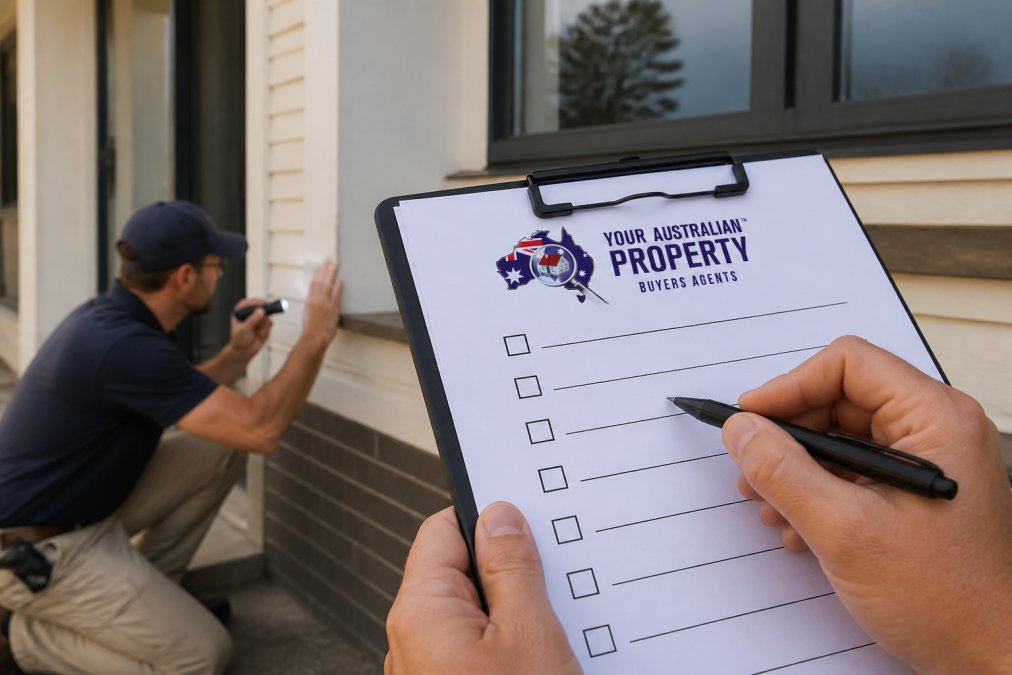
Start by examining the foundation and external walls for visible cracks. Look for:
Horizontal cracks running across brickwork (these indicate movement and are more serious than vertical cracks)
Cracks wider than 3mm (these suggest structural settlement)
Stair-step cracking in brick mortar (a classic sign of foundation movement)
Cracks that follow a diagonal pattern (often caused by foundation settling)
Walk around the entire perimeter. Take photos. Document everything. Multiple cracks across different walls suggest foundation movement, a red flag.
Foundation movement and cracks
Foundation movement happens when the ground beneath the property shifts or settles unevenly. This is one of the most expensive problems to repair.
Look for cracks inside the home as well. Check corners of doorways and windows, these are stress points where cracks first appear. If doors or windows are sticking or won’t close properly, that’s another indicator. As Myles Clark, Director at the Victorian Association of Home Inspectors, notes: “Doors or windows that stick or do not close properly indicate movement. This can be seasonal and very normal.” But document it anyway.
Check the roof line from outside. Is it sagging? A sagging roofline suggests the structure is settling. Inside, look at ceilings for cracks that radiate from corners, these follow stress patterns and indicate movement.
A professional building inspector will assess whether cracks are structural or cosmetic, whether movement is ongoing or historical, and what repairs might be needed. Get this assessment in writing before you commit.
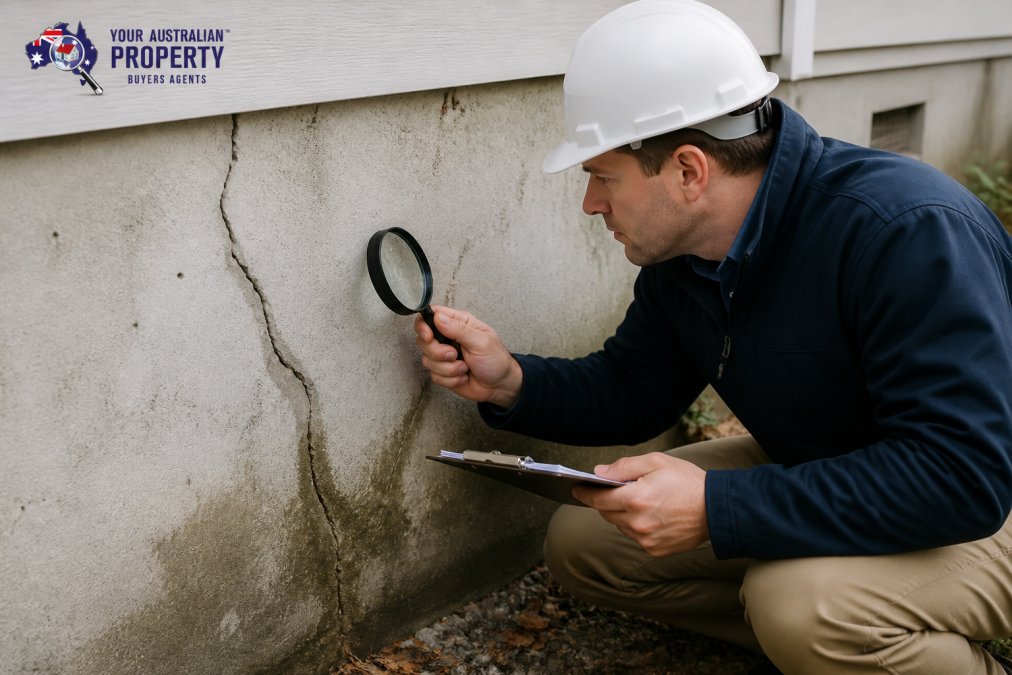
Professional building inspector examining foundation wall showing visible cracks and moisture damage, with magnifying glass and clipboard in hand, natural outdoor lighting
Rising damp and water intrusion
Rising damp is water that travels up through the foundation and into the walls. It damages plaster, causes paint to peel, and creates an environment where termites and rot thrive.
Look for:
Discoloured patches on walls, typically 1-1.5 metres above floor level
Peeling paint or wallpaper
A musty smell in lower rooms
Efflorescence (white, powdery deposits on brickwork)
Soft or crumbling plaster at the base of walls
Check the weep holes, small gaps in the brickwork designed to allow moisture to escape. If they’re blocked or missing, water can’t drain properly. According to [Property Due Diligence(/property-due-diligence-checklist-melbourne/) guidance | propertychecklist.com.au], poor drainage and water pooling around the property indicates inground drainage damage.
Walk around the exterior. Is water pooling near the foundation? Are gutters overflowing? Does water run toward the house or away from it? Proper grading should slope away from the building. If it doesn’t, water will accumulate and cause problems.
Roofing, Drainage and Weatherproofing
The roof protects everything underneath. If it fails, the damage cascades into the ceiling, walls, insulation, and structure. A compromised roof can be costly to replace.
Roof condition and cavity inspection
Start from the ground. Use binoculars to look for missing, broken, or slipped tiles. Check for sagging sections or areas where the roof line dips. Look at the flashing around chimneys, vents, and skylights, these are common leak points.
If the roof is accessible, climb up and inspect it directly. Look for:
Missing or cracked tiles
Broken or corroded metal sheeting
Gaps in flashing or sealant
Moss, lichen, or debris accumulation (which traps moisture)
Damaged guttering or downpipes
Check the roof cavity from inside the home if you can access it safely. Look for water stains on the underside of the roof, mould growth, or daylight coming through gaps. These indicate leaks.
Modern inspections often use drone technology for safety. According to RBI’s 2026 inspection guidance, drone roof inspections check for missing, broken, or slipped tiles and reveal sagging roof lines and damaged flashing that are hard to see from the ground.
Ask the real estate agent when the roof was last replaced or repaired. If it’s over 25 years old, budget for replacement soon.
Drainage systems and weep holes
Drainage failures cause foundation problems, rising damp, and structural damage.
Walk the perimeter and observe:
Do gutters overflow during rain?
Are downpipes connected to underground drains or do they discharge onto the ground?
Does water pool near the foundation?
Are there visible signs of erosion or soil subsidence?
Are weep holes clear and unobstructed?
Weep holes are critical. These small openings in the brickwork (typically near the base of walls) allow moisture to escape. If they’re blocked by soil, paint, or debris, water accumulates and causes damp. Check each one.
Look at the ground slope around the property. Ideally, ground should slope away from the building at a gradient of at least 1:20. If the ground slopes toward the house, water will collect against the foundation.
Electrical, Plumbing and Water Systems
Electrical and plumbing issues can be expensive and dangerous. A faulty electrical system creates fire risk. Leaking pipes cause water damage and mould.
Electrical safety and meter board
Look at the meter board. Is it:
Accessible and clearly labelled?
Free of corrosion or damage?
Equipped with a safety switch (RCD, Residual Current Device)?
Showing signs of arcing or burning?
Check that all circuits are labelled. If the meter board is a mess of unlabelled switches, that’s a warning sign, the property may have been modified by non-licensed electricians.
Look for outdated wiring. Older properties may have:
Knob and tube wiring (pre-1950s, extremely dangerous)
Cloth-wrapped wiring (deteriorates over time)
Insufficient grounding
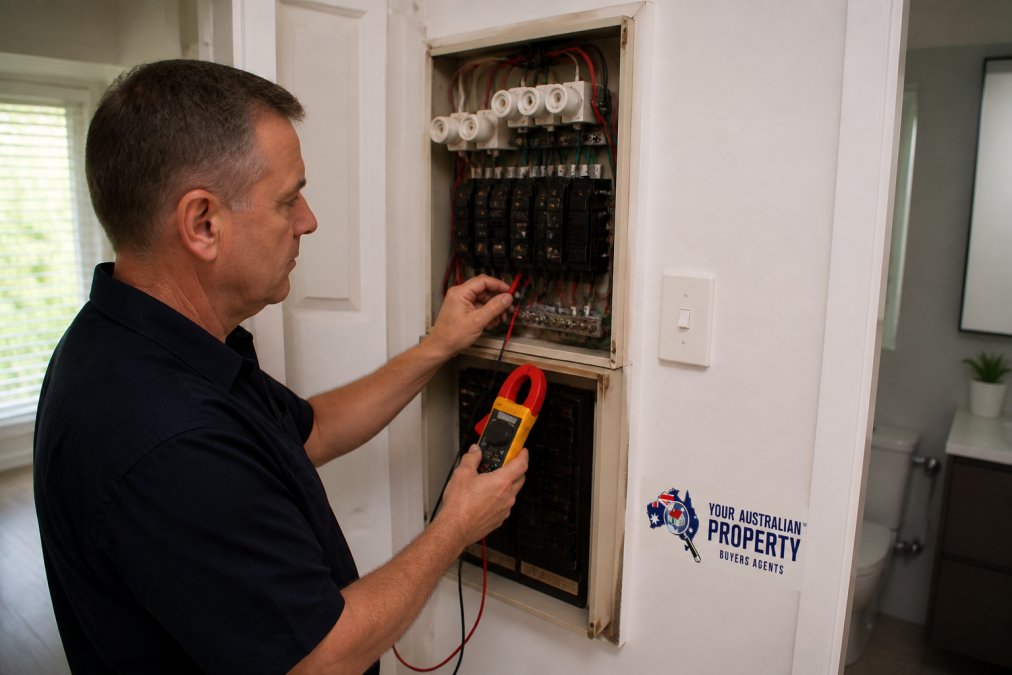
Property inspector examining an older meter board and electrical switchboard, checking connections and safety compliance with multimeter, indoor setting with natural light
Test light switches and power outlets. Do they work? Are any outlets warm to the touch? Are there burn marks around switches? These indicate electrical faults.
Ask when the electrical system was last upgraded. If it’s original to a 40-year-old house, budget for rewiring.
Discoloured water (indicates rust or corrosion in pipes)
Slow drains
Listen for running water when all taps are off. If you hear water flowing, there’s a leak somewhere, possibly in the walls or under the house.
Check under sinks and behind toilets for water stains or damp. These indicate slow leaks. Look at the water meter; if it’s running when no water is being used, there’s a leak.
Inspect the hot water system. Is it leaking, making unusual noises, or showing signs of rust or corrosion? Ask when it was installed. Most hot water systems last 10-15 years. If it’s older, budget for replacement.
Check the toilet cistern for leaks. Put food colouring in the cistern and wait 15 minutes without flushing. If the colour appears in the bowl, the cistern is leaking.
Windows, Doors, Interior and Flooring
Interior condition often reveals underlying problems. Damage to windows, doors, walls, and flooring can indicate moisture, movement, or poor maintenance.
Assess:
Windows and doors:
Do they open and close smoothly?
Are there gaps around frames?
Is glazing intact or cracked?
Do locks work properly?
Interior walls and ceilings:
Are there cracks, especially radiating from corners?
Is plaster soft or crumbling?
Are there water stains or discolouration?
Is there evidence of mould or mildew?
Flooring:
Is it level or does it slope?
Are there cracks in concrete slabs?
Is timber flooring cupped, crowned, or warped?
Are tiles cracked or loose?
These observations often point to deeper issues. A sloping floor might indicate foundation settling. Water stains suggest leaks. Mould indicates moisture problems.
Pest and Termite Inspection Essentials
Termites cause more damage to Australian homes than fire, flood, and storm combined. Around one in three homes has had termite activity or damage at some point, according to Property Due Diligence [guidance on(/benefits-of-using-buyers-agent-melbourne/) termites | propertychecklist.com.au]. A termite inspection isn’t optional, it’s essential.
Look for:
Mud tubes on walls or foundations (termites build these as highways)
Timber that sounds hollow when tapped
Frass (termite droppings, small pellets)
Damaged or weakened timber
Visible termites (usually only seen when disturbing infested areas)
Check the subfloor if accessible. Crawl spaces are termite highways. Look for mud tubes, damaged timber, and evidence of activity.
Ask the real estate agent if there’s a history of termite treatment. If the property has been treated, get copies of the reports. If it hasn’t been treated in the last 5 years, budget for preventative treatment after purchase.
The inspection report should note any evidence of termite activity, the extent of damage, and recommendations for treatment or prevention. Use this information in your negotiation.
Questions to Ask Real Estate Agents at Inspections
Real estate agents can provide valuable context about the property. Ask:
When was the roof last replaced or repaired?
Has the property had any major renovations? (Ask for council approval documentation)
Are there any known issues with the property?
Why is the owner selling?
How long has the property been on the market?
Has the property ever flooded or had water damage?
Are there any disputes with neighbours?
What’s the council’s flood risk rating for this address?
Has the property had a building or pest inspection? (Ask to see the reports)
Take notes. If the agent seems evasive or contradicts the building report, that’s a red flag. Remember: the agent represents the seller, not you. Get answers in writing where possible.
How to Negotiate After a Bad Building Inspection
A bad building inspection doesn’t mean you have to walk away. It means you have leverage.
First, get the inspection report in writing. Quantify the problems. “The roof needs replacement” is vague. “The roof requires replacement at an estimated cost of $18,000 based on quotes from two licensed roofers” is specific. Specificity drives negotiation.
Categorise the problems:
Critical (structural, safety, immediate): Foundation cracks, electrical hazards, gas leaks, termite damage
Major (expensive, requires professional repair): Roof replacement, replumbing, rewiring, rising damp treatment
Minor (cosmetic, low cost): Paint, carpet, minor repairs
Focus your negotiation on critical and major issues. Calculate the total cost of repairs using quotes from licensed tradespeople.
Now you have three options:
Renegotiate the price. Use the repair costs to justify a lower offer.
Request repairs as a condition of sale. Ask the seller to complete specific repairs before settlement.
Walk away. If the problems are too serious or the seller won’t negotiate, walking away is the smartest move.
Most buyers choose option 1, renegotiating the price. This works because you have concrete evidence, the seller knows other buyers will see the same problems, and a lower price compensates you for the risk and cost of repairs.
Be prepared to walk away. This is your strongest negotiating position. Sellers know that buyers with inspection reports are serious. If you’re willing to walk, they’re more likely to negotiate.
A property inspection checklist is your roadmap to a successful purchase. It catches problems before you sign. It gives you negotiation leverage. It protects your investment. Most buyers only see five obvious steps: find property, make offer, get finance, settle, move in. We control the other 30. The difference happens behind the scenes, in the inspection, the report, the negotiation, and the strategy that determines whether you win or lose.
Your Australian Property Buyers Agents has guided buyers through this process for over 30 years. We’re Melbourne’s leading independent buyer advocates. We know which questions to ask, which problems matter, and how to negotiate with confidence. Our independent buyer advocacy service focuses on everything that determines a successful purchase, not just the property itself, but the process, the negotiation, and the outcome. If you’re buying in Melbourne and you want expert guidance on inspections, due diligence, and negotiation strategy, book a free strategy session with our team to discuss your property goals.
Frequently Asked Questions
Q: What is the biggest red flag in a property inspection checklist?
A: Structural movement is the most serious red flag. This includes foundation cracks, foundation movement, and signs of rising damp. These issues are expensive to fix and can worsen over time. Termite activity and damage is another critical issue, around one in three homes has had termite activity at some point. Water damage, electrical safety problems, and asbestos also rank high. These aren’t cosmetic fixes; they affect the property’s safety and value significantly.
Q: How does a professional building inspection differ from a buyer’s walkthrough?
A: A buyer’s walkthrough is a visual scan of the property. A professional building inspection is comprehensive, systematic and documented. Inspectors use specialist equipment, check hidden areas like roof cavities and sub-floor spaces, and produce a detailed report. They assess structural integrity, electrical safety, plumbing, drainage, pest activity and compliance. Most buyers only see what’s obvious during a walkthrough. A professional inspection uncovers defects that cost tens of thousands to repair.
Q: What should I include in a pre-purchase building inspection report checklist?
A: Your pre-purchase building inspection report should cover structural integrity, foundation condition, roofing and roof cavity, drainage systems, electrical systems and meter board, plumbing and water pressure, windows and doors, internal walls and ceilings, flooring, kitchen and bathroom fixtures and fittings, ventilation and insulation, external cladding and weatherboards, and pest activity. The report should be thorough, itemised and include photographs. It’s your due diligence document, use it to negotiate or walk away.
Q: What are the most common reasons a property fails a building inspection?
A: Rising damp, structural cracks, roof damage, faulty electrical systems, plumbing leaks, pest damage, and asbestos are the most common failures. Weatherboard decay, peeling paint, and poor drainage also fail properties regularly. Many of these issues are discoverable only during a professional inspection. Seventy per cent of newly built homes contain defects at handover. Fifty-five per cent of buyers discover hidden problems only after moving in, problems they could have avoided with proper due diligence.
Q: Can a buyer’s agent help identify structural issues during an inspection?
A: Yes. Experienced buyer’s agents understand building defects, structural issues, and what repairs cost. They attend inspections, ask the right questions, and interpret the inspection report strategically. They know which issues are deal-breakers and which are negotiable. This is where experience matters, we’ve seen the costly mistakes buyers make when they inspect alone.
Q: How can I use inspection findings to negotiate a lower price?
A: Get a professional building and pest inspection before making an offer. If defects are found, use the report to negotiate. Request the seller fix the issues, reduce the price, or contribute to repairs. Structural issues, termite damage, and electrical problems are strong negotiation points. Cosmetic issues are weaker. The key is knowing which issues justify a price reduction and how much they’ll actually cost to fix. This is where negotiation strategy determines the outcome.
Most buyers focus on finding the right property. They spend weeks scrolling listings, attending open inspections, and comparing features. What they don’t see is everything that happens behind the scenes.
Here’s where buyers get it wrong: they treat property purchase like a consumer transaction. Find something you like, make an offer, negotiate a bit, settle. Five steps. But there are actually 30+ decisions that determine whether you win or lose. Market timing. Suburb selection. Vendor psychology. Contract terms. Settlement conditions. Off-market access. Negotiation strategy. Each one moves the needle.
According to Buyers Advocate’s 2025 Melbourne Housing Market Analysis, Melbourne’s median house price sits at $1.04 million, with 70% of suburbs experiencing quarterly growth. That’s a competitive market where the difference between a good outcome and a costly mistake can easily be $50,000 to $140,000.
Your Australian Property Buyers Agents has spent 30+ years working exclusively for buyers in Melbourne‘s property market. We see this pattern constantly: buyers who try to negotiate themselves end up paying more than they should, or worse, they buy the wrong property entirely. The ones who win understand that independent guidance, data-driven strategy, and professional negotiation are how you avoid overpaying in a hot market.
This guide covers what separates buyers who secure excellent outcomes from those who don’t. We’ll show you exactly where buyers get it wrong, how off-market opportunities work, what real negotiation looks like, and when a buyers agent becomes essential to your success.
Access to Off-Market Property Opportunities
The property that saves you $50,000 probably isn’t on Domain or realestate.com.au. It’s not advertised. The vendor didn’t want the stress of open inspections or a public auction.
Off-market properties represent a significant portion of quality stock in Melbourne. Research from the Real Estate Buyers Agents Association indicates that up to 20% of properties nationwide are sold off-market without public advertising, particularly in tightly held or high-demand suburbs.
Here’s why this matters: buyers without agent connections never see these properties. They’re competing for the same advertised stock as everyone else. Prices are pushed higher. Competition is fiercer. Your negotiating position is weaker.
Buyers agents have built networks across Melbourne, other agents, developers, financial advisors, accountants. When a property is about to be listed, or before it even reaches the market, these networks get the first call. You get the first right of refusal. Our Off-Market Properties Melbourne service connects you directly to opportunities that never reach public advertising.
We see this all the time: a client finds a property on the open market, but we’ve already secured something similar off-market at a better price, in a better location, or with fewer competing bids. Off-market access isn’t just about finding hidden gems. It’s about controlling the negotiation from day one. When you’re the only buyer, or one of two, your position is completely different.
Expert Property Negotiation Strategies That Work
Negotiation is where experience matters most. It’s not about being aggressive or playing games. It’s about understanding what the vendor actually wants, what they’re worried about, and what gives you leverage.
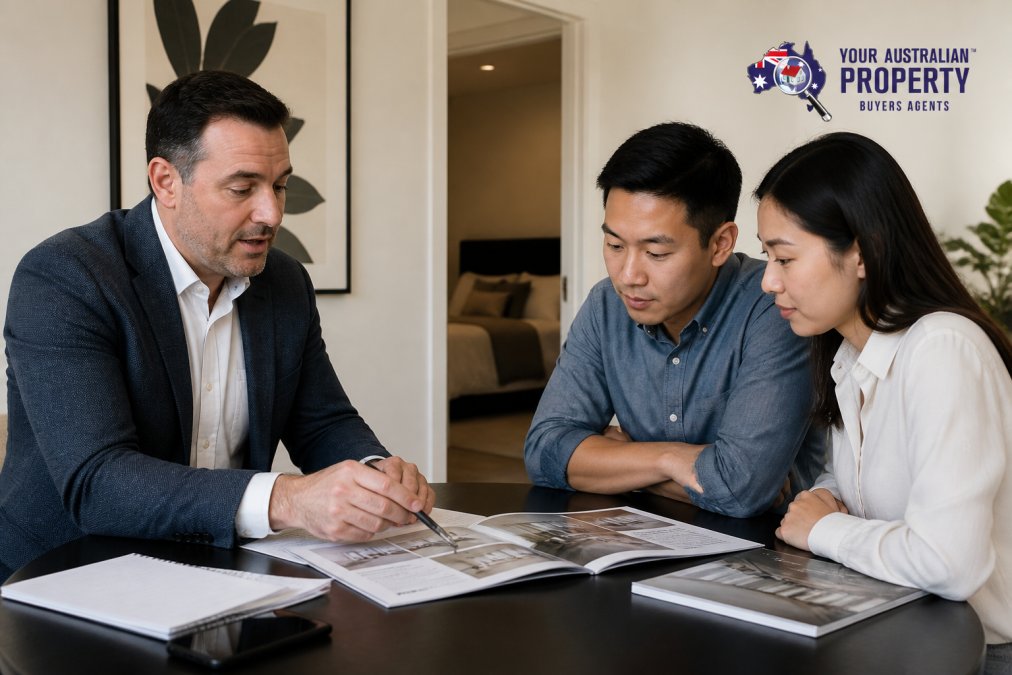
Professional buyer’s agent and client reviewing property documents and negotiation strategy at a desk with market data and property briefs visible, natural office lighting
Most buyers negotiate poorly because they don’t have information. They don’t know what similar properties sold for. They don’t know the vendor’s timeline. They don’t know whether the vendor is motivated or patient. They make an offer based on emotion.
Professional negotiators work differently. According to Somerstone Property Group’s 2026 Market Analysis, experienced negotiators achieve 5-7% below initial asking prices in balanced markets, while in hot markets that margin compresses to 2-4%. The difference comes down to three things: information, timing, and strategy.
Information:A buyers agent pulls comparable sales data, understands suburb trends, knows recent vendor behaviour in that street. You know what the property is actually worth.
Timing: Vendors have different timelines. Some need to settle quickly. Others are patient. A buyers agent reads these signals and times offers accordingly.
Strategy: Not every property deserves the same approach. Some need a strong opening offer to discourage other bidders. Others benefit from a lower offer that invites negotiation. Some require creative terms, settlement timing, chattels, conditions, that give you advantage without a higher price.
We’ve negotiated hundreds of Melbourne properties. The pattern is consistent: buyers who go it alone typically pay more than they should. Buyers who work with an experienced agent often secure better prices. That’s a substantial swing.
Auction bidding is a specific negotiation skill. Most buyers get caught up in the moment and bid beyond their limit. Experienced auction bidders understand reserve prices, bidding patterns, and psychological triggers. Our Auction Bidding Service Melbourne ensures you contest the right auctions at the right price, we’re not winning every auction, we’re winning the right ones.
Data-Driven Market Knowledge and Analysis
Melbourne’s property market moves fast and unevenly. Some suburbs are growing. Others are flat. Some are overheated. Some represent genuine value. Most buyers don’t have access to the data that reveals these patterns.
A buyers agent doesn’t just know Melbourne. We analyse it. We track sales data, rental yields, capital growth patterns, infrastructure projects, school catchments, and demographic shifts. We know which suburbs are about to move, which are already overcooked, and which represent opportunity.
HtAG Analytics 2026 research shows that validated recommendations from Melbourne buyers agents achieved a median first-year capital growth of 9.8%, compared with CoreLogic’s Melbourne-wide median of 3.1% for the same period. That’s the difference between systematic suburb selection and median chasing.
We look at quarterly growth patterns across 300+ suburbs, rental yield and investor demand, infrastructure projects and their timelines, school catchment changes, demographic trends, and historical price cycles. Location is everything in Melbourne. But location isn’t just the suburb, it’s the specific street, the property type, the demographic fit. A buyers agent helps you understand not just where to buy, but why that location is right for your goals.
First-home buyers often overpay because they fall in love with a property and assume it’s worth the asking price. Investors sometimes chase growth stories without understanding the actual fundamentals. A data-driven approach removes emotion and focuses on what the numbers say.
How to Choose a Property Advocate You Can Trust
Diverse team of experienced property professionals in a modern office setting, reviewing property portfolios and market data, natural lighting
Not all buyers agents are equal. The industry has over 200 practitioners across Victoria, but only a subset hold formal accreditation and adhere to professional standards. Quality varies enormously.
Here’s what to look for:
Experience in Melbourne specifically. A buyers agent who works across three states doesn’t have deep market knowledge. Melbourne’s market is complex. You want someone who lives and breathes Melbourne property.
Auction bidding experience. If your buyers agent doesn’t have a track record bidding at auctions, they’re not equipped to handle one of the most common purchase scenarios. Ask how many auctions they’ve contested and what their success rate is.
Off-market network. This is where the real advantage comes from. Ask about their connections. Do they have relationships with other agents, accountants, financial advisors, developers? Can they actually access properties before they hit the market?
Transparency about fees. A good buyers agent explains exactly how they’re paid and why. Fees should align with securing the right property at the right price, not with pushing you toward any particular outcome. Your Australian Property Buyers Agents operates on a success-based fee structure that aligns our incentives with yours: we win when you win.
Independence. This is non-negotiable. Your buyers agent should work exclusively for you, not for sellers or developers. No conflicts of interest. No hidden relationships that might influence their recommendations.
Track record. Ask for references. Talk to past clients. How quickly did they find the right property? Did they actually save money? Would they recommend this agent to a friend?
The best buyers agents are specialists. They know specific suburbs deeply. They understand different buyer profiles, first-home buyers, investors, downsizers, relocating professionals. They can articulate why they’re recommending a particular property or strategy.
Due Diligence in Property Investment: What Buyers Miss
Due diligence is the most overlooked part of property purchase. Most buyers inspect the property, check the title, and assume they’ve done their homework. They haven’t.
Real due diligence covers building and pest inspection, title and legal issues, body corporate and strata records, rates and utilities, market comparables, and neighbourhood planning. Our Property Due Diligence process reviews these systematically. We inspect thoroughly. We review all documents. We ask the hard questions. We tell you what you need to know, not just what you want to hear.
We see this all the time: buyers skip proper due diligence because they’re excited about a property or worried about losing it in a competitive market. They find out after settlement that there’s a structural issue, a problematic neighbour, or a planned development that kills resale value. That’s when due diligence becomes expensive.
When a Buyers Agent Isn’t the Right Fit
There are scenarios where a buyers agent doesn’t make sense.
You’ve already made an offer. If you’re already in negotiation on a specific property, bringing in a buyers agent mid-process can complicate things. The best time to engage is before you start looking seriously.
You’re buying in a different market. If you’re purchasing in Sydney or Brisbane, a Melbourne-based buyers agent isn’t the right fit. You need someone with deep local knowledge in that market.
You have unlimited time and patience. If you’re happy to spend six months looking at every property on the market and managing all the logistics, you might not need professional help. But most people don’t have that luxury.
The property is significantly below asking price. If you find a genuine bargain, a deceased estate, or a forced sale, you might not need negotiation help. The deal is already there.
You’re buying off-the-plan from a developer. Developers have fixed pricing and terms. There’s less room for negotiation. A buyers agent still adds value through due diligence and advice, but the use is different.
You’re working with a trusted family contact. If you have a close relationship with a real estate professional who’s genuinely independent and putting your interests first, you might not need a separate buyers agent. But be honest about whether that relationship is truly conflict-free.
The reality is that most property purchases in Melbourne benefit from professional buyer advocacy. The key question is: what’s your situation, and where do you genuinely need help?
Real-World Example: How Strategic Guidance Saved $140,000
A client came to us after making an initial offer on a house in Windsor. The asking price was $1.65 million. They’d prepared to offer $1.55 million, expecting negotiation to land around $1.60 million.
We reviewed the property, the market, and the vendor situation. The property had been on market for six weeks without strong interest. The asking price was 10% above recent comparable sales in the street.
Our strategy: open with a lower offer to signal seriousness, then negotiate based on the vendor’s response rather than their asking price.
We secured the property for $1.51 million with favourable settlement terms. The client saved $140,000 from their prepared price.
The lesson: buyers who negotiate themselves typically anchor to the asking price and negotiate downward from there. Professional negotiators anchor to the market and negotiate from a position of information. The difference is substantial.
Buyers who win in Melbourne’s market understand that property purchase isn’t just about finding the right property. It’s about controlling the process, the negotiation, and the outcome. Most buyers focus on the property. We focus on everything that determines whether it becomes a successful purchase.
If you’re serious about securing the right property at the right price, book a Strategy Session with Your Australian Property Buyers Agents. We’ll show you exactly where you stand in the market and what’s possible with professional guidance.
Frequently Asked Questions
Is it worthwhile using a buyer’s agent in Melbourne?
Yes. Experienced buyers agents can achieve better prices in various market conditions. With median house prices at $1.04 million, even a small saving can be significant. Beyond price, agents provide access to off-market properties (up to 20% of sales), due diligence expertise, and auction negotiation skills that most buyers lack. The median first-year capital growth on professionally selected properties reached 9.8%, compared with the Melbourne-wide median of 3.1%, a compounding advantage that justifies the engagement.
What are the downsides of hiring a buyer’s agent?
The primary downside is cost. Fees typically range from flat structures to percentage-based models aligned with purchase price. Quality varies significantly across the 200+ practitioners operating in Victoria; many lack formal accreditation. Some buyers feel uncomfortable delegating the property search entirely and may worry the agent prioritises speed over suitability. Communication gaps can lead to unsuitable property recommendations. Additionally, if the market doesn’t align with your criteria or timeline, you may not secure a property despite paying for the service. Choosing an agent without auction experience or one who prioritises lowest fees over expertise amplifies these risks.
How do buyer’s agents gain access to off-market opportunities?
Buyer’s agents leverage established networks across the real estate industry, relationships built over decades with selling agents, developers, and private vendors. Properties sold off-market (silent listings) represent up to 20% of transactions, particularly in tightly held suburbs where vendors avoid public marketing costs and stress. Agents with 30+ years’ experience and 500+ real estate connections gain first right of refusal on these opportunities before they reach public portals. This network access is a critical differentiator; it’s not available to individual buyers and creates genuine competitive advantage in finding quality properties before the broader market sees them.
What’s the difference between a real estate agent and a buyer’s advocate?
A real estate agent represents the seller and earns commission when the property sells, creating a conflict of interest aligned with maximising the sale price, not protecting the buyer. A buyer’s advocate (or buyer’s agent) works exclusively for the buyer with no conflicts of interest. They’re paid by the buyer to negotiate the best price and terms, conduct due diligence, manage the buying process, and access off-market opportunities. The buyer’s agent removes emotion from decisions, applies data-driven analysis, and uses professional negotiation skills to secure strategic advantage. This fundamental difference in incentive structure is why independent buyer advocacy delivers measurable savings.
How does professional negotiation impact the final purchase price?
Professional negotiators understand market psychology, vendor motivation, and leverage points that individual buyers typically miss. In balanced markets, experienced negotiators can achieve reductions from asking prices; in hot markets, margins compress but remain significant. A $1 million property negotiated down by just 3% saves $30,000. Beyond price, skilled negotiators secure favourable contract terms, extended settlement periods, or vendor inclusions (chattels, repairs) that add value without increasing the purchase price. They also know when to walk away, avoiding emotional overbidding that costs buyers far more than any negotiation gain.
What due diligence should property buyers conduct before purchasing?
Due diligence encompasses building and pest inspections, title searches, local council reports, planning restrictions, flood risk assessments, and neighbourhood research. Many buyers skip thorough due diligence or rely on incomplete information, leading to costly post-purchase surprises. A buyer’s agent coordinates these checks systematically, interprets findings in the context of market value, and identifies red flags early. They also analyse comparable sales data, rental yields (for investors), and long-term growth prospects. This structured approach to due diligence prevents buyers from overpaying for properties with hidden defects or poor investment fundamentals, a critical protection that justifies professional engagement.
Can a buyer’s agent help if I’ve already found a property I want to buy?
Yes. Even if you’ve identified a specific property, bringing in a buyer’s agent before making an offer is valuable. They’ll conduct independent due diligence, research comparable sales to establish fair market value, and advise on realistic offer strategy. They can also negotiate on your behalf, potentially saving thousands on price or securing better contract terms. However, the earlier an agent engages in your buying journey, the more value they deliver, they can help you avoid pursuing unsuitable properties, identify better alternatives, and ensure a more strategic purchase overall.